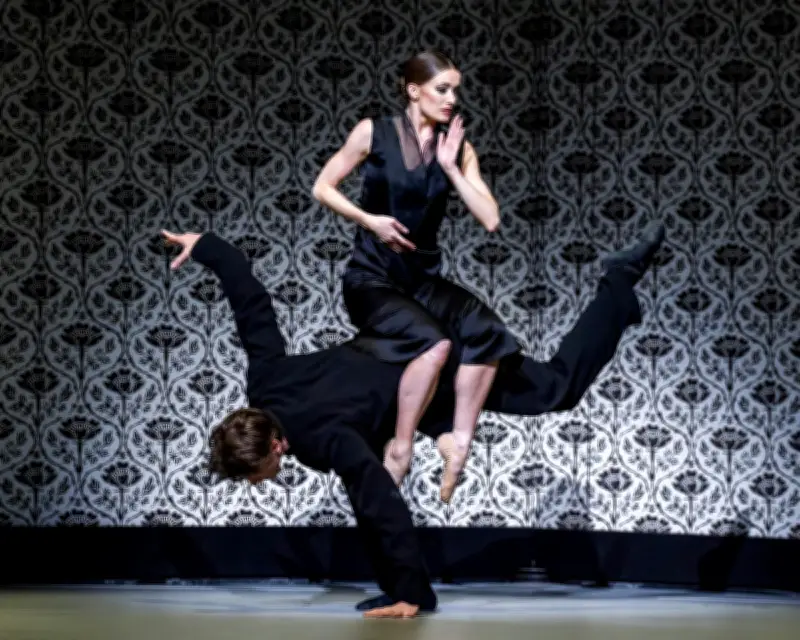
Paul Lightfoot, a prolific and multi-award-winning British choreographer with over 35 years in the industry, has created dance alongside his former wife Sol León. Yet, remarkably, this is the first time their work has been performed by a British dance company. The pair spent their careers at Nederlands Dans Theater (NDT) as dancers and choreographers, with Lightfoot serving as artistic director from 2012 to 2020. However, Lightfoot, who hails from Cheshire, trained at the Royal Ballet school, making this a prodigal son situation. The Royal Ballet now presents an evening of the duo's work: one piece revived from two decades ago, and another that originated during lockdown, dramatically recreated for this company.
A Distinctive Style
The dance style is highly distinctive, heavily influenced by NDT's longtime director Jiří Kylián. It is full of steps, exclamations, exaggerations, and quirks, with constant shifts in tone and timbre. The Royal Ballet dancers are accustomed to demanding, ultra-contemporary movement, but completely absorbing this new style proves challenging. It is fascinating to see dancers play against type, such as Vadim Muntagirov, a classical prince, who becomes an ultra-serious, starkly angled figure in 2006's Shoot the Moon. He is one of five protagonists on a clever rotating set that reveals different rooms and relationships. The piece is not so much a story as a set of moderately opaque situations. The style can be polarising: Euro arthouse angst, well-dressed people in crisis set to Philip Glass. Yet it is always a beautiful crisis.
Standout Performances
The dancer most impressively invested in the work is Lauren Cuthbertson, who seems almost reinvented for this piece. At one point, a live camera feed on stage shows a close-up of Cuthbertson, her facial expressions as frantic as her body. She is mesmerising, like a silent movie star cycling through different roles – puffed cheeks, villainous pout – which could be comical if she were not so committed. However, there are so many expressions and steps, saying so much, that it almost says nothing. The piece attempts to tell a hundred stories, but sometimes one story is enough.
Salle de Danse: A Ballet Class Reimagined
Reinvented for the Royal Ballet, Salle de Danse is an hour-long piece roughly based on the template of a ballet class, featuring a huge cast of dancers from across the company. Titles of exercises are projected onstage – tendus, ronds de jambe, pirouettes – though often there is only a cursory nod to the step before heading off in another direction. Some sections become repetitive, with recognisable tropes recurring. But when contrast appears, it is striking, especially a central section where the whole company moves in unison, their arms with the steely intensity of an archer taking aim. Additionally, the incongruous appearance of Francesca Hayward and Marcelino Sambé, sensual and slow, seems beamed in from a different ballet.
Moments of Tenderness
There is cheekiness and brief moments of tenderness, notably in a lovely pas de deux for couple Calvin Richardson and Marco Masciari. The power moves are impressive, with virtuoso jumps given supple invention, and some joyful whoops of movement. It is all wildly impressive, but overall the evening leaves the heart rather untouched. Nevertheless, the enthusiasm of the cast is certainly touching. It is a worthwhile homecoming.
At Royal Opera House, London, until 20 June.