The summer musical coming to the National Theatre is all about real people, but here’s a strange feeling – many of them are literally sitting around me tonight. In a buzzy, early preview for Pride: The Musical at Cardiff’s Sherman theatre, there’s Reggie Blennerhassett and Ray Aller, a couple who have been together for 44 years, wearing T-shirts printed with the poster for a notorious 1984 fundraising gig they helped organise. Its name? Pits and Perverts.
Siân James watches her younger self dance at an LGBTQ+ club in Soho, while retired tailor and actor Jonathan Blake is recast on stage in a glitzy robe and kaftan, performing a Broadway-style showstopper. “My words coming out of his mouth as he sang!” Blake shakes his head more than four decades later. “I was utterly floored!”
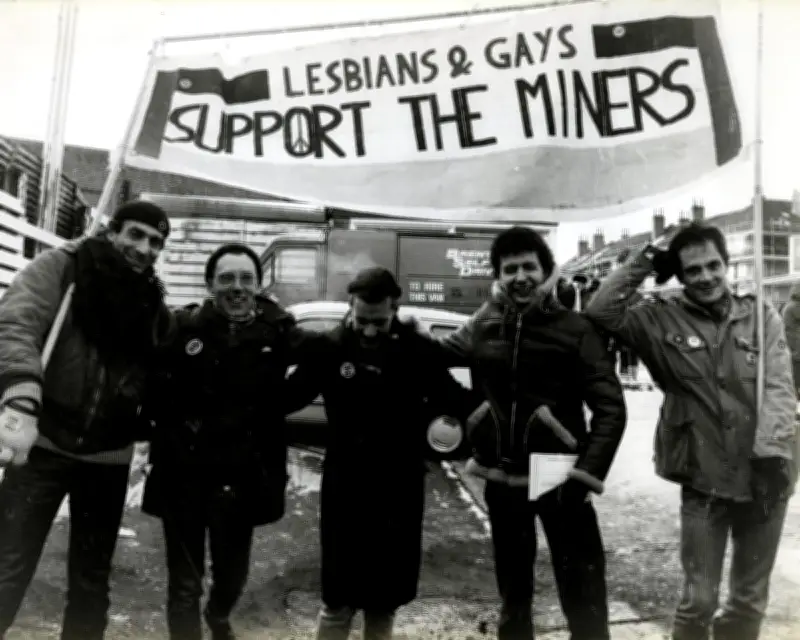
Twelve years ago, Dominic West danced on tables as Blake in the 2014 Golden Globe- and Bafta-nominated British film Pride, which told the story of the London-based activist group, Lesbians and Gays Support the Miners (LGSM), and the members of the Neath, Dulais and Swansea Valley colliery community whom they supported financially during the 1984-1985 miners’ strike. Pride: The Musical now adapts this film, melodiously, from screen to stage, revealing how two outwardly very different communities challenged prejudices, fought against the government and made lifelong friendships.
A Romantic Comedy Between Hostile Entities
“Pride’s always felt to me like a romantic comedy between two ostensibly hostile entities, who eventually become soulmates,” says Matthew Warchus, director of both the original film and the new musical (as well as being the outgoing artistic director of the Old Vic theatre, and director of blockbuster film and stage adaptations of Matilda). Having grown up in the North Yorkshire mining village of Drax with a half-Welsh mother, he fondly recalls getting writer Stephen Beresford’s original script – and how it “straight away” felt like a musical.
Why? “There’s something about Pride’s emotional heart on its sleeve that made it perfect … and a musical felt like a lovely, social way of appreciating the story, to hear the audience as part of it.”
The Origins of LGSM
Beresford, who also worked on the original film with Warchus, first heard of LGSM’s story in the early 1990s through an old boyfriend. He discovered how it was formed in July 1984, a month after the group’s leader, Mark Ashton, decided to collect money for the miners at that year’s Pride march in London. Ashton explained why in an evocative 1986 short documentary, All Out! Dancing in Dulais (which you can still see on YouTube): “So that one community could give solidarity to the other.”
But until Neath, Dulais and Swansea Valleys Miners’ Support Group answered its call, LGSM struggled to find communities that weren’t blinded by prejudice, despite the poverty they faced. Pride: The Musical’s previews have reminded Beresford how radically British attitudes have changed since the late 20th century. “In my 20s, I can remember any gay content on stage getting gasps or a laugh, because people were uncomfortable. Last night, when the kiss happened” – he’s referring to a gorgeous moment in act two – “the whole audience roared their approval.”
Musical Moments and Fundraising
Musical moments are also vital in Pride’s origin story. The December 1984 Pits and Perverts gig, headlined by Bronski Beat in north London’s Electric Ballroom, was LGSM’s biggest fundraiser, raising an astonishing £5,500 for the miners, out of a total of £22,500 (the equivalent of more than £70,000 today). Rousing folk singing in the Onllwyn Welfare Hall, captured beautifully on film, is also translated to the stage, led by Mared Williams, while the musical’s team of composers (the Tony award-winning Christopher Nightingale, alongside Josh Cohen and DJ Walde) contribute genre-spanning compositions including punky pop, ballads, disco and Broadway-style torch song.
A new composition, Light Perpetual, also explores the raw grief and horror of that time, when the impact of the Aids epidemic was starting to hit the tabloid press. During its performance, I see Ray Aller, his head on Blennerhassett’s shoulder, in tears. “The film of Pride was incredible,” he says, sitting in the green room with his partner, as well as Jonathan Blake and Siân James. “But there’s something about the musical – it’s almost like you’re back there. It’s very real.”
James – a young mother who helped welcome LGSM to the village in 1984 – nods. “When I watch the musical now, I don’t feel that it’s about me. I sit there and think about all the people no longer with us, and how this is a testament and document of their lives.” This includes Mark Ashton himself, who died of Aids at 26 in 1987, and Cliff, an older, quieter member of the mining community, played by Bill Nighy in the film, who later came out.
A Testament to Lives Lived
The musical also makes Blake feel “like I’m absolutely there”. One of the first people in the UK to be diagnosed with HIV in October 1982, he has been on anti-retroviral therapy since 1997, and is a sparky, healthy 76. He joined LGSM after meeting boyfriend Nigel Young in 1983, who ran London’s Gay’s the Word bookshop; they remained a couple for life (Young died in 2022). “Meeting Nigel, who was so politically active, changed my life. LGSM gave me the best kind of distraction therapy, and so many delights,” Blake says.
Pride: The Musical is also very funny – a bit rude, a bit blue, but still full of heartwarming jokes (including the classic from the original about lesbians and vegetarians – if you know it, you’ll love it). When the film was being made, James was worried about how “the Welsh are so often made to look like silly billies – but that didn’t happen to us, which is the thing I’ve been most grateful for over the last 12 years”. Politically empowered by her role during the strike, James served as MP for Swansea East from 2005 to 2015, and she tells me she’s often approached by people moved by the original film. This includes a young, gay woman who watched it with her grandfather, once a striking miner, too. “She told me that he cried at the end of it, then said: ‘It’s only a beginning, but I’m starting to understand.’” She smiles. “Isn’t that the power of the story?” James also mentions today’s grandchildren mentioning others of their generation coming out. “That wouldn’t have happened when my children were young, so we’ve come a long way – although we’ve still got a long way to go.” (This year, trade unions banded together to fundraise for Durham Pride, after the Reform-led council cut funding for the event.)
At the extraordinary Pride march in London in June 1985, the LGSM-funded Dulais Valley miners’ minibus arrived in Hyde Park, and Dulais Valley mining representative Dai Donovan led the whole parade. I notice him in the row in front of me in the second act: now white-haired at 78, his fist held gently against his mouth, as his character sings a song about resilience in the final days of strikes.
Reflections from the Miners' Representative
I speak to him after the standing ovations. How did he find the musical? “Very moving,” he says gently. “Tonight really articulated the pressures faced by gay people – and more people finding out about that was the one good thing that came out of the miners’ strike.” Four months after Donovan led the parade, the Labour party cemented its support for gay rights at its annual conference. Three years later, it fiercely opposed section 28. In government in 2004, it set up the Civil Partnerships Act, which led to same-sex marriage being enshrined in law.
It speaks volumes that the LGSM and the miners’ community have been “tirelessly” supportive for these previews, Warchus adds, even when rehearsals “were a bit rough, and we told them not to come”. Beresford laughs. “They came anyway. They’re basically ungovernable.”
But Warchus doesn’t mind. “We really wanted to start it in Wales, so that first early preview night …” He exhales. “You can’t print this without me sounding obnoxious, but it was one of the highlights of my life. Having them there was really precious, for us to be the custodians of their story, and for them to feel it was theirs.”
Pride: The Musical is at the National Theatre: Dorfman, London, to 12 September. This article was amended on 11 June 2026. An earlier version incorrectly said that Stephen Beresford had worked on the Matilda adaptations.