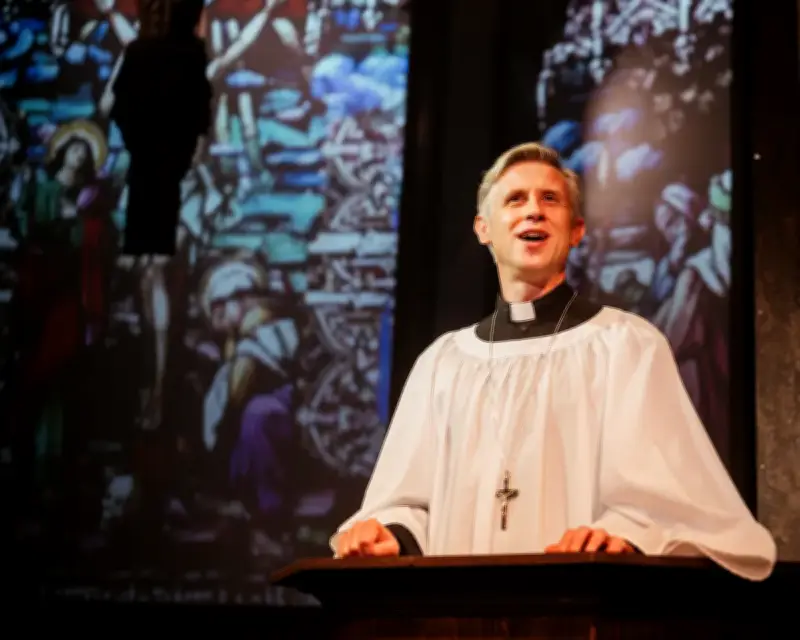
Canon Daniel Clement, the detecting rector created by Reverend Richard Coles, takes the stage at Watermill theatre in Newbury in an adaptation of the 2022 novel Murder Before Evensong. Ian Hallard impresses as the rector in a thoughtful production that sometimes strains under a villageful of suspects, victims and doubling actors.
A village mystery with wartime roots
Coles's 1980s setting spared him the alibi-limiting restrictions of mobile phones and CCTV but also allowed characters in Champton, his fictional benefice, to have links with the second world war. The plot links the canon's plans to install a lavatory at St Mary's to events buried in the village's military history that led to serial killing.
The murder mystery's demand for a satisfying number of victims and suspects and a small, non-subsidised theatre's casting budget create economic tension. This is resolved in the production by Watermill artistic director Paul Hart with seven of the eight actors sharing 16 roles between them. One performer counterintuitively plays a cop and a corpse. Such doubling – especially when the parts are stark class contrasts – can push portrayals towards caricature, while the number of villagers and torrent of necessary exposition can result, on the cramped stage, in characters lined up like speakers at a parish council meeting.
Standout dialogues and a poignant lord
Strikingly, the standout scenes are dialogues between actors who play only or mainly one person: Ian Hallard's Canon Clement and Jaz Singh Deol's DS Neil Vanloo. Drawing on a couple of lines in the book, Hart and co-adapter Shaun McKenna fascinatingly explore the common ground between policeman and priest as ministers to the grieving and guilty in the community. Hallard deftly sidesteps the English theatrical elephant trap of the twittish vicar, offering hints of Clement's open faith and closed sexuality.
Earl Spencer, a friend and co-podcaster of Coles, is thanked in the acknowledgments of the novel. The Champton lord of the manor, Bernard De Floures, one of three pivotal parts gamely played by David Hounslow, feels like a poignantly informed portrait of the responsibilities and rituals of a rural toff, able to make available a private chapel when the parish church repeatedly becomes a crime scene.
A thoughtful addition to stage crime
The narrative connection of a planned church WC to the second world war can feel a stretch, but a show that finds thoughtfulness amid generic jauntiness should draw more worshippers to the flourishing church of theatricalised literary crime. At Watermill theatre, Newbury, until 14 November.