Michelle Lim Davidson’s debut play, Koreaboo, is a tender tribute to fan culture, exploring a fraught mother-daughter reunion across cultural divides. The play, inspired by Lim Davidson’s own experiences, is taking a victory lap of Brisbane and Melbourne this month after a sellout premiere season at Sydney’s Griffin theatre in 2025, directed by Jessica Arthur.
A stranger in a strange land
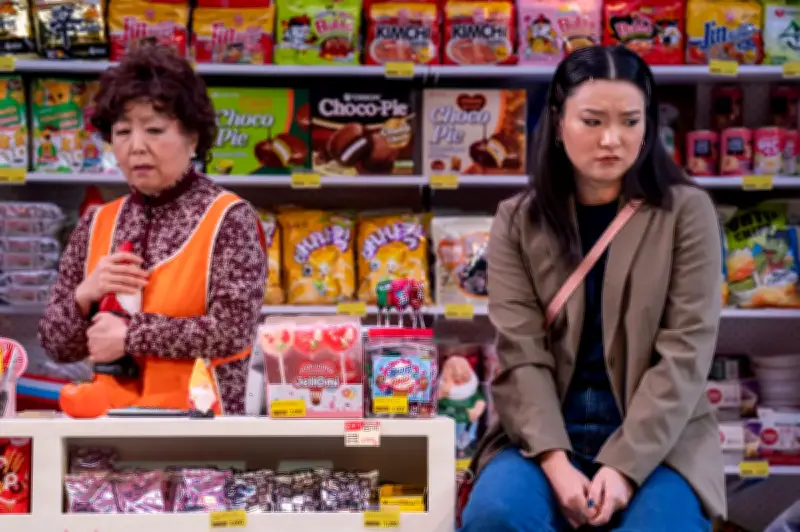
The play’s title references a “Koreaboo” – someone, typically not Korean, obsessed with Korean pop culture. In the story, Hannah (played by Lim Davidson) is a young Australian woman who arrives at a tiny one-woman convenience store in Seoul to spend time with its proprietress, her birth mother. Hannah was born in Korea, put up for adoption as a baby, and raised in regional New South Wales. She has only recently reconnected with her Umma and arrives in her shop very much a stranger in a strange land.
In the first of many communication mix-ups, Umma (Heather Jeong, a TV chef making her acting debut) thinks Hannah is due in a week and coming for a short vacation. Hannah’s emotional hunger is evident when she clarifies she is there for the whole summer: “I want to be with you.” Umma’s emotional discomfort is equally evident when she says, brusquely: “Go to Busan. Eat some fish.”

Performance and identity
The stakes are especially high for Hannah: she seeks not only maternal validation but confirmation of identity. She feels too Korean to be properly Australian and too Australian to be properly Korean. Umma taps into her worst fears of both parental and cultural rejection, treating Hannah like a tourist and criticising her language skills and her skin. “[You are] not Korean,” she says bluntly.
The play unfolds largely inside the convenience store – an intimate, visually rich set designed by Mel Page, stacked with mouth-watering snacks – as a cat and mouse game, if the cat were a kitten and the mouse knew Hapkido. Hannah seeks validation and intimacy; Umma blocks and deflects. But a common language emerges: K-pop. Umma loves K-pop even more than Hannah does – and has better dance moves. As fellow soldiers in the BTS Army, they find the first glimmers of a solidarity that slowly kindles to something more.
A tender tribute to kinship
There is a specificity to Lim Davidson’s characters, and the actors’ performances, that is rich and beguiling, and saves the material from feeling cliched. Hannah is a former eisteddfod tap dance champion (like Lim). Umma is obsessed with garden gnomes, her “friends”. It speaks to her loneliness and her sense of imagination. When Hannah asks about her attachment to this quintessentially white cultural artefact, Umma explains that they are manufactured in Korea – so they’re Korean. Both women’s faces fall as the implications of the comment land.
Performance is a running theme: performance of identity, of intimacy, of culture. In the opening scene, Umma touchingly tells Hannah to re-enter the shop as a stranger so they can re-do their botched reunion. Later, Hannah enters a TV talent show and transforms herself with cute-core outfits and K-pop affectations per Umma’s instructions – to be more “Korean”.
This cultural appropriation cuts both ways: Umma, we find out, is a Carrie-boo – a Sex and the City fan who can quote the dialogue and whose secret remedy for the blues is closing the shop and pretending she’s in “the Big Apple”, hailing taxis and drinking cosmopolitans. Koreaboo is a tender tribute to the ways in which fan culture fosters kinship across all kinds of seemingly unbreachable divides.
It is significant that we only find out Umma’s name in the final stretch of the play. We also find out she – Soon Hee – dreamed as a young girl of being a singer. It underscores Lim Davidson’s perhaps hard-won emotional wisdom about these kinds of relationships between mothers and daughters: that you can’t re-do or manufacture a parent-child connection later in life; that you have to meet each other as fully formed individuals and aim first for friendship.

If Koreaboo is at risk of being too sweet, too cute, it is saved by this undercurrent of emotional complexity. The play is less interested in the performance or the facade than what happens once it crumbles; what tendrils grow in the ruins. Koreaboo is on at La Boite theatre as part of Brisbane festival until 19 September, then at Melbourne’s Malthouse theatre from 24 September to 10 October.