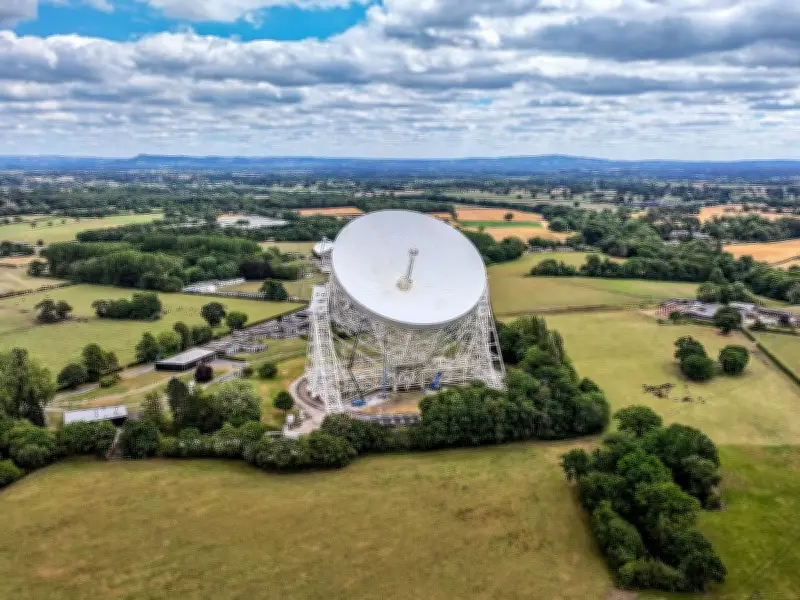
An associate director at Jodrell Bank who has spent his career developing its famed telescope network has said he would be 'heart-broken' if it had to cease operations.
Funding cut announcement
It was announced on Monday (July 27) that the centre's future was in doubt after it emerged that funding for the e-Merlin array, a national network of telescopes led by Jodrell Bank, would not be prioritised after March 2028.
Bosses at the University of Manchester, which manages the observatory, said the cut would mean the end of the Lovell Telescope as an 'active scientific instrument for radio astronomy' and the loss of 28 jobs employed by the e-Merlin grant.
e-Merlin network details
The e-Merlin system is a network of radio telescopes, with two at Jodrell Bank and five others across the country, all operated by the University of Manchester. They span nearly 220km across the country and connect together 'like one single telescope,' its director Simon Garrington explains. 'I've spent my entire career developing and using it.'
'We can make images of stars, galaxies, black holes on the same level of detail as the Hubbell Telescope. No other network does that and it's used for a whole range of science around the UK.'
Reaction and impact
Simon first came to the centre as a PHD student in 1984 and has worked there ever since. He said he had known about the prospect of cuts since January of this year. 'We were asked to submit information as to what the impact of the cuts would be - 20pc, 40pc, 60pc. They made a statement a couple of weeks ago saying that the average cut would be about 10pc. So we were shocked to find out that all our funding would be cut. I had to tell all my staff, which is about 40 people.'
He describes the reaction among the science community as 'stunned'. 'Everyone agrees what a big loss it would be. We have had many messages and they are just as shocked as we are that something like this would be stopped in its tracks. We are not an experiment or solving one problem. We provide so much detail and to have that taken away is just staggering.'
Future prospects and public support
The metal of the dish may be from the 1950s but everything else is bang up to date. 'We have just upgraded almost each part, it is state of the art. We practically invented a lot of the equipment.' He said he remains 'hopeful' that the centre has a future, citing a possible foray into the field of space radar, which would use the centre's 250ft dish to 'boost' radar that can scan satellites and space debris more than 30,000 kilometres away.
'We are getting universal support on this, the public are just as shocked as we are,' he said. 'There are several petitions and hundreds of comments on social media. They've been universally supportive. Millions of people have come to Jodrell Bank over the years, about 200,000 a year. For many it's what has inspired them into careers in science.'
'People have a connection with it and they want it to be doing science, they are not happy for it to just be there. It's a Grade I listed building but nobody wants it to be a monument to the science we did in the past. We want it to be part of the future, and it can.'