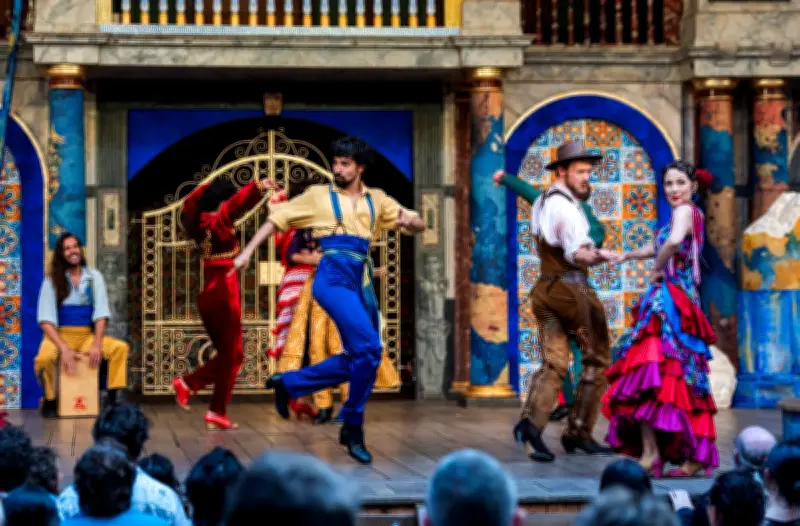
Indiana Lown-Collins’s flamenco-infused production of Love’s Labour’s Lost at Shakespeare’s Globe is a lusty and joyful success, blending stamping, torquing dance and a bullfight with Shakespeare’s wordy early comedy. Performed in an open-air London bullring coincidentally baking in Iberian temperatures, the production is impressively sure-footed bar a couple of odd choices.
A Vibrant Spanish Vision
Lown-Collins, a winner of the coveted JMK award, has helmed fine work in smaller venues and previously served as an assistant, associate, or co-director at the Globe. She clearly understands the quirks of this magnificent, demanding space. If this is a test of her ability to lead a tricky Shakespeare play and imbue it with verve and coherence, she’s passed.
Love’s Labour’s shares DNA with Much Ado About Nothing in its pairs of warring and wooing lovers, but it has too many prattling, subordinate comic characters and lacks jeopardy. Lown-Collins uses the impassioned dancing and singing, peacock costumes, and a bit of bawdiness to inject hot blood into its story of verbal fencing, courtly love, and honour.
Plot and Performances
The King of Navarre and his companions Berowne, Longaville, and Dumaine sign an oath to foreswear women, food, and sleep and undertake three years of ascetic study. But they’ve forgotten that the Princess of France (here transposed to Spanish royalty) is arriving with her own attendants Rosaline, Katherine, and Maria to discuss ceded territory. The oath turns out not to be worth the paper it’s written on. Unconventionally, this comedy doesn’t end in marriage because news of the Princess’s father’s death puts the four budding romances on hold for a year.
Unlike in Much Ado, the pairs of lovers are unbalanced. The most vivid characters are the sly, wry Berowne (Philip Arditti, saturnine and quizzical in a see-through lace shirt) and the wise, acerbic princess (Norah Lopez Holden, a stirring and accomplished dancer who also brings bittersweet grief to the ending). Both spend their wit on underwritten secondary characters, though Ned Costello amusingly channels Rik Mayall as the King, and Bea Segura is a pert, tart Rosaline.
Comic Archetypes and Staging
There is fun to be had for Shakespeare nerds in spotting him road-testing comic archetypes that find fuller expressions in later plays. The clowns include the arch servant Boyet, the silly knight Armado, the sly rustic Costard, and two learned pedants. Katy Stephens renders the schoolteacher Holofernes as a vulgar English tourist mixing up her bollocks and her bullocks. As Armado, Andro Crespo demonstrates with an extraordinarily prehensile finger how the princess would “dally with my excrement” (his moustache: it’s in the text).
The men and the Princess wear tight-buttocked, bolero-jacketed versions of the matador’s suit of lights; the garish flamenco dresses for the gentlewomen sit somewhere between Mardi Gras costumes and novelty toilet roll holders. The conversion of the deer hunt into the ritualised slaughter of the corrida, with a shirtless bailaor (flamenco dancer) as the bull, is elegant and brutal. It’s staged on a circular island stage amid the groundling audience in the Globe’s pit: here the men also conjure up the women they’ve fallen for, like ballerinas in a music box.
The main stage is dressed by designer Katie Lias with elegant tiles and painted columns (the preponderance of bright blue and yellow a coded show of support for Ukraine, perhaps). The flamenco brings an edge of yearning, and the setting of the men’s declarations of love to contemporary pop (Despacito, La Vida Loca) just about works. The scene where their oath breaking is revealed is hilarious.
Minor Quibbles
The production features many people of Spanish heritage among the crew and the musicians. In the cast, some are native Spanish speakers, some exaggerate or assume accents, and some simply don’t bother. Dialect-deafness can be as valid an artistic choice as colour-blindness, but here it feels like carelessness. Some of the contemporary ad libs ring hollow too. But these are minor quibbles. Viva the Globe, Viva Espana.