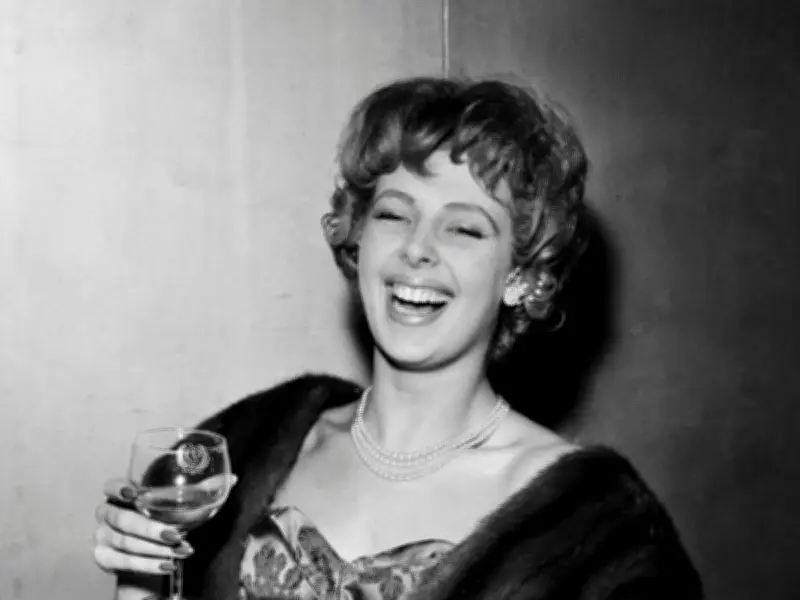
Ivor Novello appeared outside Virginia Vernon's tent in Normandy one morning after D-Day, asking her to come to the singalong that night for a new song he had written. Novello had just served a prison sentence for a wartime petrol fiddle and feared the men might turn on him. He wanted Virginia, the no-nonsense boss of the Entertainments National Service Association (ENSA) along for support.
A Poignant Moment in Bayeux
Standing at the back of the theatre in Bayeux, she heard Novello sing We'll Gather Lilacs and watched the young soldiers pick up the tune and sing along. She wept, thinking how many would not live to see the spring. It was one poignant moment in a life at the heart of ENSA, Britain's forces entertainment organisation, that took her to the furthest-flung corners of the war - from Britain and France to North Africa, Italy, India, Burma, Singapore and Hong Kong.
One newspaper called her 'the war's most travelled woman.' Her godson, Adam Fairclough, has co-written a new book about her, to coincide with the 80th anniversary of the end of ENSA in August 1946. He says: "She loved the British soldiers, and that was the heart of what ENSA was about. Her respect and affection for the ordinary soldier kept her going. She was opinionated, funny, bossy, flawed. Above all she was fearless."
Early Life and Career
Born in America, Virginia made her Broadway debut in 1915, later working as a translator and novelist and adapting plays for the French stage. But her success was tinged with sadness, after her father committed suicide in 1916. Virginia married the theatre director Frank Vernon, the only man she ever loved, and her happiest years were the 1930s, which she spent in London and Paris with him. Adam says: "I think she turned her back on America when she married Frank. She reinvented herself as an Englishwoman."
ENSA was established in 1939 to entertain British and Commonwealth forces wherever they served. Its director, Basil Dean, recruited Virginia in Paris that summer, after Frank, by then in failing health, put her forward. Frank died of pneumonia in Dieppe on 18 March 1940. "Thank God you're here," he said when Virginia reached him, and they said their farewells.
Working with Gracie Fields
Alone, without children, siblings or parents, she told a staff officer who offered her home leave: "All I want is to go on with my job and have plenty of work to do." Matt says: "ENSA was music hall - a long way from the West End plays Virginia had worked on. She had no idea who Gracie Fields was." But she respected ENSA artists' work ethic and was enchanted by the mutual love and respect between Lancashire-born Gracie and the battered troops. Becoming firm friends, after one concert in France Virginia wrote: "Gracie Fields is absolutely wonderful. Now that IS the stuff to give the troops. She is the bravest, grandest person and I wish she could stay with us forever. The chaps ADORE her. And they KNOW she loves every mother's son of them."
Encounters with Royalty and Resourcefulness
With the Germans advancing through France, Virginia escaped from Brest on one of the last troopships to England. Her work took her all over the world, including to Tunis, where she met King George. At a gathering for him, Virginia kept out of sight in a borrowed uniform, nervously stubbing out a cigarette, when George asked for her by name. "Why did you put out your cigarette?" he said, smiling. "Have another?" The King asked her about ENSA in Tunisia, then said: "I do envy you, because you can see so many more of the boys than I can and you can do so much more for them." In Italy she found performers sleeping on straw, as entertainment officers said mattresses were unobtainable. So, she drove to the factory that made the ticking, talked the owner into handing over the material and had the mattresses made. Adam said: "She didn't take no for an answer." In India, she began learning Urdu and had no patience for the imperial set. Matt says: "Her politics were never far from the surface."
Post-War Life and Legacy
On VE Day, she listened to the drums, unsure whether they meant celebration or warning. According to Adam, she said: "Are they beating for us, or is this them coming for us?" Despite their sterling wartime work, ENSA was omitted from the 1946 victory parade - a "deliberate snub," says Adam. ENSA director Basil Dean never got his deserved knighthood. And in the House of Commons, Labour MP John Strachey, a wartime RAF officer, said: "Some of the worst experiences of my life have been sitting through ENSA concerts." Snobbery towards ENSA was rife. Matt says: "Noel Coward couldn't stand ENSA. Joyce Grenfell was equally scathing. But it was incredible what they did. It's the World War Two equivalent of British Rail - you complain about the sausage rolls, but actually they did a good job."
Virginia joined The Daily Mirror after the war, at the urging of Guy Bartholomew, her neighbour during the Blitz, who transformed the paper into a tabloid. Adam says: "As soon as she finished with ENSA, Guy Bart said, 'there's a job for you at the Mirror.' She accepted it right away." Touring Canada from late 1946, Virginia spent Christmas in Santa Monica with Gracie Fields. Part of her job was selling the Mirror's Jane cartoon strip to North American papers, although Adam says it "would have been too risque." In 1948, she launched the Mirror's Paris bureau, running it for ten years. She knew the politicians, carried the contacts, and was admitted to the Légion d'Honneur by President Auriol, while filing background stories for correspondents, who took the bylines. Some of her profiles of French politicians carried the heading "Confidential, Libellous." Taking zero credit for the foreign reporting, Adam says: "They would have been filed by the male Paris correspondents. She was writing articles on fashion. But behind the scenes, she was doing vital work." From 1957, she ran the Mirror's West African edition, written in French and based in Dakar, until 1960.
Adam says: "Virginia retired from the Mirror, aged 65, but she never stopped working. She wrote for a French-language magazine published in Senegal, interviewing singer Millie of My Boy Lollipop fame. She moved to Guernsey, threw herself into the cause of European unity, published a biography of a 17th century French murderess, and in 1969 began a fictionalised life of the painter Monet. She was still writing when she died at home on the island in 1971, aged around 78." Her formidable spirit did waiver after the war. She wrote to Basil Dean: "I'm tired. You've never heard me say that before. And I've had it, in a big way." The last words of her unpublished memoir describe the flight home from India, landing in the Middle East, expressing her longing for a better world. She wrote: "We came down in the Dead Sea. Dedication, hope and faith were dead, dead, dead. In 1939, we believed that we must fight and win the war to end all wars. In the cruel bright dawn, on the Dead Sea, a war had been won, the war to end all wars had not been fought."
MADAM V: Battling to Bring Entertainment to the British Troops, is published August 13 by The History Press, priced £25.