There were more walkouts than I’ve ever seen in a theatre from this gruelling, gripping orgy of cruelty. But as one survivor put it after the stunned curtain call: “If you come to a Sarah Kane play, what do you expect?” The writer, who hanged herself aged 28 in 1999, was a singular dramatic voice, unusually attuned to the horrors humans can perpetrate and endure. In the first three of her five plays – Blasted, Phaedra’s Love and Cleansed – this manifested in stark depictions of violence, rape and torture.
A Hard Watch, Impeccably Done
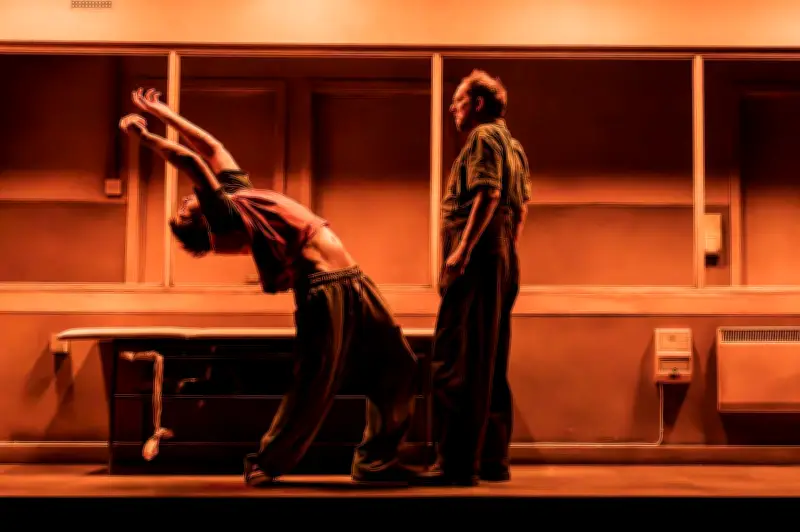
Rebecca Frecknall’s revival of Cleansed is certainly a hard watch, but it is impeccably done. We are in a grimy facility, half prison, half hospital - one long, strip-lit room containing a gurney with a windowed corridor behind. Its overlord is Tinker (Leo Bill), who self-identifies as a doctor, but whose first act is to inject a lethal dose of heroin into the eyeball of junkie Graham (Jack Riddiford). Graham’s sister Grace (Pearl Chanda) apparently commits herself to the institution (“you shouldn’t be here”) and conducts an incestuous affair with her brother’s ghost. At times this unfolds in tandem with a half-flirtatious, half-maternal relationship with illiterate Robin (Stuart Thompson), who wears Grace’s dress and tights after she forces him to give her Graham’s clothes.
Ritualised Sex and Violence
The sex and the violence are ritualised. Tinker’s invisible helpers violate and beat Grace and batter and bind his other victims. The brutalities Tinker himself metes out are stylised but unspeakably gruesome, particularly those inflicted on gay couple Carl and Rod (Luke Cinque-White and Parth Thakerar) who he forces to betray each other. A tongue is snipped off, hands and feet butchered, and Robin is bullied into wetting and then hanging himself.
It may surprise you to hear that it’s not all atrocity and ghastliness. A mechanical sunflower sprouts and at one point the whole stage retracts to reveal a field of artificial daffodils. There is real affection here, between Carl and Rod, and also, complicatedly, between Grace, Graham and Robin. Even the sadistic, desensitised Tinker seeks connection to the woman (an inmate or a sex worker, perhaps both, played by Lizzy Connolly) who he pays to bump and grind behind neon-lit glass, repeatedly asking her to show him her face. A late sex scene between them is rawly tender, and some of the writhing during the torture scenes verges on the balletic.
Power Through Juxtaposition
Part of the power of the piece comes from the juxtaposition of fragile moments of hope with outright savagery. Some of the most eye-averting actions happen to a loop of the heraldic hornpipe from Handel’s Water Music, or Ray Davies’s cheerful, grateful pop song Days. Elsewhere warped, staticky compositions by Angus MacRae foster the oppressive atmosphere, as does Madeleine Girling’s set. We hope for solace or humanity, but both are crushed.
I was one of the critics who misconstrued Kane as a shock merchant when I excoriated her debut Blasted in 1995, along with the Daily Mail’s Jack Tinker (the naming of the torturer here may be a wry joke: Jack’s review and his notebook, meanwhile, are in the V&A theatre galleries). Her suicide four years later - enshrining her as tragic, depressive and misunderstood - made it even harder to appraise her work coolly. What the ever-impressive Frecknall shows is Kane’s empathy, her absolute command of atmosphere and tension on stage and her refusal to glamorise or soften the effect of cruelty. There is more humanity in Cleansed than I remember from the National Theatre revival in 2016: also more echoes of Titus Andronicus and the Jacobeans.
Performances and Legacy
Chanda, Thompson and Riddiford mine nuggets of delicacy from the script. Bill is a terrifyingly normal, nondescript Tinker. Thakerar and Cinque-White don’t get to do much except spasm through their suffering, but Connolly is striking in the underwritten part only identified as “Woman”. The clarity and honesty with which Kane viewed a bleak world shines through. Who knows what she might have gone on to do?
To 29 Aug, almeida.co.uk.