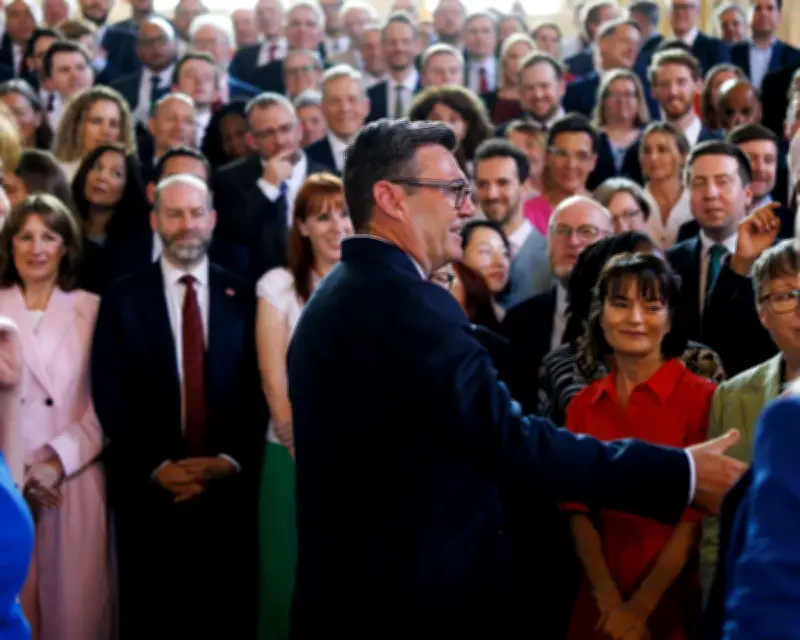
Andy Burnham's journey from Manchester to London on Monday became the focus of intense media coverage, with helicopters tracking his train and cameras following his every move, despite a fatal rail crash that occurred just days earlier. The crash near Bedford on Friday evening killed one person and left eight in critical condition, with 45 others hospitalized, yet it was Burnham's arrival in the capital that dominated news cycles.
Media Spectacle and Westminster Theatre
Burnham, widely expected to become the next prime minister after Keir Starmer's swift departure, orchestrated a photo opportunity in Westminster Hall surrounded by Labour MPs, drawing comparisons to scenes from 'Return of the Jedi' or Dorothy with the Munchkins. Critics noted the lack of substance in the display, with one commentator describing it as 'twee' and emblematic of a political culture that prioritizes affectation over policy.
According to briefings, Burnham's team admitted he was 'not going to be close to being ready' for the premiership, yet the media frenzy continued unabated. The BBC broadcast live helicopter shots of his train, while GB News chased him through Euston station in a scene likened to horror-movie found footage. Sky News even tracked his taxi from Euston to Westminster.
Rail Crash Overshadowed
The wall-to-wall coverage of Burnham's journey stood in stark contrast to the ongoing tragedy on the rail network. The crash, the worst in Britain in almost two decades, occurred when a train traveling toward London collided with a stationary train just outside Bedford. Despite modern safety systems, a driver was killed and dozens were seriously injured. Survivors' accounts described horrifying scenes, yet the story quickly faded from public attention.
As one commentator noted, 'all our trains of thought run on dopamine now – and perhaps that’s a big reason why we never seem to arrive anywhere better.' The incident raised questions about media priorities, with the Westminster bubble consuming attention while a major transport disaster slipped from view.
Burnham's Journey South
Burnham boarded his train in Manchester wearing dark jeans and a T-shirt, changing into a suit in the toilet due to a lack of facilities at the station. The train was reportedly late, prompting jokes about delay repay. Once in London, he took a taxi to Westminster, tracked by Sky News overhead. Observers described the spectacle as 'very British,' but the juxtaposition with the rail crash highlighted a troubling imbalance in news coverage.
The frenzy around Burnham's arrival is part of a broader pattern, with previous transitions of power also marked by superficiality. The focus on trivial details, such as the Downing Street cat, often masks a lack of substantive political debate. As one analysis put it, 'the yawning lack of substance, intellectual heft and high performance in our politics can be disguised by the right kind of affectation or cosy joke or vibe.'
Public Reaction and Future Implications
The media's fixation on Burnham has drawn criticism, with some arguing it distracts from pressing issues like rail safety. The crash near Bedford has prompted calls for an investigation, but public discourse remains fixated on the incoming prime minister. Burnham's team has yet to address the tragedy directly, focusing instead on his transition to power.
As the country awaits Burnham's official ascension, the question remains: will the media's obsession with political theater continue to overshadow real-world events? The answer, based on Monday's coverage, seems to be a resounding yes.