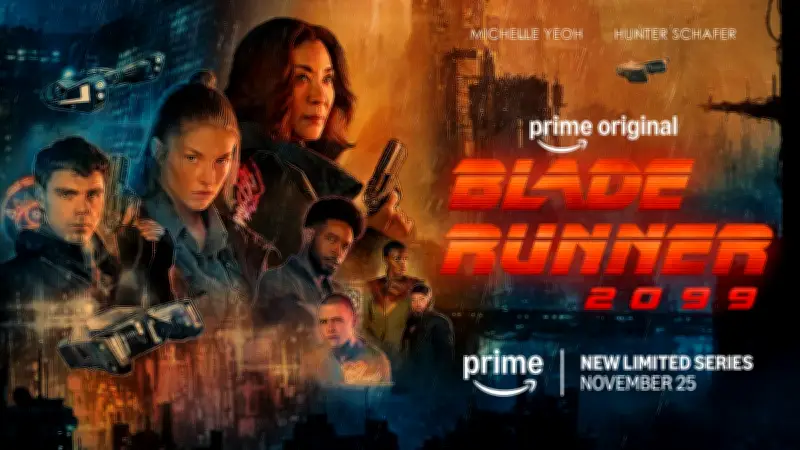
The new Amazon series Blade Runner 2099 is a visual marvel, but its spectacular production design and effects are undermined by the small screen, leaving a story that fails to grip.
The show, created and written by Silka Luisa, recreates Ridley Scott's dystopian Earth with a score that echoes Vangelis and retro-future detail: smoke and smog, chunky computers, cathode-ray screens, broken teeth and skin grafts, and giant video screens advertising off-world colonies.
Small screen undermines spectacle
One of the odd consequences of the streaming age is that the most spectacular and expensive productions are immediately neutered by being delivered on the small screen. This paradox proves fatal for Blade Runner 2099. On the big screen, awe at the world it presents could overwhelm, but when shrunk down, the realities of plot, character, and performance confront the viewer.
In 2099, bioengineered replicants have taken over Earth, reducing humans to an underclass. Unlike the first film, Blade Runners are not humans hunting rebellious replicants, but replicants hunting rebellious humans.
Plot and performances falter
The focus is Cora (Hunter Schafer), part of a human resistance hunting for artefacts that could end the replicants. On the run, she is given a false identity by veteran Bebeto (Dimitri Abold): she must pose as a replicant Blade Runner called Marian who has just returned from off-world.
She is partnered with Olwen (Michelle Yeoh), the toughest and smartest of the Blade Runners. Olwen has the blue nails of a replicant reaching the end of its limited lifespan and is searching for her missing replicant lover Marek (Johnny Harris), who seems to have disappeared into the orange-hazed desert.
The buddy-cop setup should create tension as Cora tries to pass herself off as Marian, but it is not believable that she could achieve this, given replicants' superhuman abilities. Marian is repeatedly beaten up, outrun, and chucked about, with barely an eyebrow raise from colleagues. Schafer's nervy performance does not help, and the cool of her fellow Blade Runners is only occasionally glimpsed.
Set pieces and dialogue issues
For some viewers, this won't matter; it's possible to switch off critical thinking and enjoy the set pieces, which do deliver. There is a chase in a backstreet sideshow where replicants can wear pregnancy body suits, a replicant love scene above a planet blooming with terraforming explosives, a circus nightclub where Ana de Armas's giant hologram Joi takes centre stage, and a journey across the ocean to an abandoned Mexico City.
Yet it fails to grip in the way Andor does. Scenes lack internal cohesion, the leads have zero chemistry, and it can't resist explanatory dialogue. At one point Cora/Marian says to Olwen, “Everyone is waiting for you to die. But you're looking for the one person who should be here, but he's not. He left you. And now you're alone.”
The original had a kind of contempt for humanity, while the short lifespans of the replicants allowed them to grab every moment. Here, neither humanity nor AI robots seem particularly worth saving, both being little more than memory-scrolling devices. The series is out now.