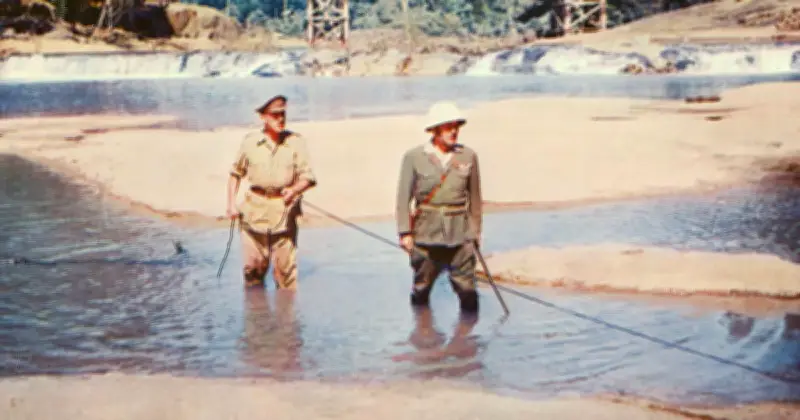
The 1957 war classic The Bridge on the River Kwai will leave Netflix on December 1, giving viewers only a few days to watch it. The film holds a 96% rating on Rotten Tomatoes, placing it above other celebrated war films such as Saving Private Ryan, Dunkirk and Apocalypse Now.
A Seven-Time Academy Award Winner
Directed by David Lean, the film stars William Holden, Alec Guinness, Jack Hawkins and Sessue Hayakawa. It is an adaptation of the Pierre Boulle novel about prisoners of war in Burma who are forced to build a bridge to support the war effort of their Japanese captors. British and American officers plot to destroy the structure, while the commander overseeing the bridge's construction has other intentions.
The film won seven Academy Awards, including Best Picture, Best Director, Best Actor for Guinness, Best Adapted Screenplay and Best Cinematography. It has been regarded for around 70 years as one of the finest war films ever made.
Critical Praise and the Real Bridge
Richard L. Coe of The Washington Post described it as a "gripping tale" that "will keep you tied to your seat thanks to the brilliant effectiveness with which director David Lean has tied together script, casting and technical demands." The Boston Globe called it "a picture of so many excellencies it is difficult to enumerate them," while The Detroit Free Press said "the madness of war has never been shown more graphically." The Standard praised it as "flawlessly acted" and "entertainment that is both expert and honourable," adding: "I am grateful that it was made."
The bridge shown in the film is real. Bridge 277 still stands and is a well-known local tourist attraction. It crosses the Khwae Noi river at Kanchanaburi, Thailand, where a small tourist train offers rides and pedestrians can cross on foot.
The Death Railway's Toll
The bridge formed part of the Burma-Siam Railway, a 250-mile line built during World War Two by around 60,000 Allied prisoners of war and 200,000 forced Asian labourers taken from territories conquered by Japan. Japan needed the railway as a supply route linking Singapore and Malaysia to Burma. It became known as the Death Railway, with workers dying at a rate of 20 a day. Bridge 277 was overseen by 2,000 British and Dutch prisoners of war and Malaysian labourers.
Among those who built it was Australian Army Lieutenant George Hamilton Lamb, a former politician who joined the Army in 1940 and died at Camp Kilo 101 in Thailand. The Commonwealth War Graves Commission states: "It's estimated around 16,000 Allied prisoners of war were killed during construction of the Burma-Siam Railway. Civilian workmen suffered terribly too, with their casualties far outstripping the military personnel. Around 90,000 forced labourers are thought to have died building Death Railway."
Workers were often buried in camp burial grounds near where they died, but after the war their remains were moved to purpose-built sites. The key locations holding Thailand and Burma war graves connected to the Death Railway and the bridge are Kanchanaburi War Cemetery, Chungkai War Cemetery and Thanbyuzayat War Cemetery, where Lieutenant Lamb is buried.