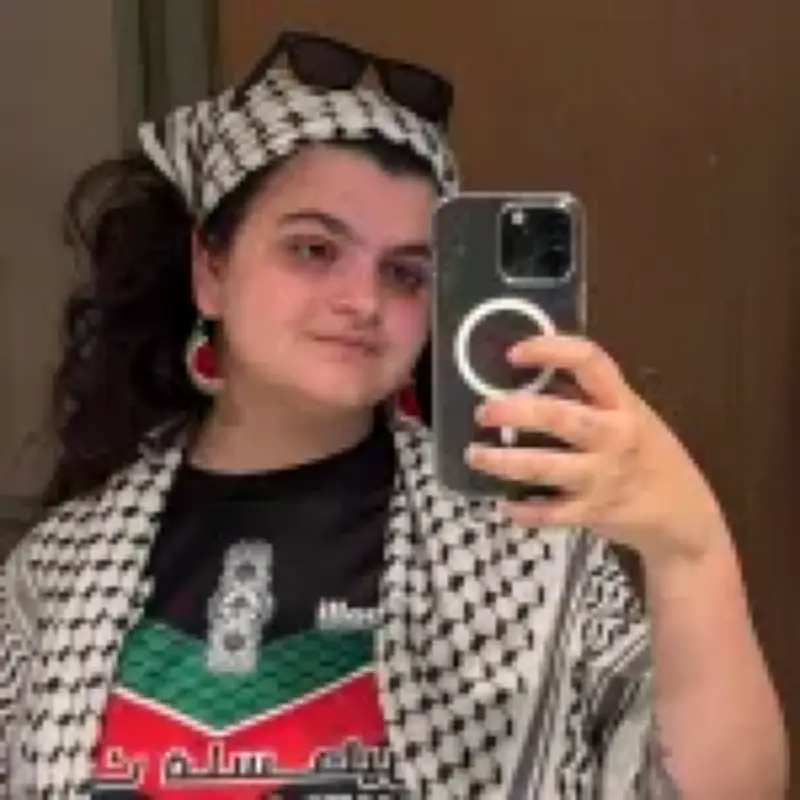
Nisreen Fox, a freelance journalist, has written about her journey of embracing her identity as a queer Palestinian, a path marked by early confusion, fear, and ultimately, joy. Born in 1999 in Geneva to a British father and a Lebanese mother, Fox came out as a lesbian to her mother in 2013. Her mother cried, hugged her, and warned that life would become more difficult. Fox had already faced hardship: losing her father suddenly as a child and her mother suffering a life-altering stroke a few years later.
Discovering Palestinian heritage
Fox's mother became her biggest supporter, and when Fox came out to the rest of her family in 2020, she met with unconditional support. Unexpectedly, her mother revealed a secret: she was born and raised in Lebanon with a Lebanese passport, but she was not Lebanese—she was Palestinian. Fox's grandmother, forced out of Palestine during the 1948 Nakba, had instructed her mother not to tell Fox, fearing she would ask questions and be exposed to the trauma of the Palestinian experience.
At school, Fox initially distanced herself from her culture, changing her name to Alex and telling people she was British-Arab but 'mainly British.' She felt far removed from her heritage, worried her sexuality would be an issue. When she began embracing it through queer communities online, her identity was questioned. At 17, she offered to present on the Israel-Palestine conflict in a politics lesson, and a group of boys confronted her, asking if she was spreading 'terrorist propaganda' about Israel. She held her ground, stating she would present historical facts, but it was the first time she realized how alienating her identity could be.
Moving to Brighton
In 2017, Fox moved to Brighton, where life looked very different. Brighton & Hove is only 10.9% non-white according to the 2021 census, compared to London's 46.2%, while 39.2% of Geneva's population are non-nationals. Fox felt lost, as few people knew about Palestine or her culture. After the October 7 attacks, the city shifted and everyone had an opinion. In gay clubs, people called her 'exotic' and asked where she was 'really from,' touching her curls without permission. Dates questioned how she could be Muslim and gay, assuming her family didn't accept her—but they do.
Fox felt different from everyone else, not white enough for the gay scene and not Arab enough for her community, known as SWANA (South West Asian and North African). Many Arabs use SWANA to identify themselves, as it feels more true to their origins. But because Fox doesn't speak Arabic and felt 'othered' due to her sexuality, she assumed she couldn't enter SWANA spaces.
Finding community and joy
Nine years after moving to Brighton, Fox has expanded her LGBTQ+ SWANA network through visiting the Old Palestine House and local fundraising events by Queers for Palestine Brighton. She has a community that supports her activism, fundraising for Palestinian and Lebanese causes, and offers advice. The community has faced hardships, including being told by the white queer community and local Zionists that they are hypocrites for being LGBTQ+ and pro-Palestinian. Far-right thugs have yelled 'Chickens for KFC!' at them on marches. Once, a Palestinian fundraiser Fox was hosting was cancelled by a prominent LGBTQ+ venue last minute due to 'concerns from the local community' around 'safety.'
Despite these challenges, Fox experienced true queer joy at the 2026 Brighton Pride weekend, attending her first SWANA Pride Party at Old Palestine House. She danced to music from her culture, did the dabke (a dance popular among Lebanese, Jordanian, Palestinian, and Syrian communities), laughed, and cared for others. For the first time, she felt she understood what it meant to be Palestinian and queer, because she was just being herself. She didn't have to defend or explain herself—she just danced as authentically as she ever had, with her partner, friends, and local aunties.
Fox concludes that being Palestinian shouldn't be alienating, being queer shouldn't be controversial, and combining the two shouldn't be shameful. It should be, and will always be, joyous.