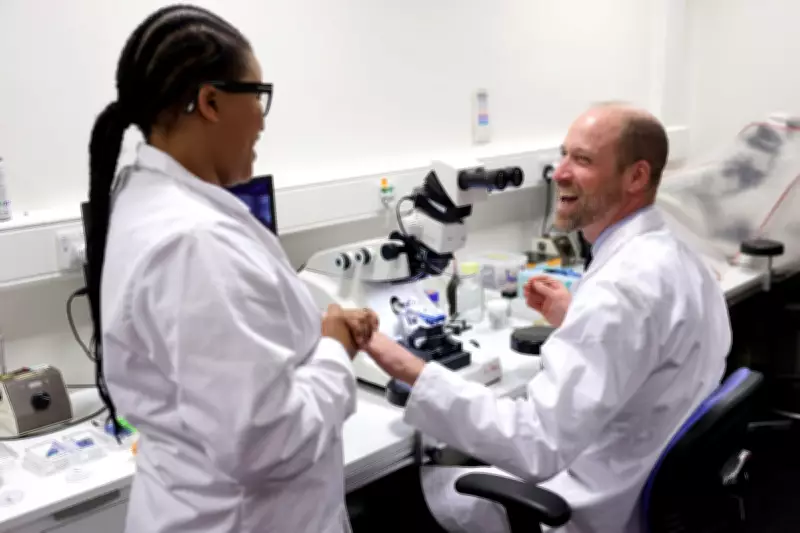
The Prince of Wales received unexpected praise during a visit to a leading biomedical research centre in London, where he was told he was "doing a great job" handling a mouse sample and even joked about a potential job offer.
Royal Tour of Cutting-Edge Research Facility
William spent Wednesday morning at the prestigious Francis Crick Institute in King's Cross, central London, where he donned a white laboratory coat for a comprehensive tour of the facility's advanced electron microscopy department. This state-of-the-art equipment allows scientists to study cells at the atomic level, providing crucial insights into biological processes.
Hands-On Experience with Scientific Procedures
During his visit, the prince received hands-on instruction from senior research scientist Dumisile Lumkwana and facility deputy lead Pippa Hawes, who demonstrated how to prepare a mouse kidney cell sample for microscopic observation. As William carefully handled the delicate sample, institute chief executive Edith Heard observed his technique and offered enthusiastic praise.

"You're doing a great job," Heard told the prince, adding with a smile, "we're hiring." The lighthearted comment highlighted the royal's engagement with the scientific process during his visit to the institute, which is celebrating its 10-year anniversary later this year.
Exploring Critical Medical Research
William also met with scientists who use electron microscopy technology to study how tuberculosis bacteria (TB) manages to evade the human body's defenses and survive inside human cells. TB claims millions of lives globally each year, making this research particularly vital. When shown a highly magnified sample on screen, the prince humorously remarked, "it looks like the moon to me," acknowledging the unfamiliar appearance of microscopic structures.
Connecting with Neuroscience and Education
The royal visitor engaged with neuroscientists Katharina Schmack and Andreas Schaefer, who explained their research into how the human body processes sensory information, particularly smells, and the biological mechanisms underlying mental health conditions. This intersection of neuroscience and mental health represents a growing area of biomedical research with significant implications for treatment approaches.
Inspiring the Next Generation of Scientists
William also encountered a class of A-level biology students from the nearby William Ellis School, who were participating in a genetic engineering workshop designed to demonstrate how classroom learning translates to practical laboratory applications. The 17 and 18-year-olds had been told a "VIP" would be visiting but only learned it was the prince shortly before his arrival at the research centre.
Research Achievements and Royal Context
Founded in 2015, the Francis Crick Institute brings together approximately 1,500 scientists and staff members dedicated to studying the biological foundations of health and disease. Their research aims to understand disease development and improve prevention, diagnosis, and treatment of conditions including cancer and heart disease. Notable achievements include identifying the genetic causes of inflammatory bowel disease and discovering biological links between air pollution and lung cancer in non-smokers.
The visit comes during a challenging period for the royal family, following the recent arrest of William's uncle, Andrew Mountbatten-Windsor, on suspicion of misconduct in public office. William had previously mentioned at the BAFTA awards that he needed to be in a "calm state" to watch certain content, adding "I'm not at the moment." Both William and Catherine have reportedly supported King Charles's statement emphasizing that "the law must take its course" regarding the allegations against Andrew.
Departure with Scientific Mementos
As he prepared to leave the institute, William signed a visitor's book and received three gift bags containing science-related books, along with a paperweight presented by Sir Paul Nurse, the institute's honorary life president and principal group leader. The gifts symbolized both appreciation for his visit and encouragement of continued interest in scientific advancement.