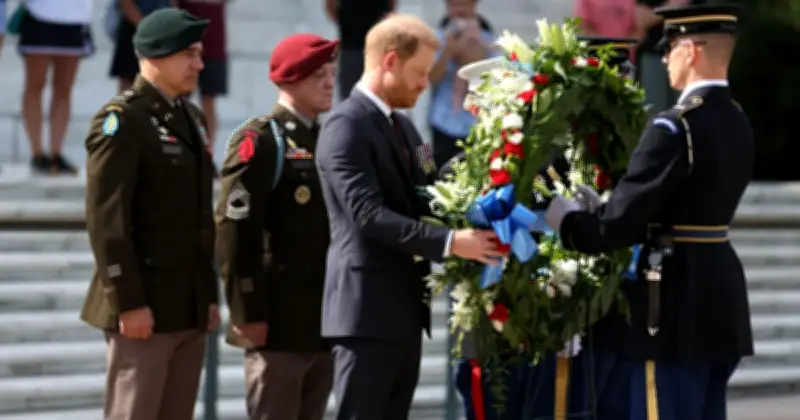
The Duke of Sussex quietly visited Arlington National Cemetery this week, a site his father, King Charles, had visited just a few months earlier. Prince Harry made a number of appearances on Wednesday in Washington DC, including a tribute to generations of American service members who made the ultimate sacrifice.
Wreath-laying and visits to fallen heroes
On Wednesday, Harry laid a wreath at the Tomb of the Unknown Soldier after observing the Changing of the Guard. He then visited Section 60, the final resting place of many service members killed during the wars in Iraq and Afghanistan.
He met with four Gold Star families and learned about the lives and service of their loved ones, visiting the graves of Specialist Christopher D. Horton, U.S. Army National Guard, killed in action in Afghanistan in 2011; Staff Sergeant James F. “Jimmy” Moriarty, U.S. Army Special Forces, killed in action in Jordan in 2016; Master Sergeant Joshua L. Wheeler, U.S. Army Special Operations, killed in action in Iraq in 2015; and Corporal Ian Thomas Zook, U.S. Marine Corps, killed in action in Iraq in 2004.
Hospital visit and decade-long commitment
The Duke concluded his visit to Arlington at the grave of Army Sergeant Michael Verardo. Earlier in the day, he visited Walter Reed National Military Medical Center (WRNMMC), the top United States military hospital, where he met recovering service members and medical staff.
Having previously toured the hospital in 2013, the visit offered an opportunity to see firsthand how advances in rehabilitation research and technology are helping wounded, injured and sick service members rebuild strength, independence and confidence.
Statement from the Duke's office
According to a statement released by the Duke’s office, Wednesday’s visits reflected a “shared commitment that has been central to The Duke’s work for more than a decade: ensuring those who serve, and the families who serve alongside them, are supported and valued not only in moments of crisis or active service, but throughout their entire lives”.
The statement concluded: “Through the Invictus Games Foundation and his continued work with the global service community, The Duke remains committed to advancing recovery through sport, strengthening the bonds between veterans and their communities, and ensuring that service is met with enduring support long after the battlefield.”