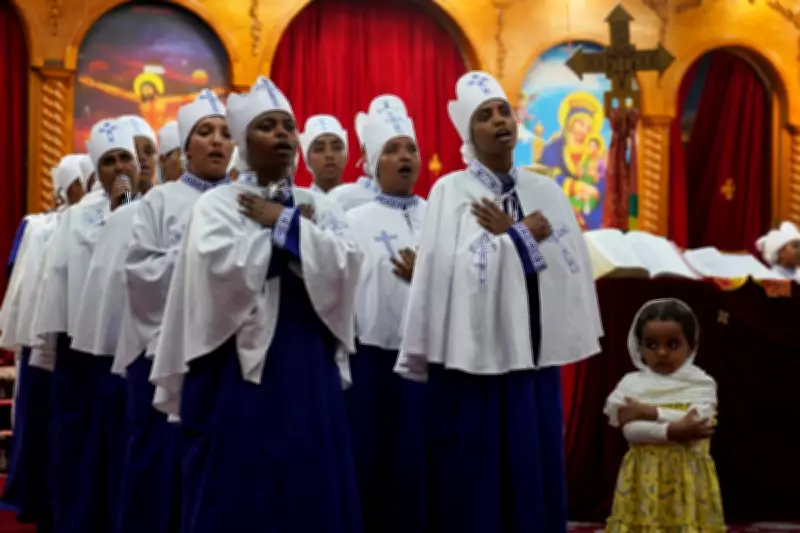
Ethiopian Orthodox Community in Washington Celebrates Easter with Ancient Traditions
Hundreds of Ethiopian Orthodox Christians, dressed entirely in white, packed tightly into Washington, D.C.'s DSK Mariam Church to celebrate Easter Sunday with prayer, hymn singing in the ancient Ge'ez language, and overnight vigils. The celebration, known as Fasika in Amharic, occurred a week after Catholic and Protestant Easter observances, marking Christ's resurrection with deep reverence.
White Garments and Heavenly Preparation
Archdeacon Getahun Atlaw explained the significance of the white attire: "We dress in white so that we are groomed for heaven." For Ethiopian Orthodox believers, Fasika represents the most important period in the church calendar, with festivities building throughout Holy Week and culminating in an intensive eight-hour overnight service.
This service concluded with the breaking of a rigorous 55-day fast during which participants abstained from all meat and animal products. The spiritual discipline required for this observance was particularly challenging this year as Ethiopian communities in the United States faced uncertainty regarding temporary protected status.

Community Resilience and Historical Context
The Trump administration's efforts to revoke temporary protected status for over 5,000 Ethiopians created additional hardships, though a federal judge recently blocked this decision. 18-year-old deacon Jonathan Melaku reflected on the church founders' perseverance: "It takes a grind and courage to get to where they're at. Our people will always stay resilient."
DSK Mariam Church, formally known as Re'ese Adbarat Debre Selam Kidist Mariam Church, belongs to the Ethiopian Orthodox Tewahedo tradition—one of Christianity's oldest branches. Located in the Washington metropolitan area, which hosts the largest Ethiopian diaspora community in the United States, the church serves approximately 4,000 people weekly.
Overnight Vigil and Theological Significance
This Easter, about 1,500 congregants gathered for the nocturnal service that ended at 3 a.m. on Sunday. Abraham Habte-Sellassie, a priest or "kesis" who helped lead the Divine Liturgy from midnight to 3 a.m., emphasized the resurrection's centrality: "The climax is the resurrection because if there was no resurrection, there would be no Christianity. It would just be an empty philosophy."
The three-hour service symbolically represented the time they believe Christ spent on the cross. Sebawit Yirsaw, who joined the church 16 years ago after immigrating from Ethiopia, described the special connection felt during Fasika: "The salvation is always something that we feel like much needed because we all go through a lot of hardship in life."
Holy Week Rituals and Symbolism
Earlier in the week, on Good Friday, priests wore dark purple and gold garments representing Christ's triumph over evil and provision of salvation. They chanted "Lord have mercy upon me" while clergymen beat out a flame symbolizing Satan's defeat. Throughout the service, congregants and clergy prostrated themselves dozens of times.
Archdeacon Atlaw explained: "We're living Christ-like as much as we can. The prostration is a passion to Christ's love. What he has done for us, the sacrifice."
During the Easter overnight service, dimmed lights and long skinny wax candles called tuaf represented the resurrection moment when Christ's light dispelled darkness. The church erupted as clergy and lay people chanted: "Your resurrection is for us who believe. Send your light upon us, send your light upon us."
Fast-Breaking and Family Celebrations
After the service, congregants rushed into dimly lit streets drawn by the aroma of doro wat—a traditional Ethiopian spicy chicken dish simmering in spices. They gathered in small sidewalk groups to eat small bites breaking their fast before resting at home.
Later in the day, families and friends assembled for elaborate Easter feasts, fully breaking their fast together with doro wat and other traditional Ethiopian foods. 21-year-old Deacon Amanuel Argaw described the experience: "The celebration is so joyful that you don't even feel that you're tired."

Cultural Preservation Across Generations
Maintaining these ancient traditions in the United States and teaching them to younger generations remains crucial for community members. Archdeacon Atlaw emphasized: "This history and value can go wherever Ethiopians go. This is our history. How can we take it lightly? This is who we are. We have to pass it from generation to generation."
For Selamawit Tekola, breaking the Easter fast with her large Ethiopian family is essential. Her niece, Adey Thomas, joked: "When Selama says, take off work and show up, it's not optional." They celebrated in a Virginia home filled with friends and family.
Thomas reflected on the celebration's significance: "In the States, it's very, you know, rush to go, go, go especially in the D.C. area. This is the one time to stop and celebrate with family."
On a warm Easter Sunday in Virginia, the family gathered wearing traditional clothing, standing together around homemade food for prayer. They shared traditional honey wine called Tej and eventually Ethiopian coffee. Tekola affirmed: "I was born Orthodox and I respect it, I love it. So that means a lot for us. That's what we are teaching our children."