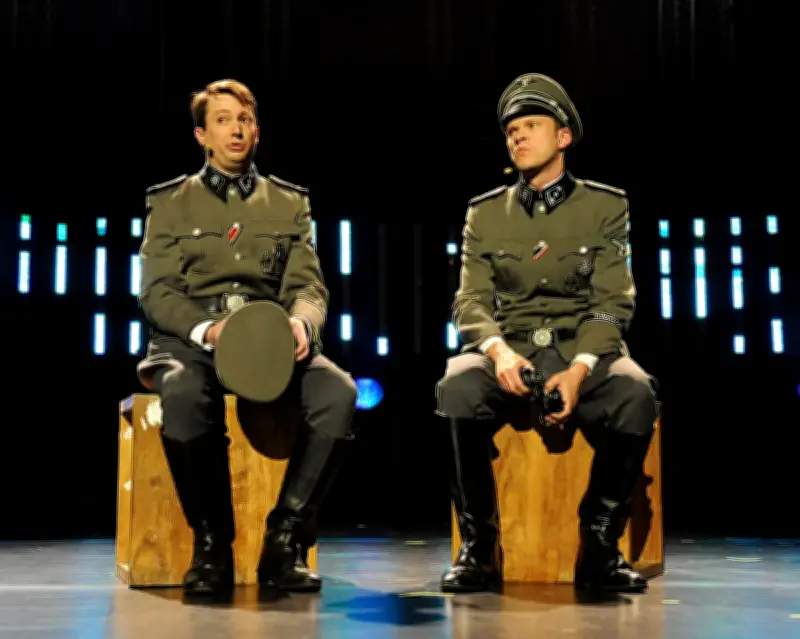
The BBC has deleted 11 sketches from the 20th-anniversary rerelease of That Mitchell and Webb Look on iPlayer, prompting criticism from culture warriors and raising questions about how society's values have changed.
The sketches include jokes about Jimmy Savile, Robert Webb playing a rude Gandhi (seemingly wearing skin-darkening makeup), and two scenes in which the comedians wear blackface. In neither sketch are they depicting people of colour; instead, they portray white people (in one scene, re-enactors of historic battles having a go at an African skirmish) who themselves wear blackface. In both, they are alert to their own indelicacy: “Are you sure,” asks Webb repeatedly throughout one, “that this isn’t racist?”
Context and defence
Some have argued that sketches such as these – satires on chauvinism, not examples of it – should be spared the editor's scissors. But that misses the point: blackface (and indeed the N-word, which caused the standup comic Alfie Brown so much trouble recently when he used it in his own anti-racist routine) is considered beyond the pale, irreducibly hurtful to a portion of the BBC's audience, regardless of context.
Is it right that it is so considered? There's no question these terms and behaviours are associated with very real harms. Perhaps the corporation focus-grouped that question – or perhaps it is pre-empting criticism, erring on the side of caution and care. Is it so outrageous that they should do so? The BBC is, as the comedy producer Jimmy Mulville stated this week in the most sensible comment yet made on the controversy, “in an impossible position”.
Comparisons and implications
For my part, I can't get too exercised by the removal of a handful of sketches – one of them, which jokes about the recently deceased Bill Oddie, for reasons of common decency, and others on the same basis that 70s sitcom It Ain't Half Hot Mum has long been withheld, without great controversy, from our screens. It feels important, mind you, that the episodes in question should be prominently marked as abridged, much as those Roald Dahl books adjusted for modern sensitivities were marketed as “updated texts”, in a move even more contested than this one. (Interestingly, David Mitchell responded very cynically to Dahl's “updating”.)
That act of bowdlerism felt more extreme because it affected (some would say diluted) the entire text, leaving readers uncertain what was Dahl and what was edited Dahl. (On the other hand, unlike in the case of Mitchell and Webb, the unexpurgated versions remained freely available.) In sketch comedy, by contrast, individual sketches can be removed wholesale, leaving the others unmolested. And yet in both cases, there's a risk the public will be misled into thinking the past was just like the present, and a chance missed to consider that values – and the boundaries of the acceptable – are perpetually shifting and up for grabs.
Comedians' perspective and the future
Do measures such as these give comedians the collywobbles? Mitchell and Webb themselves have apparently sanctioned the sketches' withdrawal. In 2017, Matt Lucas disavowed his sketch series Little Britain (“I wouldn't make that show now. It would upset people”) and didn't sound as if he were doing so just to stay employable; three years later, the show was removed from iPlayer and Netflix for its egregious use of blackface. In my experience, comics don't tend to consider anything sacrosanct, least of all old episodes of comedy shows. No one is more aware than a comedian of the shifting of social attitudes over time.
But equally, comics are – or should be – constitutionally averse to piety. None would wish to see abridgements to vintage comedy become commonplace, nor for what is sayable to be any more strictly policed. All would defend the space for comedy to be uncomfortable, to tease at cultural faultlines, probing what we think and feel about ourselves, one another and the world.
I doubt many comics will expend outrage on this isolated instance of pruning that renders a well-loved series palatable on a mainstream, licence fee-funded platform in 2026. What they will, and what we should, care more about is that the BBC invests in new comedy. And empower it to explore and address the issues that define and discomfit our times as irreverently as Mitchell and Webb did theirs.