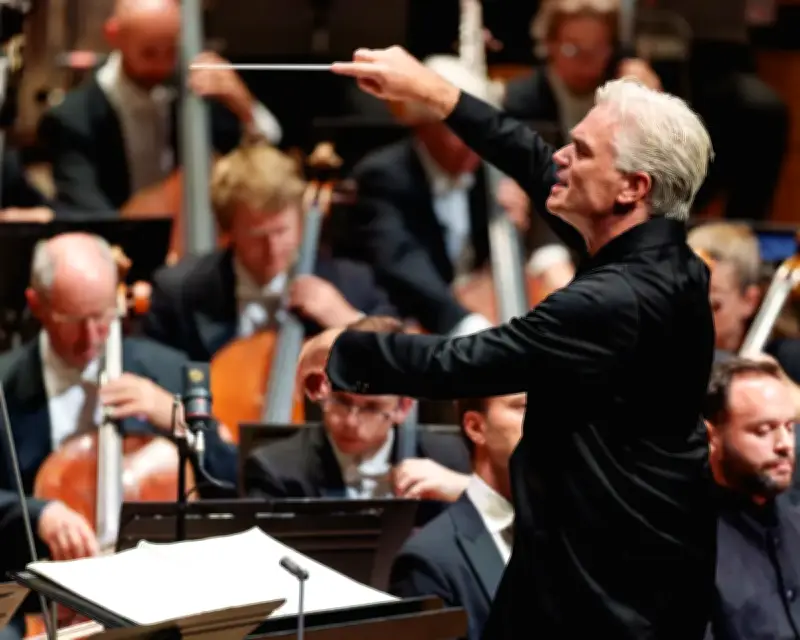
The London Philharmonic Orchestra opened its new season, In Search of Purpose, with a performance of Benjamin Britten's War Requiem at the Royal Festival Hall, London. Conducted by Edward Gardner, the piece landed with a bitterness and snarling irony to equal its solemnity and prayerfulness, capturing the edgy charge of Britten's pacifist manifesto.
A Pacifist Manifesto for the Ages
As Wilfred Owen wrote in 1918, "All a poet can do today is warn." The orchestra finds purpose in Owen's words, just as Britten did in 1962 with the premiere of his War Requiem. The piece doesn't just mourn the dead but rages at the senseless conflict that killed them, cautioning of "greater wars" yet to come.
It's a curious starting point for a season, a piece that stresses the limits of art as well as its capacity, but one depressingly, perennially pertinent. Originally cast to reflect the three main warring nations, the three solo roles reflected this topicality in Ukrainian-Welsh soprano Natalya Romaniw, American tenor Paul Appleby (replacing an indisposed Allan Clayton), and German baritone Benjamin Appl.
Gardner's Edgy Reading
Gardner has form with this piece. His reading has shed some of its cushioning grandeur over the years. The LPO caught the edgy charge, embedding it in the machine-gun rattle of the trumpets in the Dies Irae and those mocking fanfares of the Sanctus, anticipating the shocking punchline of Owen's The Parable of the Old Man and the Young in the chamber orchestra's sardonic commentary.
High up in the hall's rear balcony, the excellent children of the Tiffin Boys' and Girls' Choirs felt – deliberately – a long way from the action: an angelic chorus remote and unconcerned by human struggles below. A copy-bound Romaniw conveyed the same impression, bell-clear but impassive in the Benedictus, oddly aloof through the Lacrimosa.
Humanity in the Soloists
It was left to Appleby and Appl to find the humanity, both mining the text with lieder-singers' sensitivity, each devastating in the slow-burn horror of Strange Meeting. But it was Appleby's face you watched even as Appl delivered that climactic moment of revelation – "I am the enemy you killed, my friend" – embodying the drama without reservation.
The War Requiem is big enough to need a little help from friends, and the London Philharmonic Choir joined forces with the London Symphony Chorus to powerful effect: consonants bullet-clean, fortissimos blazing. But it was the pianissimo singing that left us with a much-needed glimpse of hope, floating that final cadence – whose resolution seems dropped from heaven itself – with unearthly delicacy.