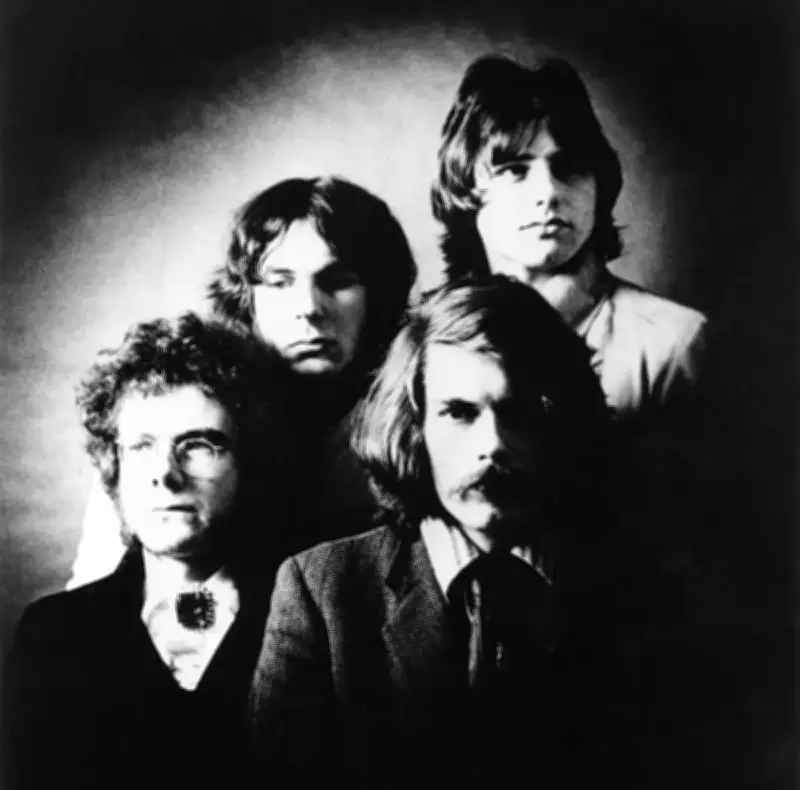
Michael Giles, the drummer who co-founded prog rockers King Crimson, has died aged 84. The news was announced by King Crimson’s record label DGM, who said he died on Monday 23 November, but did not give a cause of death.
Label Pays Tribute to Founding Drummer
“Michael was instrumental in establishing King Crimson as one of the most innovative and influential bands in the history of progressive music,” the statement reads. “His extraordinary rhythmic imagination, musical sensitivity and highly inventive approach to drumming were fundamental to the band’s pioneering sound.”
That skill and dexterity made a huge impact on the prog artists who followed him, including Rush drummer Neil Peart, who called Giles “a very important influence on me”.
From Bournemouth to King Crimson
Born in Bournemouth in 1942, Giles and his brother Peter sowed the seeds for King Crimson by advertising in a local newspaper for a bandmate: guitarist Robert Fripp answered it, and the trio formed Giles, Giles & Fripp, who alighted on an eccentric, sprightly jangle-pop style. They released their debut album The Cheerful Insanity of Giles, Giles & Fripp in 1968, which sold poorly and their label Deram rejected their next set of songs.
Ian McDonald joined the group, along with Fairport Convention singer Judy Dyble, though the group only recorded a handful of home-recorded songs before Peter Giles left later in 1968. Michael Giles, Fripp and McDonald forged ahead, forming King Crimson with Greg Lake and Peter Sinfield, debuting live in April 1969 and supporting the Rolling Stones in Hyde Park that summer.
Legacy and Later Career
Their debut album In the Court of the Crimson King, released in October 1969, was a sensation: a vision of rock music as not only heavy but shapeshifting, symphonic and mystical, it was an instant critical and commercial success, reaching the UK Top 5 and US Top 30. Giles’s deft drumming was a key ingredient, from the heavy tumbling fills of 21st Century Schizoid Man to lighter jazz-adjacent playing and pattering ghost notes, all with a sure-footed rhythmic sense that guided songs through shifts in time signature. “I was always interested in space, restraint and atmosphere, in allowing music to breathe rather than constantly filling it,” Giles later said.
Giles (as well as McDonald) then walked away from King Crimson, later citing a desire to “explore and develop new ideas for a much more expansive approach to playing drums and percussion into being equal and integral to my own compositions,” though he played as a session musician on King Crimson’s second album In the Wake of Poseidon, which returned them to the UK Top 5.
Giles and McDonald formed a duo, releasing the album McDonald and Giles in 1970, but thereafter Giles worked chiefly as a session musician. He backed Leo Sayer on his 1975 album Another Year, including the UK No 2 hit single Moonlighting; recorded with other prog figures such as Soft Machine’s Kevin Ayers and former Genesis member Anthony Phillips; and in 1993, played with Bryan Ferry on his cover of soul classic Taxi, plus there were numerous stints with other musicians.
He also reconvened with another ex-King Crimson member, Greg Lake, for the latter’s 1981 self-titled solo debut album; with McDonald again for McDonald’s only solo album, 1999’s Drivers Eyes; and in 2002 formed a band with various King Crimson alumni, 21st Century Schizoid Band.
Giles also released two solo albums, 2001’s Progress and, earlier this year, Shadows/Solo, a compilation of material recorded over a number of years. “It probably does reveal a more private and continuous thread running through the different phases of my life as a musician,” he said of the latter album in an interview with It’s Psychedelic Baby magazine. “What has always been important to me is to remain honest and genuine in the creative process, to make music only when it feels natural and truthful to do so … I have always preferred to allow the music to pass through me like a conduit, in its own time.”
He is survived by his five children: Tina, Amanda, William, Rosie and Oliver.