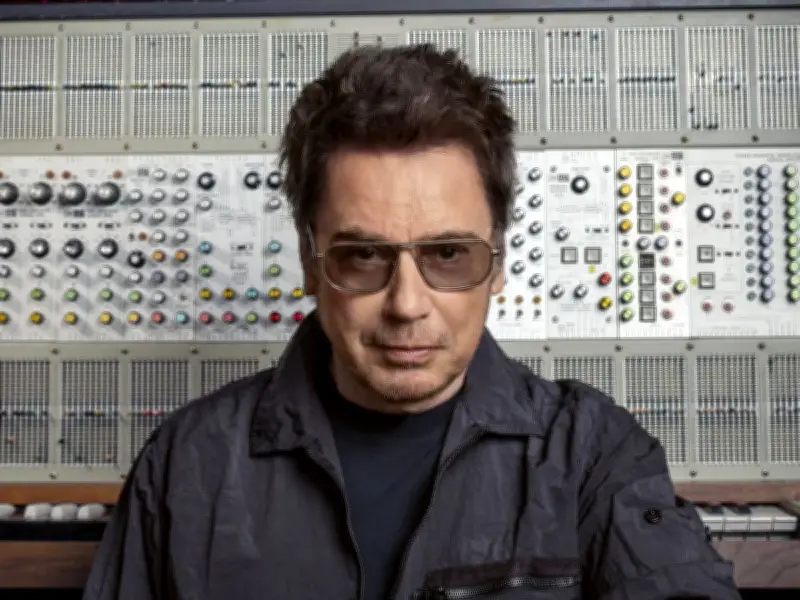
Jean-Michel Jarre is marking 50 years since the release of his debut album, Oxygène, with a new book, Machines: A History of Electronic Music, featuring more than 1,000 electronic instruments from his collection, and a 2027 Oxygène and Beyond tour of Europe and the UK. His maxim, contrasting with punk's 'no future' ethos, has been 'future, why not?'
From Rejection to Global Success
Jarre was denounced by fellow musicians early in his career for using synthesisers. Yet Oxygène reached number 2 in the UK Albums chart and sold around 18 million copies worldwide. Jarre, who lives in Paris with his wife of seven years, Chinese actress Gong Li, still revels in his notoriety, saying: “Punks were probably the most extreme enemies of synthesisers.”
Accusing the so-called anarchists of being narrow minded, he adds: “It’s strange how conservative the artistic world is. Especially the music world and the movie industry. Always rejecting. Rejecting streaming at the beginning; rejecting CDs at the beginning; rejecting recorded music when electricity came along. At the beginning of photography, some painters were signing petitions saying photography is the end of painting. It’s a never-ending story.”
A Revolutionary Vision
Seeing himself as a revolutionary, he explains: “I had this obsession to try to create a kind of bridge between experimentation - what I studied at the Music Research Centre in Paris - and pop. I thought ‘that’s actually my revolution.’”
Explaining how punk, despite emanating from his generation, was a music revolution coming from America, he adds: “When I was in contact for the first time with the concept of electronic music and electroacoustic music - saying for the first time music is not based on notes, but actually on any kind of sounds or noises, which can be mixed into your own score - I thought, 'that's a real revolution. This is what I want to explore.'”
Early Influences and Breakthrough
Jarre’s revolutionary streak was nurtured as a boy by his grandfather. The musician says: “My grandfather was a great genius. He was an engineer, he was a musician playing the oboe. In France, he created one of the first mixing desks for radio stations. He created also the ancestor of the iPod, the first turntable with batteries built-in, where you could go for a picnic to listen to Édith Piaf.”
Aged 12, he was given a secondhand Grundig tape recorder by his grandfather, saying: “For a young kid, it was like a monster. Then I became obsessed with this machine by, basically, recording everything. One day, by mistake, I played the tape backwards, and I thought that aliens were talking to me.”
By then, playing in local rock bands, Jarre started recording himself playing instruments and then playing the tape backwards at different speeds. He says: “That was the beginning of it all.” When the dad of his band’s drummer, who worked on French radio, told him about some other people doing the same kind of thing, he suggested the lads should link up.
Created largely using synthesisers in his Paris apartment, Oxygène showcased his brilliance, earning him a reputation as the father of dance music. Despite having sold 85 million records and playing for millions of people worldwide, Jarre’s music was initially rejected by major record labels because it had no vocals and was so unconventional.
Global Milestones and Legacy
Jarre was the first Western musician invited to play in post-Mao China in 1981, and Pope John Paul II attended his Lyon concert in 1986. At his 1997 Moscow gig, he spoke to cosmonauts on a live link with the MIR space station. His New Year’s Eve virtual reality concert, staged on December 31 2020 during the Covid pandemic, reached an audience of 75 million.
Jarre, who has seven top 10 albums to date in the UK, says of his Russian experience: “We established a live link with the MIR space station. The cosmonauts spoke to the audience and, as it transpired, had been listening to Equinoxe [his 1978 album] in orbit. Seeing them weightless, floating in zero gravity to that music was a moment I'll never forget.”
Of his Chinese fan base, he says: “The British embassy gave my first three albums - Oxygene, Equinoxe and Magnetic - to Radio Beijing. For the first time in 25 years, Chinese audiences heard something other than the small number of pieces approved under Maoist isolation. It came as quite a shock to them. The performances in China felt like playing on the moon - for both sides.”
Electronic Music Today and AI
Now, in 2026, electronic music is the most streamed and fastest-growing genre in the UK. It generated £2.47 billion in measurable economic activity in 2025, up 3% year-on-year, according to The Fourth Electronic Music Report, produced by the Night Time Industries Association (NTIA).
Jarre says: “Technology has always dictated styles and created art forms. It’s because the violin was invented that Vivaldi did the music he did. Because we invented electricity, we have Jimi Hendrix and Billie Eilish. And it’s because we created electronic components that guys like me are doing the music we are doing.”
Ever the great innovator, Jarre has also embraced AI. He says: “I’m one of the activists to tell everybody, ‘you know, guys, AI is an opportunity to explore technology in a different way. It’s going to, of course, define and generate the genre—the next hip-hop, the next rock and roll, the next techno of the 21st century …whatever.”
With his anthology of electronic music acting as a literary testament to his achievements, Jarre says: “I wanted to write a love letter to the instruments that created this vast movement of music.” The book is out now, and the Oxygene 50th Anniversary Edition is released on 20 November via BMG. Jarre plays London’s O2 and Manchester’s Co-op Live in October 2027, with tickets on sale now.