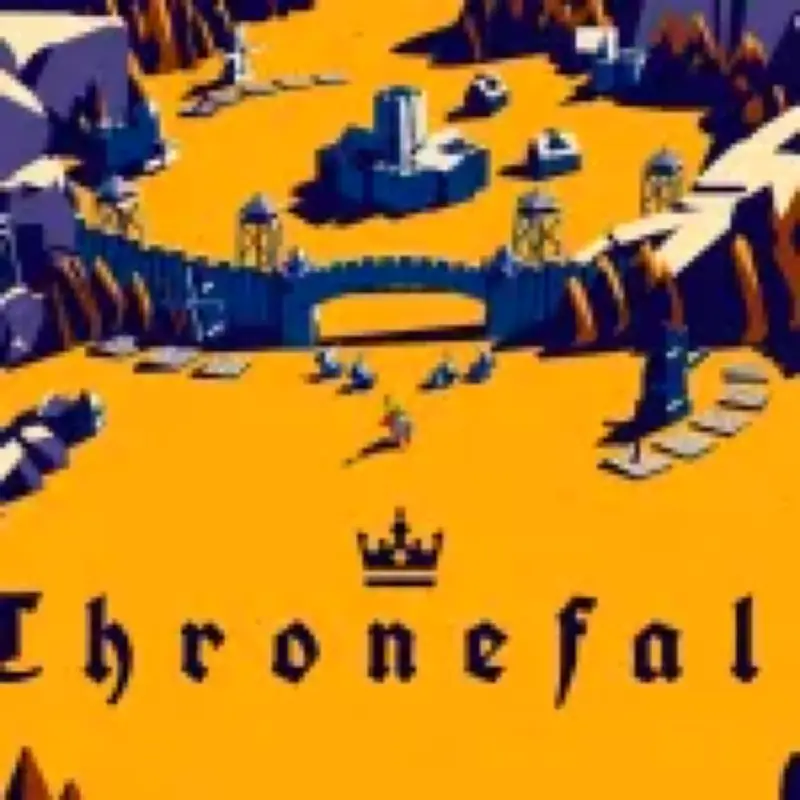
Thronefall is an elegantly designed twist on the tower defence genre, putting you in control of a heroic monarch who must defend a central castle against waves of invaders. The game, developed by Grizzly Games and published by Mythwright, launched on 11th November 2026 for PlayStation 5, Nintendo Switch, Xbox Series X/S, and PC, priced at £11.69. Our review scores it 8/10.
A fresh take on tower defence
Unlike many mobile game ads that promise gameplay far more interesting than the actual product, Thronefall delivers exactly what it appears to be. The minimalist presentation and the king galloping on a tiny horse to collect gold coins evoke those misleading advertisements, but here there is no subterfuge. Instead, players find a well-designed, highly playable game with a puzzle-oriented approach to the genre.
You control the king, who serves as defender, protector of resources, and your avatar on the battlefield. During in-game days, you ride over to towers to upgrade them or order construction of new buildings, some generating gold while others enable research to buff your defences. At night, the king helps combat waves of enemies that arrive in many forms, including flying and land-based foes, plus a memorable giant that rises from the water.
Balancing economy and defence
Damage is automatically repaired at night, and all surviving resource buildings generate income used to buy and upgrade defences. This creates a crucial tension between economy and defence: every gold coin spent on increasing future revenue cannot be spent on defensive structures, leaving you slightly weaker for that night's assault. It is a continual balancing act, initially easy to manage but prone to catastrophic errors as you dig deeper.
Each map offers six crowns for completion. The first simply requires winning, while the rest demand victory with specific buffs and debuffs equipped. These debuffs downgrade aspects of your king, buildings, or resource generation in return for greater experience point rewards, making decisions more consequential.
Strategic depth and mini-modes
Maps generally take 13 to 15 in-game days to complete, and you can retry each day, though you receive an additional bonus for not doing so. Notably, this is one of few tower defence games that does not let you sell or demolish towers. Accidentally choose the wrong one, or erect an unintended building, and you are stuck with it unless you restart that day.
Towers and buildings can only be placed on pre-defined nodes, with your agency coming from when to build and which upgrades to apply. Resource buildings can only be improved to generate extra coins, but defensive turrets benefit from up to three rounds of improvement, each offering four options once unlocked. This allows optimisation for radically different use cases, from sniping to pouring fiery boiling oil over nearby enemies.
After the campaign, puzzle-like mini-modes provide specific set-ups requiring near-perfect accuracy in every choice. They are savagely difficult but very satisfying, a quality reflected throughout the game. Its initially gentle learning curve steepens considerably, making victories more fulfilling. The sound design is beautifully engineered, with the jingle of gold, the fanfare at each night's attack, and the victory drums all resonating distinctly.
With minimalist visuals and a refined set of variables within each map's rigid framework, Thronefall offers a unique spin on the genre. The inability to sell or demolish towers, moments of frustration from difficulty spikes, and the rigidity of its design are noted drawbacks, but the welcoming learning curve, rewarding experimentation, and brutal mini-modes make it an easy game to recommend.