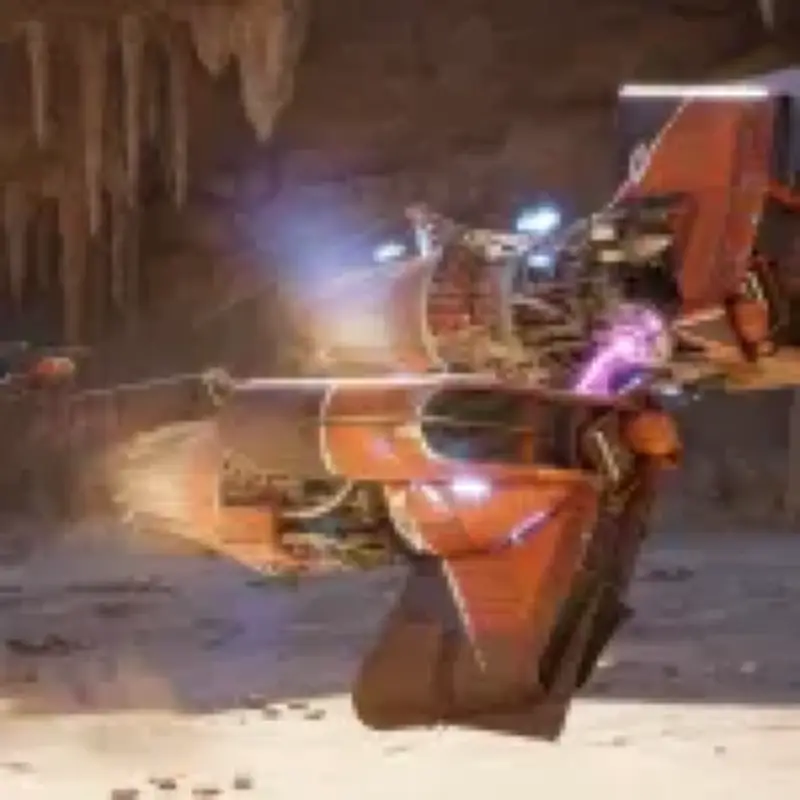
Star Wars: Galactic Racer is the first Star Wars racing game in over two decades, and it's shaping up to be a worthy successor to classic sci-fi racers like F-Zero. We went hands-on with the game and spoke with creative director Kieran Crimmins about its development, the return of podracing, and what fans can expect when it launches on October 6, 2026.
A long-awaited return to podracing
The last podracing game, Star Wars: Racer Revenge, was released on the PlayStation 2 in 2002. While its sense of speed still holds up, the visuals have aged poorly. In contrast, Star Wars: Galactic Racer, over 20 years later, aims to deliver the wish fulfillment that podracing fans have been craving, with added layers of depth that go beyond a simple nostalgic retread.
The game combines land speeders, speeder bikes, skim speeders, and podracers into one package. While the first three vehicle types can race against each other, podracers are separated into their own modes. Creative director Kieran Crimmins explained that this separation is due to canon and gameplay variety, as podracers are much faster and more fragile than the other vehicles.

Gameplay mechanics and vehicle handling
In our preview session, we were introduced to the lower-grade vehicles in a tutorial that highlighted their unique traits. Land speeders are all-rounders with high durability. Skim speeders excel at tight corners with a vertical 'knife-edge' drift, while speeder bikes get a small boost when launching from drifts, similar to kart racers.
The core racing mechanic revolves around managing two boost systems: basic turbo thrusters and the ramjet. The ramjet is designed to batter opponents into walls or obstacles, and both are tied to cooldown meters, with the ramjet risking overheating if used for too long. The skill lies in managing these thrusters while navigating tracks filled with acid pools, lava pits, and claustrophobic caves at high speeds.
Crash spectacle and podracer intensity
Like F-Zero, the sense of velocity is immense. Crashes are spectacular, with the camera dramatically swinging in slow motion when you cause another racer's demise. The same pageantry applies to your own crashes, and while it can be frustrating to make a miscalculation, the slick crash theatrics alleviate the frustration.
Podracers are described as Formula One-esque glass cannons, with increased speed and fragility. Mechanically, podracing is similar to other vehicles, but the heightened speed and fragility force a different approach, feeling true to the Star Wars universe.
Campaign and multiplayer modes
The single-player experience includes an arcade mode with pre-determined conditions and a story-driven campaign with roguelike elements. The campaign is structured like Star Fox, with stages on a grid of branching pathways, progressing across planets, and buying upgrades to conquer the Galactic League. Stages include standard races, eliminator races, and field tests, which are minigames requiring you to use the ramjet a set number of times over three laps.
The multiplayer mode, Multiplayer Tour, allows up to 12 people to compete over a series of races, with the ability to buy perks and attribute points between events. You can also bet on your placement in the next race to earn more credits and assign yourself a rival. The tour culminates in a Championship, an extended race with fully customised rides.
After playing for around two hours, we didn't want to stop. At a time when WipEout and F-Zero have faded into obscurity, this looks destined to be not only the best Star Wars racing game ever made, but a triumphant comeback for sci-fi racers.
Interview with Kieran Crimmins
Following our hands-on, we spoke with Kieran Crimmins about the origins of the game and its setting. The game is set after the Battle of Yavin, between that and where The Mandalorian starts, five years after Return Of The Jedi. The Empire has fallen, and the Galactic Racing League is being formed as a post-war celebration of speed, inspired by the post-World War II resurgence in drag racing.
Crimmins confirmed that the story is canon, developed in close collaboration with Lucasfilm. When asked about Sebulba's appearance, he said that Lucasfilm confirmed the character is alive in this timeline, so he is an integral part of the story.

On the roguelike campaign, Crimmins explained that the goal was to add consequence, depth, and agency, making every upgrade and race feel meaningful. The decision to separate podracers from other vehicles was due to canon speeds and the desire to keep them as the fastest, most fragile, and most frenetic vehicles.
Regarding the crash physics, Crimmins said it's a combination of camera tricks, physics hacks, and predictive technology, developed by a team with a strong heritage in racing games. While Fuse Games doesn't see itself as a genre-specific studio, the team's passion for racing is clear, and they are likely to make more racing games in the future.