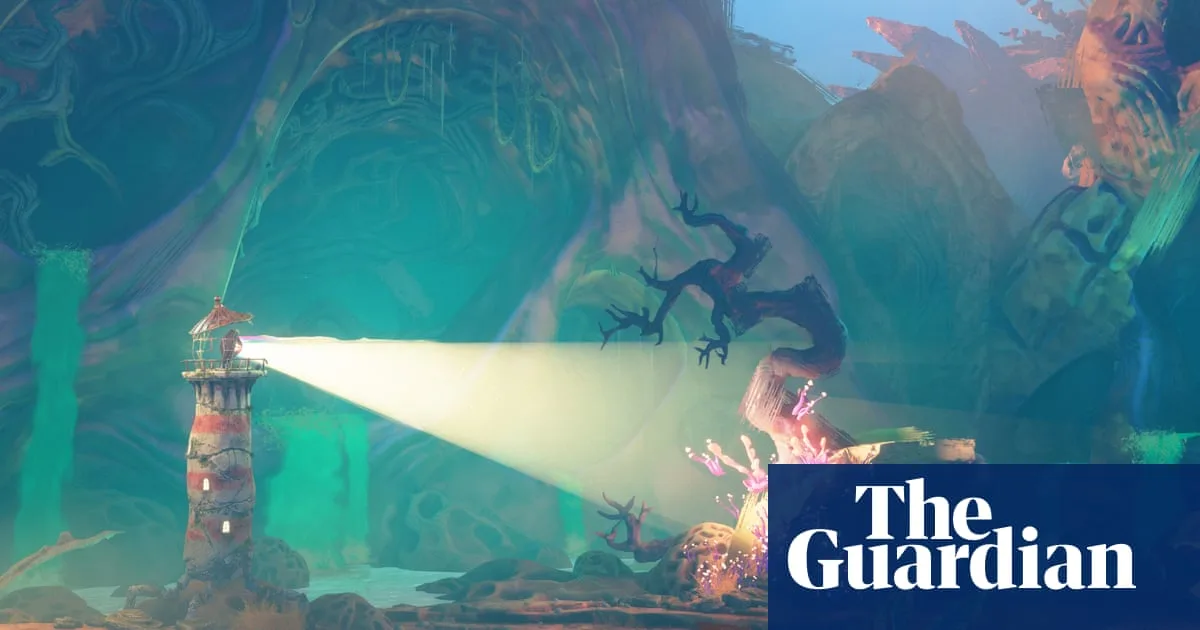
Double Fine's latest game, Keeper, is a whimsical action-adventure that may be the oddest title ever published by Microsoft. Set in a far-future, iridescent New England where organic and inorganic matter mingle, players take on the role of a lighthouse that has inexplicably come to life, sprouting tiny legs to carry its wobbly body. The protagonist is an unlikely star in a sea of action heroes, but creative lead Lee Petty believes there is an intuitive logic to it: 'You have a light, and light has a very strong connection with life.'
The lighthouse's beacon is the primary means of interaction. In 'unfocused' mode, the beam causes foliage and creatures to grow and morph; in 'focused' mode, it concentrates power to transform larger objects and solve puzzles. The game's world is a psychedelic blend of purples and greens, featuring bioluminescent rock formations, giant flower-headed tendrils, and a whale-like creature floating through the sky. This ecological extravaganza draws inspiration from 1980s fantasy films like The Dark Crystal and The NeverEnding Story, as well as real-life biology.
Petty conceived Keeper during the Covid lockdowns, walking in the foothills near his San Francisco home and meditating on a post-human Earth. He read about mycelium networks and watched movies on ecosystems, which coalesced into a 'fever dream' of a weird island where life has evolved in unexpected ways. The game was developed after Double Fine was acquired by Microsoft, and the new management gave Petty time and resources to explore his experimental idea.

Keeper offers a languorous, dreamy experience with no mission objectives or pop-ups. 'You're not rushed along,' says Petty. 'You're kind of left to dwell in the space.' However, the game's celebration of life is funded by Microsoft, whose Azure platform has been used to facilitate airstrikes in Gaza, leading to calls for a boycott from the BDS movement and criticism from unionised workers at Microsoft-owned Arkane. Petty stresses he is far removed from such decisions.