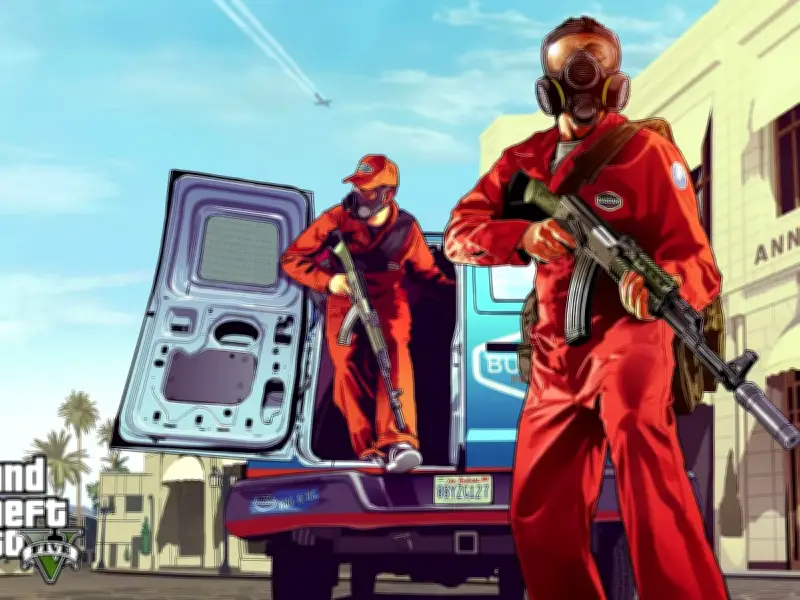
The global release of Grand Theft Auto VI marks the latest chapter in a franchise that began with a redundancy from a Dundee watch factory. David Jones, then 22, was laid off by Timex in 1987 and used his payout to buy an Amiga 1000 computer, setting him on the path to creating one of gaming's most successful series.
From Factory Floor to Game Design
Jones's first game, Menace, released in 1988, sold 15,000 copies on early consoles such as the Amiga and Atari ST, earning him £20,000. This success led to a six-game publishing deal with Psygnosis and the founding of DMA Design, where he recruited friends from Dundee's Kingsway Technical College computer club, including programmer Mike Dailly.
The duo created Lemmings in 1991, a puzzle game that became a smash hit. "In a world dominated by killing stuff, that definitely flipped the tables," Jones said. "You were looking for anything that was kind of different. I didn't know if it was going to be good or not but at least it was different."
The Birth of Grand Theft Auto
Jones, then 25, used his earnings to buy a Ferrari, but his passion for driving games led to the next project. "I loved driving," he said. "I loved the idea of a driving game. But it's hard to innovate in pure racing. If I was going to do a car game, a driving game, I wanted to do something a little bit different."
The result was Grand Theft Auto, initially conceived as Race N' Chase, where players controlled a police squad car. However, the concept proved boring. "Nobody liked playing the good guys," Jones added. "Everybody wanted to just get in the car, steal a car, go crazy. What they really wanted was to see how the city would react to the crazier stuff that they did."
A glitch gave the game its signature chaos. "One day, I think it was a bug, the police suddenly became mental and aggressive," said developer Gary Penn. "It was because they were trying to drive through you. Their route finding was screwed, I think. That was an awesome moment because suddenly the real drama was 'Oh my God, the police are psycho – they're trying to ram me off the road.'"
Controversy and Commercial Success
Financial difficulties led Jones to sell the studio in April 1997, months before Grand Theft Auto's November release. The game courted controversy from the start, aided by publicist Max Clifford, who planted stories condemning its "extreme violence."
"He was very smart. He literally laid out weeks of planning," Jones, now 61, said. "'I'll say this. This will happen. This guy in the House of Lords will make a statement. We have our agent, and you'll get on breakfast morning TV. This will be said.' And everything he said, down to the day, happened."
The game sold six million copies on PlayStation and PC. A 1999 sequel sold just over a million, but it was Grand Theft Auto III in 2001, the first 3D title, that created the modern phenomenon, spawning spin-offs set in Vice City and San Andreas.
Legacy and New Release
By that point, Jones and the Dundee crew had moved on. "I get bored quickly," he explained. "For me, it's all about new ideas and pushing the boundaries. After two or three versions of the game, I'm chomping at the bit to do something new. At that point, GTA was so big that I knew it was going to be the focus of the studio from now until eternity, which it still is, in Edinburgh."
With eight main games in the series and stars like Samuel L. Jackson, Burt Reynolds, and Debbie Harry, Grand Theft Auto VI is now available on PlayStation 5 and Xbox Series X|S, tipped to be the biggest entertainment release in history.