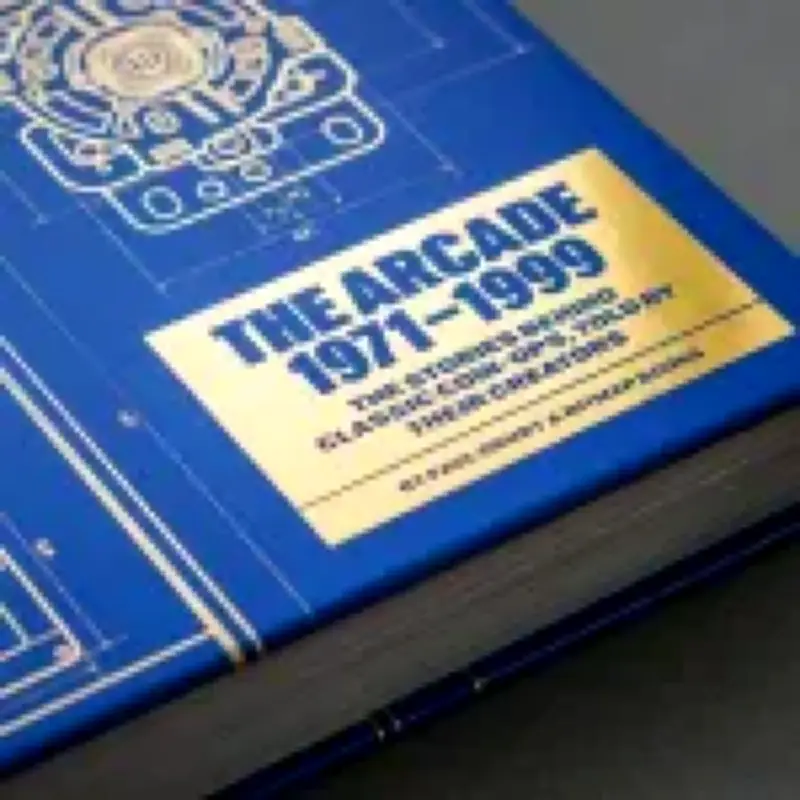
Paul Drury, author of the new book The Arcade 1971–1999, speaks to GameCentral about the history of coin-operated video games and their enduring appeal, as arcades enjoy a resurgence in popularity.
From chip shops to swimming pools: the arcade experience
Drury, who was born in 1970, has grown up with the games he writes about. He explains that the book is not just about nostalgia, but about the people who made the games. For every entry, he includes insights from the actual creators, something that was hard to discern in the early days of coin-ops.
He recalls how games like Food Fight started with a simple idea from Jonathan Hurd, who wondered what could be done if a button didn't always mean fire. That led to throwing custard pies. Similarly, The Pit by Andy Walker began as a technical error in a spaceship game, where flying back through your own tail erased the trail, inspiring a digging mechanic.
Drury notes that the experience of playing in public is unique. He mentions that many people associate Space Invaders with the smell of vinegar or chlorine, as machines were often placed in chip shops and swimming pools. This sensory memory is part of what makes arcades special.
The social dynamics of public play
The social aspect of arcades was crucial. Drury highlights how games like Gauntlet were designed for four players, despite management doubts that strangers would play together. The game's voice programming, by Bob Flanagan, even goaded players with lines like "Wizard is taking more treasure than others!"
Coin-ops were also meta-games, with players sharing tips and rumors. Drury recounts how people wrote to Atari about a supposed secret cave in Battlezone, which didn't exist, and about a player threatening to sue over the unreachable "homeworld" in Major Havoc.
From Pong to Pac-Man: the evolution of arcade games
Drury explains that arcades in Britain predate video games by decades, with the oldest continuously operating arcade in Great Yarmouth dating back to 1902. The first coin-op video game, Computer Space (1971), was loosely based on Space War (1962), and only about 1,500 units were sold, but it convinced Nolan Bushnell and Ted Dabney to found Atari.
Pong was a massive success, with Atari producing about 35,000 units, and it was widely copied. The period between Pong (1972) and Space Invaders (1978) is often overlooked, but Drury calls it the "Bronze Age," when many genres like overhead racers and maze games began.
The decline and revival of arcades
As home consoles became more powerful, arcades declined in the late 1990s, but they never fully disappeared. Drury credits Raw Thrills, founded by Eugene Jarvis, with keeping the coin-op business alive. He also notes that arcades have seen a revival in the last decade, with venues like Arcade Club, NQ64, and Four Quarters celebrating both old and new games.
Drury believes that coin-ops were essential to the video game industry, making games accessible to the public and turning them into commercial products. He says, "You wouldn't have GTA 6 if coin-ops hadn't made making games into a business." The book includes 20 games from the 1970s, 70 from the 1980s, and 30 from the 1990s, reflecting the eras that most people remember.