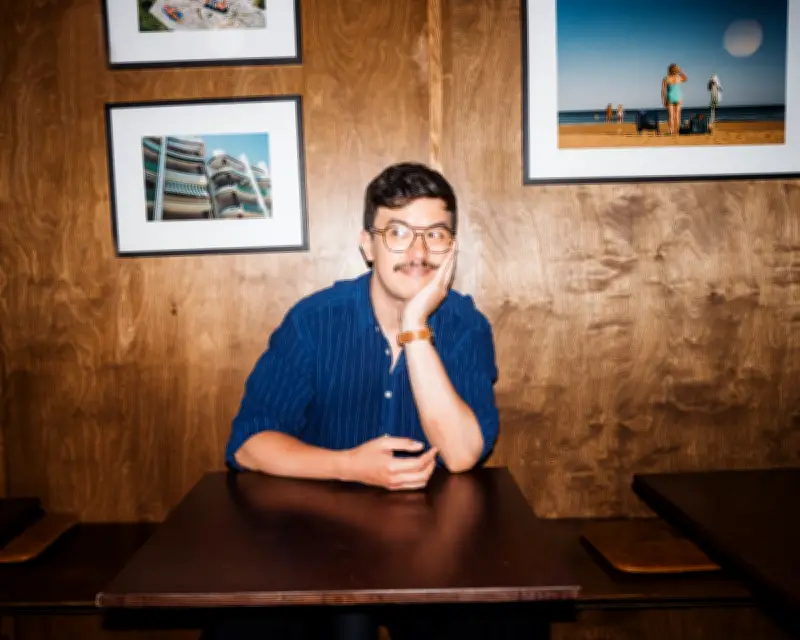
In a London cafe, Phil Wang, the 36-year-old standup with a pleasantly befuddled air, sits wearing high-waisted baggy black trousers, a blue shirt, salmon New Balances, and a baseball cap reading 'Chump'. Most notably, he sports a moustache. Wang went public with his facial hair two years ago, but his upcoming tour for the new show, Uh Oh, marks its first road trip. 'I've got five minutes of standup on it now,' he says. 'Until I come up with a better five minutes, it's staying.'
A Moustache and Ageing Themes
The moustache announces one of the show's themes. 'It's partly about ageing, so the moustache is a visible marker of trying to do that with grace.' Age-related anxieties have long been part of his routines. On stage a decade ago, he said, 'People often think I'm older, because although I am 26, I look terrible.' At 31, he joked, 'I'm getting to that age when most of my friends are having podcasts.'
But Uh Oh addresses a cultural shift specific to the mid-2020s. 'I find the ageing of millennials fascinating,' Wang explains. 'The show is about the recent end of the woke age and how it has coincided with millennials ceding cultural control.' He experiences this by finding online content more incomprehensible and people more irrational. 'Sometimes I'm like, 'Oh, I'm maturing.' When it feels bad, it's more like, 'Oh no, I'm becoming an old cunt.''
The Vibe Shift and Political Climate
The title marks a departure from his Netflix specials Philly Philly Wang Wang and Wang In There, Baby!. He considered calling it The Vibe Shift Is Real but worried the term would age. The shift he references is the dramatic lurch to the right. 'It's there in young gen Z men in response to the progressive age they grew up in, and in older people who think the country changed too quickly.' The re-election of Donald Trump felt like the final nail in the coffin of identity politics. 'The woke age was primarily invented by millennials on social media; Twitter was the main engine of cancel culture, and when Twitter died, the engine lost power.'
Wang may be the standup needed to lower the temperature. As an equable comic, his approach is to reassure and reason rather than hector. 'Politically, I always give them the benefit of the doubt. That felt especially worthwhile when progressive people were being ungenerous with supposed transgressions.' In his 2021 book Sidesplitter, he questioned the distinction between 'person of colour' and 'coloured person', calling it 'a trap intentionally designed to catch people out'.
'The underlying problem for the left,' he says, 'was they were so starved of real victories that they became addicted to small ones. Changes of language were attainable, while political victories remained out of reach.' Wang jokes he now identifies as POC: 'Phil, of course.'
Touring in Divided Times
Heading out on tour in a country where race and identity are inflamed, Wang remains optimistic. 'In divided times, extremists and populists take advantage of concerns. They give people ways to express frustrations, which can take the form of a flag. But on an individual basis, people tend to be more reasonable. Sometimes, a St George's cross is just a blunt instrument to say: 'I'm not happy.''
Recent live experiences show a craving for positivity. 'It used to be that you'd play somewhere and say, 'This town's a bit crap', and people would laugh. Now they get pissed off. They've become protective of their own community. I love this country, and that makes me feel prouder to be out on the road as a semi-immigrant.'
His ambition remains the same: 'You want to do the best comedy you can to as many people as you can. I was never trying to be alternative. I've always been mainstream.' He defines mainstream comics as thinking of the audience first, alternative comics thinking of themselves first. 'Getting big laughs in a big room is something I always pursued.'
Wang has seen fellow comics seduced by being alternative. He came close in 2015 with a show about meditation and long-distance relationships. 'It was a bid for the Edinburgh comedy award. I coined 'Fringe Derangement Syndrome' for when comics pander to that one month, one panel of judges.'
Uh Oh will stop at the fringe, but he has other projects, including a film career. His two minutes in Wonka dancing with Timothée Chalamet drew attention, and he played a grumpy manager in Finding Emily. In downtime, he reads PG Wodehouse's Jeeves and Wooster stories. 'They're amazing. It's like Frasier!' He eyes me warily when asked about writing a novel, then relaxes: 'I'd definitely like to give it a try.'
Wang has mined his background extensively but says it's about developing skills to transform unexplored parts. 'Sometimes you have a memory that you're not good enough to make a routine out of until later. I think of memories as like in an RPG where you pick up a level-30 sword early on but you're only level five and have to wait until you can use it.' I cotton on late: he means computer games. 'Video games, yeah,' he corrects me. It's a small chance for the millennial to give this gen Xer a vocabulary lesson and prove that Old Wang's not so old after all.