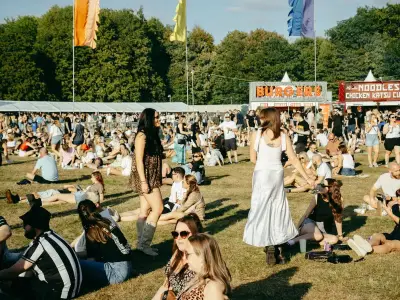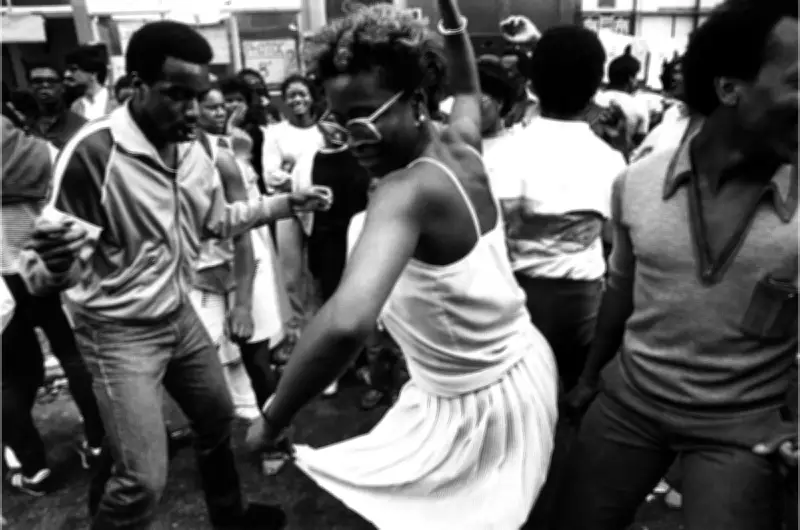
Notting Hill Carnival is preparing to celebrate its 60th anniversary in 2026, an event that has grown from a small Caribbean community gathering into London's biggest annual party, drawing over two million people to the streets each August bank holiday.
At a launch event in July, a mini-parade featuring feather-clad dancers, stilt-walkers and a sound system playing Caribbean soca music offered a taste of the full celebration. "It's exciting, the anticipation now, waiting for August to come," says Gladwin Wright, mainstay of Carnival's ska and reggae Gladdy Wax sound system since the late-1980s. "You get people spending their holiday in London at this time, from abroad. When I turn up [at Carnival] on Sunday morning, people make jokes, they say, 'Gladdy, where you been, man? We've been waiting since last year!'"
Born from resistance
In 1959, following race riots and the murder of 31-year-old Antiguan Kelso Cochrane, journalist and activist Claudia Jones organised a steel band and calypso Mardi Gras to counteract disintegrating race relations. That first event took place at St Pancras Town Hall. Seven years later, activist Rhaune Laslett organised the Notting Hill Fayre and Pageant, featuring processions of children in Charles Dickens characters and bands of Irish pipers, New Orleans brass and Trinidadian steel drums.

"They put their pans round their neck and came through the streets playing music," says long-time Carnival costume-maker and current board member Allysson Williams. "By the time they came to Ladbroke Grove, there were about 500 people following them. From then, it happened every August bank holiday."
In 1973, new director Leslie "Teacher" Palmer obtained permission to introduce static sound systems around Ladbroke Grove, where floats of costume and steel bands from the Caribbean paraded for the first time. Even by the time Williams and her husband Vernon launched their own mas band Genesis in 1980, the event was still somewhat wild at heart. "There was no route, there was no structure," Williams remembers. "The bands just went everywhere, anywhere they wanted, and policemen would move the crowd aside. It was amazing."
Overcoming hostility and negative press
Security became a priority following riots and police hostility in the 1970s, when authorities hoped to prevent the then-unlicensed Carnival taking place altogether. A savage press sought to demonise an event that, according to a 2019 report, proportionally has no more arrests each year than many other major festivals. "Spiteful people," Wright says, arguing that Carnival has survived such negativity because of the fundamentally positive power behind it. "They try to smear it. 'Lock it down, lock it down.' Because it's a black people thing. But the positive can withstand all the negative they give it."
All involved agree that Carnival is an essentially apolitical celebration, its brilliance rooted in the way it reveals the true, welcoming and uplifting spirit of London's Caribbean communities. "This is what we want," Williams summarises, "not to be fighting you."
Now Gen Z DJs are driving Carnival's sound
As a generational happening, Carnival constantly evolves. The costumes have shifted towards tropical flamboyance, the parades towards an open-arm policy including all nations from Brazil to Poland, and the sounds towards modern Caribbean strands: bashment soca from Barbados, the Gen Z revival in Dominica's bouyon music, the trap-inflected Trinidad sounds of zess. "Every 10 years the sound changes bit by bit," says Jada Pink, one of Carnival's rising next-gen DJs. "A lot of people have been involved in carnival since they were young, so it will always roll on to the next generations. We always need young people to keep it fresh, to come up with new ideas, to move with the times."
Yet Carnival's foundational spirit endures. "The meaning of Carnival is that it's a celebration of our resilience, of our heritage, our culture," says Williams. "It started off in Trinidad as a celebration of the emancipation of slavery, and it has come through the decades as something like that, where we dedicate a certain type of creative arts to acknowledging our ancestors, appreciating them. Celebrating all that they went through, those who died for us, and celebrating the culture that they left behind in terms of what they brought from Africa to enhance their communities."

"Everybody has got something to bring to carnival," says Palmer. "It's unity, coming together and embracing everybody else's culture. We like to share, so we shared our music with everybody else. Come and enjoy yourself." Ross, meanwhile, tells it from the heart. "The spirit of Carnival don't change because we've still got the spirit in us," he says. "I love my culture. I love being a West Indian. I love being me. That's what carnival means to me every year. All these people that feel the same way I do, coming together."