Leah Purcell's operatic retelling of Henry Lawson's classic Australian bush tale opens with an invitation: a whispered incantation and singing in language, as Wiradjuri soprano Shauntai Abdul-Rahman calls us to listen, look, learn. At the centre of the stage an older woman (Jeanette Fabila) wearing ceremonial headdress sits cross legged. Clap sticks sound as dancers arrive on stage, coalescing in something like a corroboree. In the audience, we sense that we're participants in something ceremonial and salutary.
A story expanded through opera
It immediately signals the significance of this latest iteration of Purcell's story, composed by George Palmer (Cloudstreet) for Opera Australia and Queensland Performing Arts Centre (where it premiered in May). Starting with her acclaimed 2016 stage play, and in subsequent novel and film versions, Purcell – a Goa Gunggari Wakka Wakka Murri woman from Queensland – has used Lawson's short story about a “sun-browned bushwoman”, who spends a tense night guarding her four children against a snake, as a springboard for a postcolonial feminist western that tells ugly truths about colonial Australia's treatment of women and first peoples.
Opera presents a distinctive opportunity for this project: a space where dance and song can combine with storytelling to produce a more holistic and ritual experience. A form of narrative that works not only on the brain but also the body. A perfect form for truth telling, perhaps.
Molly Johnson's story
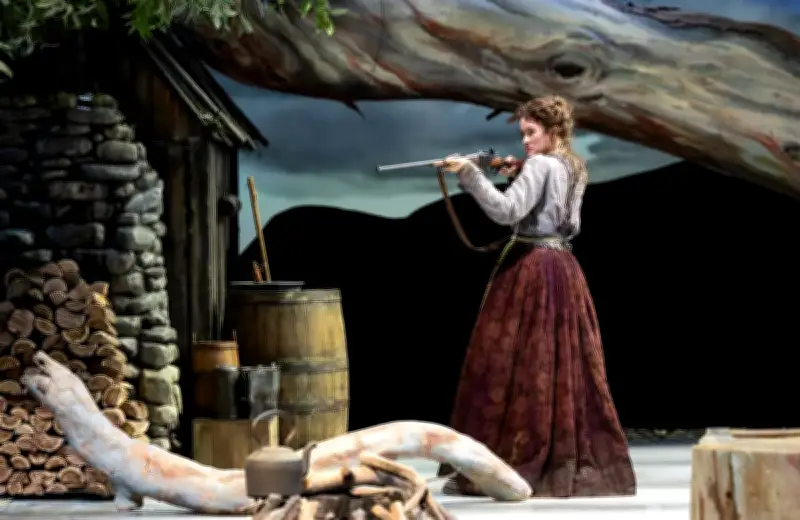
In Purcell's story, Lawson's woman has a name, Molly Johnson (sung here by Nina Korbe, Purcell's niece), and a country: the lands of the Ngambri Walgalu, in Victoria's majestic high country. Molly has a rich backstory and inner life – and a shotgun she knows how to handle. We spend several days with her and her eldest son Danny (Nick Smith) as they fend off a series of variously menacing and malevolent white male intruders, with the help of an unexpected ally: Yadaka (Marcus Corowa), a Guugu Yimithirr man adopted by the Ngambri Walgalu, on the run from the authorities. He is gentle and kind, and gifts Molly with key knowledge about her identity and heritage; he also provides a much-needed role model for Danny. The “stray black fellow” of Lawson's story – maligned for building the wood-heap hollow – is recast as a hero.
Molly and Danny and Yadaka's story becomes a prism through which to refract post-settlement race and gender relations, a framework to assert knowledge and culture, and a reclamation of the national narrative.
Libretto and music
The libretto, co-written by Purcell and Palmer, uses the play as a template (lifting dialogue and keeping the vernacular, “fucks” and all) but expands the story, fleshing out the Aboriginal characters and tightening the focus on love and relationship, particularly between Molly, Danny and Yadaka. The poetic realm of opera, unshackled to naturalism, also allows Purcell to reach into Molly's memory, to explore her relationship with her father; and into her Dreaming, as she explores her relationships with her mother, Black Mary (Abdul-Rahman), and her aunt, the medicine woman Ginny May (Fabila).
Opera excels at expressing relationships, and Palmer crafts gorgeous duets that embody the entwining of souls. Through the dance (choreographed by Yolande Brown) the spiritual dimensions of the story are made manifest, as the dancers represent ancestors and spirits, and connection to country through ceremony.
Set and sound
Everything is held within the stunning set design of Isabel Hudson, conjuring alpine country through a mix of video (Craig Wilkinson) and lighting (Karen Norris), and foregrounded by a massive, improbably curved snow gum that wraps protectively around Molly's home. The effect is something like stepping into a William Robinson landscape, all disrupted perspective and no horizon line; the colonial gaze disrupted.
Palmer's music, which is supplemented by Walgalu song and chant and vivid sound design by Michael Waters, is pleasing but not overbearing, underscoring tension, drama, character, emotion. It is most effective (and beautiful) when operating in a romantic register, but is less consistent in its treatment of the darker material. Some of the most violent parts – descriptions of the murder and sexual assault of children, and depictions of murder, rape and racial and gendered violence – might be better represented by uglier sounds. Likewise, moments of grief sometimes feel musically muted. When he leans into a more dissonant register – as in scenes where Yadaka recounts the massacre of his family, and Molly collapses in grief while her mother keens over her – the emotional effect is powerful.
Performances
The performances are uniformly excellent, though Korbe in particular is outstanding, both vocally and in her nuanced and affecting characterisation of Molly, a battered and embattled woman who has not lost her tenderness and capacity for love – or her fighting spirit. The Drover's Wife is on at Sydney Opera House until 15 August.