Every summer, hundreds of Italian villages host sagre—traditional local food festivals that turn streets into open-air dining rooms. These events are not quite food markets nor village fetes; they are like the whole village moving its kitchen outdoors for a few nights. For locals, sagre are the proper way to get through summer, and they make a meal possible for about €15.
Puglia: Farmer's Festival and Snail Feast
In Salento, the heel of Italy, the Sagra tu Furese takes place in mid-August at Mancaversa, the seaside part of Taviano. In Salentino dialect, the name means farmer's festival. Villagers gather near Piazza delle Rose, where men fan embers with cardboard, sausages hiss on grills, horse-meat stew simmers in tomato sauce, and gnummareddi (rolls of lamb offal) are offered to the adventurous. Music comes from a small stage, turning the village into an open-air sitting room.
About 400 miles north, in Cannole (a town of just over 1,500 people), the Festa della Municeddha runs from 10-14 August. Since 1985, the local Pro Loco Cerceto volunteer association has dedicated this festival to the small snail that has long been part of home cooking. The municeddha is eaten in three main ways: in tomato sauce, cooked down with onion and oil, or roasted. Whichever version, the method is the same: you free it from the shell with a toothpick and eat it standing up. Today, the festival is large, with music, stalls and full tables.
Marche and Campania: Pasta Festivals
In Campofilone, Marche, the Sagra dei Maccheroncini di Campofilone IGP (7-10 Aug) has been held since 1964. This festival features an extremely thin local pasta called maccheroncini, made with semolina and eggs and cooked in one minute. Once drained, the pasta is tossed through red mixed-meat ragù on large wooden boards, where the fine strands become a compact mass, glossy with sauce, ready to be served.
Further south in Felitto, Campania, the Sagra del Fusillo Felittese (13-23 Aug) celebrates fusillo pasta—long, hollow rolls made by hand around a thin iron rod. The festival began in 1976 at Remolino to bring people to the village. The pasta is served with castrato ragù (traditionally made with goat from a castrated male animal) or with veal ragu.
Emilia-Romagna: Tortellini Traditions
Castelfranco Emilia, between Modena and Bologna, holds the Sagra del Tortellino Tradizionale in Piazza Bergamini from 4-14 September. Legend says the tortellino was born here at Locanda Corona, when an innkeeper glimpsed Venus's navel through a keyhole and took it as his model. The pasta is thinly rolled egg pasta folded by hand around a filling of pork loin, prosciutto di Modena, mortadella di Bologna, parmigiano reggiano, egg and nutmeg. It is served in hot capon broth. The square fills with long tables, people queue at cash desks, and bowls of hot broth arrive one after another. Later, a parade leaves Corso Martiri like a small Renaissance pageant with women in brocade gowns and veils, men in caps and doublets, banners, music, and the innkeeper and noblewoman at the centre of the navel story.
Alto Adige: Alpine Dumplings
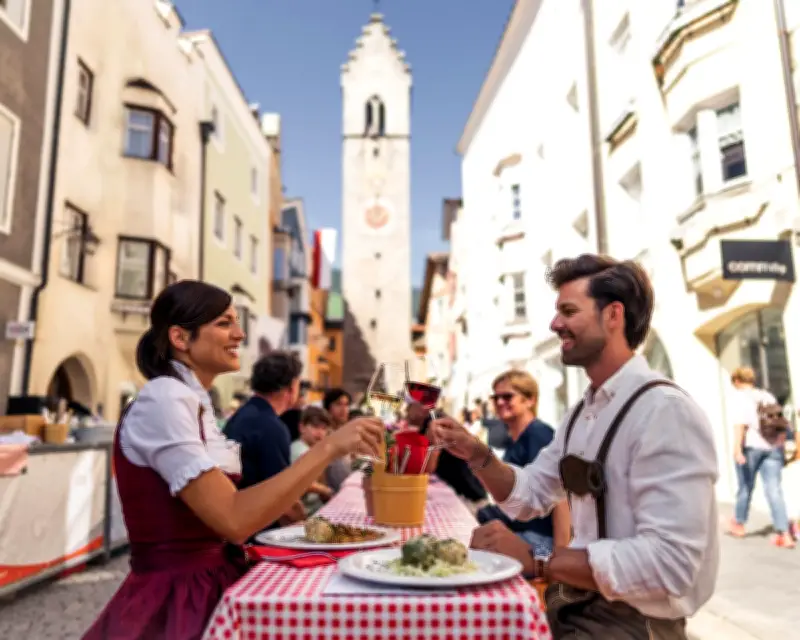
In Vipiteno, Alto Adige/South Tyrol, the Sagra dei Canederli takes place on 13 September. It feels less like a fair than an alpine dining room laid out in the street, with a 400-metre table laid with gingham tablecloth in the historic centre. Plates of canederli—dumplings made from stale bread, eggs and milk—arrive. They come in broth, with speck, mushrooms, cheese and herbs; or sweet with apricots or plums. Folk music plays in the square, and the mountains seem part of the meal.
Sicily: Sweet Onion Feasts
Giarratana, in south-east Sicily, is known for its large, flat, particularly sweet onion. The Sagra della Cipolla Giarratana (12-14 Aug) is traditionally linked to the feast of San Bartolomeo. The onion fills markets, food stalls and tables along the village streets. It is served raw, finely sliced and dressed with olive oil, salt and cheese; baked whole or stuffed; or inside scaccia, a local speciality similar to a thin, folded focaccia. There are also hot dishes, preserves, local wine and music. Giarratana is small, so it is worth arriving before dark, parking outside the centre, and if accommodation is full, staying in Ragusa, Modica or Chiaramonte Gulfi.