London Fashion Week Embraces Tactile Accessibility with Innovative Touch Tours
During the bustling schedule of fashion month, runway presentations traditionally captivate audiences through visual spectacle—the dramatic flow of silhouettes, the shimmer of intricate embellishments under bright lights, and the precise choreography of models moving to curated soundtracks. However, at designer Chet Lo's latest autumn/winter 2026 showcase during London Fashion Week, the experience commenced well before the first model stepped onto the catwalk, beginning instead with the sense of touch.
A Revolutionary Approach to Fashion Inclusion
Prior to the main runway event, blind and low-vision guests were invited to participate in a specialised "touch tour," an initiative developed as part of the Hair & Care programme. This programme was originally founded in 2019 by acclaimed hairstylist Anna Cofone, who has collaborated with high-profile artists such as Dua Lipa and Lana Del Rey. Growing up with a blind father profoundly influenced Cofone's perspective, making her expansion into fashion accessibility feel both natural and essential.
"We have witnessed firsthand the significant impact that self-care, hair, and accessible beauty services can have on blind individuals' confidence, empowerment, and sense of identity," Cofone explains. "Therefore, it seemed an organic progression to also bring fashion to the forefront, ensuring it becomes accessible for blind and low-vision people."

Collaborative Efforts Enhancing the Experience
The Hair & Care initiative first partnered with Chet Lo in 2024, and their collaboration has now spanned three consecutive seasons. For the latest event, support was provided by global brands including Philips Sound, which supplied headphones for blind attendees, and the haircare brand Authentic Beauty Concept. Cofone views this growing corporate involvement as clear evidence that the fashion industry is gradually shifting towards greater inclusivity.
"Companies are increasingly recognising the necessity to be inclusive and accessible for blind and low-vision individuals," she states emphatically.
How the Touch Tour Operates
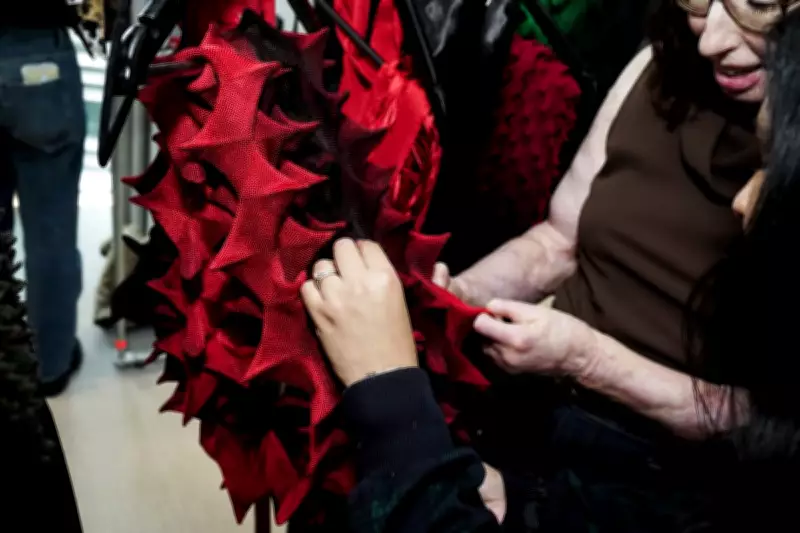
The concept behind the touch tour is elegantly straightforward: it allows guests to experience garments through texture and detailed storytelling before these pieces are presented visually on the runway. "The primary aim of the touch tour is to offer guests a chance to meet the designer in person, but more importantly, to feel the key collection pieces up close," Cofone elaborates. "This approach helps to create a much stronger visual interpretation for attendees as they listen to audio descriptions while the models are on the catwalk."
Chet Lo's distinctive work, renowned for its sculptural silhouettes and three-dimensional spiked knits, naturally lends itself to tactile exploration. Audio descriptions were meticulously prepared over a week in advance, with the final running order confirmed the night before the show to ensure seamless alignment between the tactile preview and the visual presentation.
Personal Impact on Visually Impaired Attendees
For visually impaired attendee and activist Catrin Pugh, the touch tour delivered a profoundly transformative experience. "Fashion has always felt somewhat out of reach for me," Pugh shares. "As a visually impaired person with no central vision, I cannot perceive fine details. Consequently, engaging with fashion has been particularly challenging because detail is absolutely everything in this industry."
The touch tour fundamentally altered this dynamic. "Attending the touch tour provided me with an opportunity to explore all those minute elements that designers spend hours, days, weeks, months, and even years perfecting to establish their personal brand identity," she continues. "I had the chance to see and feel these details, which made an enormous difference. When I subsequently watched those looks coming down the runway, I felt I could still be part of the experience—something I had never felt before in fashion."

Pugh emphasises that texture is central to Chet Lo's creative appeal. "A significant portion of his brand identity revolves around textures. It's about crafting shapes, creating unusual silhouettes, and using forms that extend from the garments to express his vision," she notes. "Chet's work is inherently tactile, making it the perfect collaboration for visually impaired individuals."
One garment that particularly stood out to Pugh was a pair of trousers. "It might sound incredibly simple, but when he explained the delicacies and intricacies, they were silk trousers with a felt embed at the top," she describes. "That juxtaposition between the coarser felt and the smooth silk, experienced tactilely, is so crucial because it narrates a complete story within a single piece of clothing."
Broadening the Scope of Fashion Inclusion
While discussions around inclusive model casting have gained considerable momentum in recent years, accessibility for audience members has frequently lagged behind. Initiatives like Hair & Care demonstrate that meaningful inclusion must extend beyond who is seen on the runway to encompass who can fully experience the show.
"Individuals with disabilities often feel excluded from various aspects of life, but fashion can be especially difficult to feel included in when you are visually impaired, given its heavy emphasis on visual appearance," Pugh observes. "That is essentially what fashion is all about."
The Commercial Imperative for Accessibility
For Anna Cofone, the argument for accessibility is not solely social but also commercial for fashion brands. "We are observing the positive impact it has on people, but also on designers themselves," she remarks. "The 'purple pound'—the spending power of disabled people—is substantial and undeniable. Beyond making people feel included through accessible websites, runway shows, and packaging, it also helps to build stronger revenue streams."
With approximately 25% of the UK population reported to have a disability in 2023/24, accessibility is becoming increasingly difficult for brands to overlook. As the lights dimmed and the first look stepped onto the runway, guests who had already felt the fabrics and heard the stories behind the collection experienced the show in a fundamentally different manner—not as peripheral observers, but as engaged participants.
For many, this shift represents everything. "The touch tour means that I do get excited about fashion," Pugh concludes. "I get to feel like I am genuinely part of it."