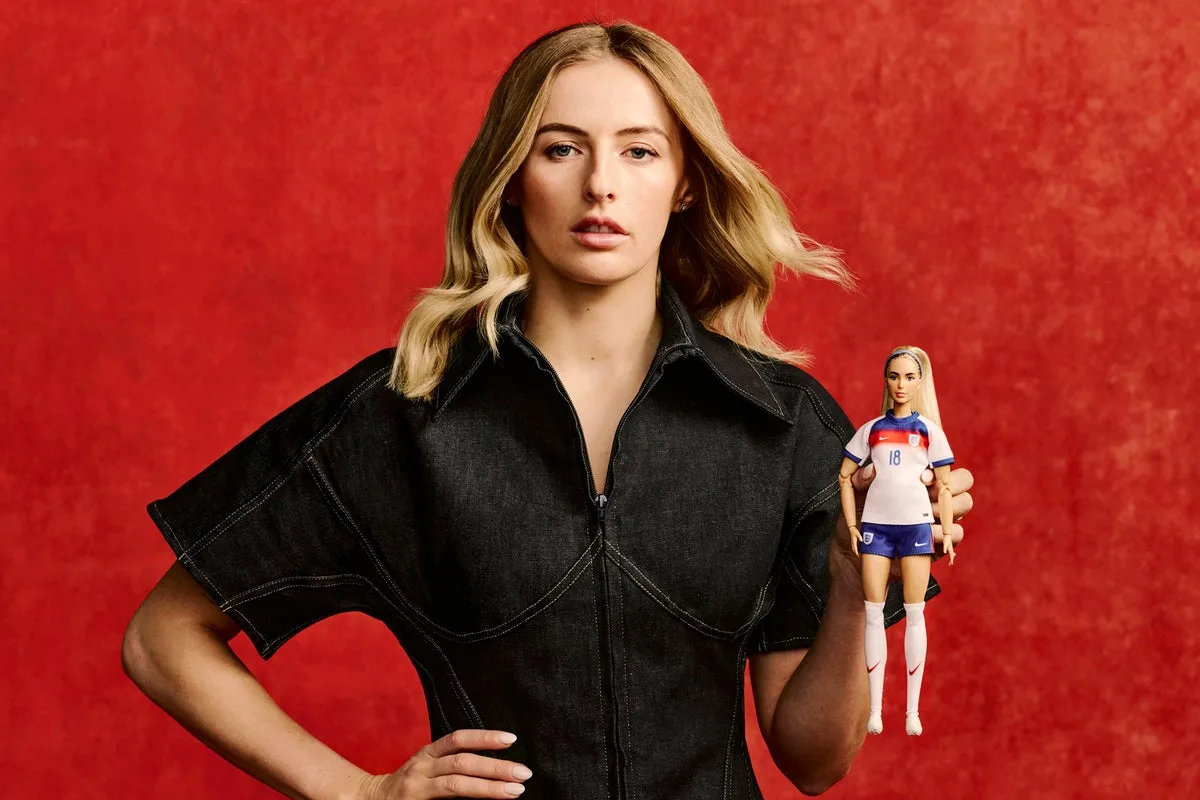
Mattel's New 'Role Model' Barbie Line Features Lionesses Star Chloe Kelly
Toy manufacturer Mattel has unveiled a fresh collection of 'Role Model' dolls to mark International Women's Day, featuring sporting icons including England football star Chloe Kelly alongside tennis legend Serena Williams and cricket's Smriti Mandhana. The launch follows previous inclusive releases such as autism Barbie, type 1 diabetes Barbie, and a Ken doll with vitiligo.
Chloe Kelly becomes the first England player immortalised in plastic, with a unique doll wearing the kit from England's triumphant 2025 Euros victory in Switzerland. Kelly told The Independent exclusively about her hopes for the doll's impact on children.
'Two Worlds Colliding' Says Football Star
"I think for me, seeing this Barbie doll is two worlds colliding," Kelly explained. "My sister used to play with Barbie dolls and I used to play football, but this feels like a game-changing moment. Having young girls believe, 'I can do both'. I can sit there and play with my Barbies, but I can also play football too, and also I can be a Barbie doll one day."
While Kelly's sentiment celebrates breaking traditional boundaries, the announcement has reignited longstanding debates about Barbie's complex legacy regarding body image and gender expectations.
Growing Up With Barbie's Problematic Legacy
For many women who grew up with Barbie in the 1980s and earlier, the dolls represented unrealistic physical ideals rather than empowerment. The classic Barbie featured impossibly proportioned anatomy with a tiny waist, long platinum blonde hair, dainty arched feet, and exaggerated feminine features.
"I still have a box of my old Barbies and I can't say they did me any good," writes commentator Victoria Richards. "Mostly, I remember feeling dismayed that I didn't have long, platinum blonde hair like Barbie did; that my feet weren't dainty and pointy and impossibly arched."
The dolls' career aspirations during that era often reinforced traditional gender roles, with variations including "air hostess Barbie," "waitress Barbie," and "wedding Barbie" rather than representations of diverse professional achievements.
Research Reveals Lasting Impact of Childhood Stereotyping
Organisations like The Fawcett Society have documented concerning evidence about how gender bias in childhood affects long-term development. Their research indicates stereotyping has wide-ranging negative consequences for both women and men.
More than half (51%) of people surveyed reported that childhood stereotypes constrained their career choices, while 44% said it harmed their personal relationships. The society's commission found that parents with young children often inadvertently reinforce gender stereotypes through toys, play, language, and environment.
Educational settings contribute to the problem, with teachers frequently rewarding boys' and girls' behaviour differently. By age two, children demonstrate awareness of gender, and by six years old, many already associate "intelligence" with being male and "niceness" with being female.
Modern Parenting Approaches and Continued Concerns
Some parents who grew up with problematic Barbie messaging have adopted different approaches with their own children. "As a direct result of the way Barbie made me feel when I was little, I resolved not to let my daughter play with dolls at all," explains Richards.
Instead of traditional "girls' toys," she provided trucks, toolboxes, and Star Wars figurines, even challenging nursery teachers about separating toys by gender. Despite Mattel's recent inclusive efforts featuring dolls with wheelchairs, canes, prosthetic legs, hearing aids, and representations of various conditions, concerns persist about underlying messaging.
"I'm still haunted by the messaging of my past: those unrealistic body image ideals and the way they made me feel about myself," Richards notes. "And I worry that we might be inadvertently switching one pressure off (to be skinny and pretty and blonde) and piling another one on (to play for England)."
The Fundamental Question About Childhood and Aspiration
The debate raises fundamental questions about what constitutes healthy aspiration for children and whether any doll, regardless of its inclusive features, should represent the "ultimate proof" of success. While celebrating female athletes like Chloe Kelly represents progress in diversifying role models, critics question whether plastic representation truly addresses deeper issues of gender stereotyping.
As Mattel continues expanding its inclusive doll lines, the conversation continues about whether corporate efforts at representation can genuinely counteract decades of problematic messaging or whether they risk creating new pressures for children navigating identity and aspiration in an increasingly complex world.