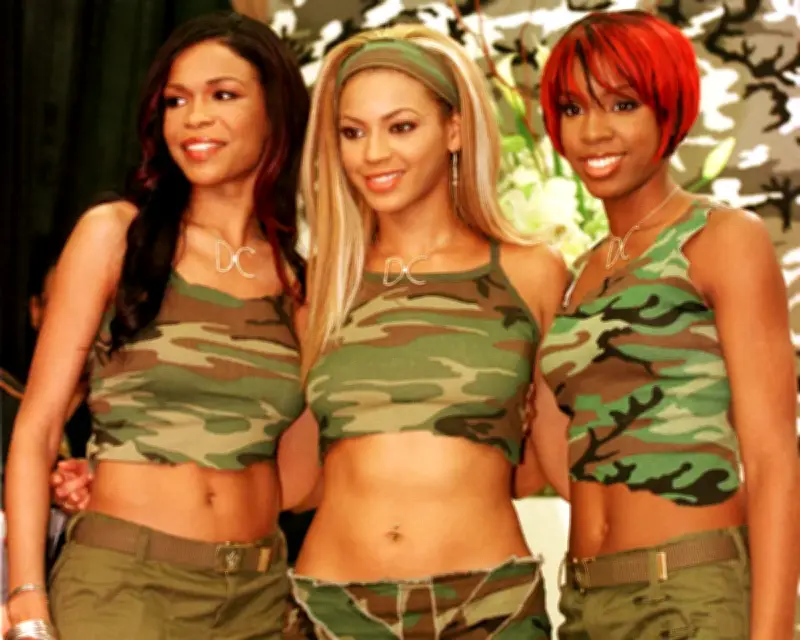
Camo is back. The military-inspired look that defined noughties pop acts like All Saints and Destiny's Child has returned to the fashion spotlight, with camo trousers becoming a standout front-row trend at London fashion week this month. The trend first emerged at Copenhagen fashion week in August, where Vogue called it “a clear winner among the trends we spotted outside the shows”.
Celebrities and the high street embrace camo
Fashion editors are not alone in embracing the look. Celebrities including Alexa Chung and Iris Law have worn camo recently, and Brad Pitt, promoting his new survival movie Heart of the Beast, wore camo trousers and a matching jacket this month. Hetty Mahlich, a brand editor at Burberry, was photographed wearing her army surplus camo pants at fashion week. She likes the contrast they bring to an outfit: “They go with a vintage nightdress or a white baby tee, but they're also great with a heel as I never like feeling too dressed up.”
Beyond the front row, camo is gaining ground. Searches have increased 108% on the resale app Depop since April, and brands from Zara to Marks & Spencer and Adidas are selling it on the high street. Maharishi, the label that dressed All Saints in their camo pants, has enjoyed a revival, collaborating with Arsenal in 2023 on a popular camo-tinged collection.
Nostalgia and the pattern's military roots
Most wearers of camo now are looking back to the early noughties, when bands like All Saints and Destiny's Child made it fashionable. With a generation born at that time now coming of age, the era is being viewed with nostalgia. Andrew Groves, a professor of fashion design at the University of Westminster, said this was when camo went mass market. “By the noughties, camouflage had become completely normalised,” he said. “You could wear camo trousers without consciously making a military statement. It had become comparable to tartan or leopard print.”
The history of camo begins with the military, first used extensively in the first world war. By the Vietnam war in the 1960s, it was worn as a statement by those in the US opposed to the war. In the 80s, the pattern moved into high fashion after Andy Warhol's camouflage paintings were used in a collection by Stephen Sprouse in 1987. “By then it wasn't simply military clothing any more,” said Groves.
Ambiguity and new meanings
Fast forward nearly 40 years, and the trend comes with a backdrop of wars around the world. Groves said even with its established place in fashion, the military connections remained, but this might be part of the appeal: “It carries associations with warfare but also protest and counterculture. That ambiguity is perhaps why fashion keeps returning to it.” For Mahlich, the long history of camo wearers since the 60s means the military element fades into the background. “I think of it more as a universal pattern,” she said. “Military uniforms have been co-opted by subcultures and on the runway for so long that now they have new meanings and associations.”