The Bayeux Tapestry, on display at the British Museum in London, is often associated with blood, booze, arrows, and boats. However, the fashion of the near-1,000-year-old embroidered work offers insights into the people depicted.
Hair and Clothing as Status Symbols
Prof Laura Cleaver, an expert in medieval manuscripts at the Institute of English Studies, notes that "the Anglo-Saxons all have these little moustaches, which are brilliant. And then the Normans have these funny haircuts with the back of their heads shaved." The clothes, including crowns, tights, and brooches, provide codified hints about status and power, indicating who was wealthy enough to own and flaunt the medieval equivalent of designer pieces.
King Edward and Harold Godwinson
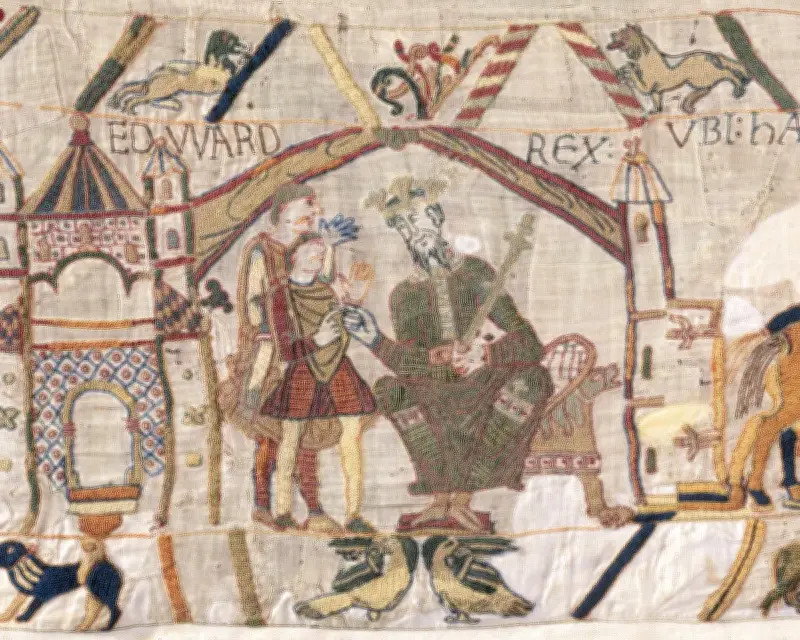
King Edward the Confessor, depicted in the first scene, wears "the most elaborate dress in the whole tapestry," according to Gale Owen-Crocker, professor emerita of Anglo-Saxon Culture at the University of Manchester. He is seated on an elaborate lion-headed bench, symbolizing the prosperity of England. Harold Godwinson, a powerful earl, appears frequently, and Prof Leonie Hicks, a medievalist at Canterbury Christ Church University, highlights his accessory: a hawk, a status symbol of aristocratic pursuit. He also rides a stallion with a swanky saddle, indicating his importance in the story.
Count Guy, Duke William, and Bishop Odo
Count Guy of Ponthieu wears a patterned garment and two-tone garters, which Owen-Crocker says is "an attempt to make him look really fancy" but also satirizes him, making him look foolish. Duke William of Normandy, on a great big stallion, has ribbons attached to his cloak, a Roman imperial style denoting power, along with a gold-bordered cloak, a double gold belt, and spurs. Bishop Odo of Bayeux, believed to have commissioned the tapestry, wears "really fancy armour," according to Hicks, and is depicted galloping on a virile stallion, taking up space in a heroic way.
Archbishop Stigand and Aelfgyva
Archbishop Stigand, who crowns Harold, wears liturgical garments including a maniple, chasuble, alb, stole, and pallium, marking him as archbishop. His tonsured hair also identifies him as clergy. Aelfgyva, one of the few women on the tapestry, wears loose sleeves, which Martin Bostal, director of the museum of Bayeux, says suggests "the tapestry is depicting the attire of the wealthy class, as such loose sleeves would be unsuitable for manual labour." Owen-Crocker describes this as "conspicuous consumption of cloth," a medieval precursor to today's logo-drenched designer wear.