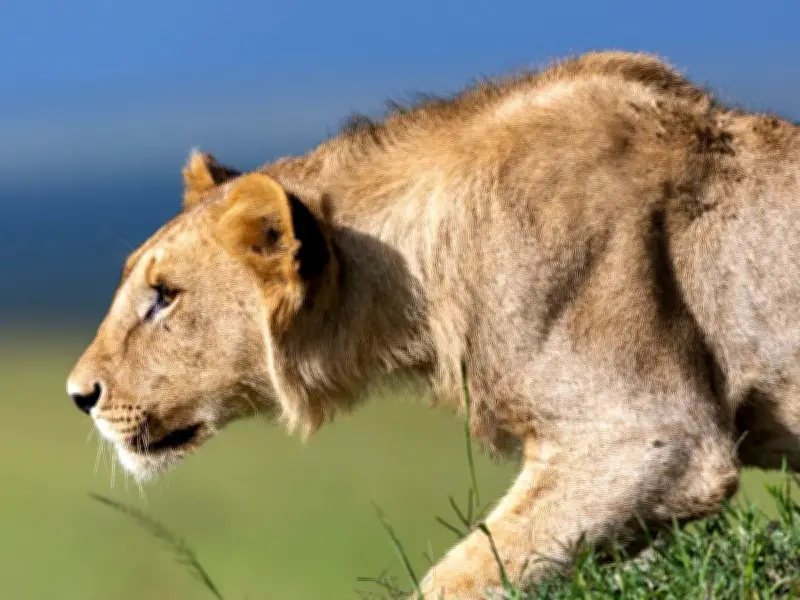
Producers of National Geographic's epic series Lion begged their four-legged star 'please don't die' during the four-year making of the show, which follows a cub's journey to become king.
Four Years in the Making
After 52 shoots over 1,400 filming days in Kenya and 1,000 hours of footage, the team focused on the journey of eight-week-old male Kio. It is the first natural history series to follow a lion throughout its full journey from tiny cub to king.
The four-part series is the brainchild of The Lion King director Jon Favreau and BBC Studios executive producer Mike Gunton, with a score by renowned composer Hans Zimmer. Series producer Jane Atkins said it had been a rollercoaster of emotion: "We poured so much love into the project, so I just hope that passion comes through with the way audiences receive it. We want to make films that transport people."

High-Stakes Gamble
Lions have a high infant mortality rate, with more than 50% not making it past their second year, and male lions are notoriously hard to follow because they wander off. Jane initially thought the main story would be about a female matriarch, but she soon knew Kio, who was close to his mother Summer, had potential. "I knew it was risky, because of all the statistics, but I was backing that story quite early on. To not have a clue right at the beginning what our end story was going to be was terrifying. But we thought we must be bold, ambitious and able to shift if we don't get the story that we want. We were playing a very kind of high-stakes gamble the whole time."
Mike said his pitch to National Geographic was vague: "My pitch was not to tell the Lion King, it was to tell the story of a lion pride. None of us knew that it would end up being a male but relatively quickly this male started to stand out as a potential character. But you'd be foolish to just follow him. We were following some adult females, we were following many other lions but as time went on, he became more and more a key character."
"As time goes on, it gets increasingly risky, because you've invested more and more in that individual, both emotionally and in terms of footage. As you get closer and closer to the end - which is when you run out of time and money - every day, you think, please don't die, please don't die."
Emotional Journey
Across the four episodes, Kio loses important family members and his home, but proves himself equal among his older brothers, fighting rival males and taking over a new pride of females. Jane said the filming pulled at the heartstrings: "We were so in love with the characters, by the end I felt really emotional, not just because I was so proud of the team, but also - this sounds strange - I was so proud of this little cub who had made it. He had become this incredible adult male, and it's like seeing my 14-year-old son, over those years, kind of become a man."
She said the male lions had to fight hard, which wasn't always easy to watch. "You feel incredibly protective, so it is like having your own son, and having to sort of let go of them a little bit." She could only relax after three and a half years of filming. "We lived and breathed every second of it," she said. "Jon Favreau was so nervous, he'd say 'every time you phone me, I feel like you're about to say something terrible'. His first question was always, 'is Kio alive?'"
Overcoming Grief
At one point, one of the big characters dies and director of photography Sophie Darlington had to overcome her grief to carry on filming. "The way she died was incredibly sad," Jane said. "We had meetings straight away in the office, and people were crying and there was a lot of upset, and then we had to ask Sophie to go back out to film the aftermath of what happened on Kio and the boys."
Mike told the Mirror that making a drama with a cast over which they had no control was nerve-wracking, with one of the biggest challenges keeping tabs on them. "They're not collared so we rely on the guides to find them. Every morning before dawn you'd go to where you saw them last, and hope they're there. If they're not you drive around and hope that you can find them."
He said the only script was the one that "nature has written" and explained: "Our job is to just gather and pick the moments of relevant excitement."

Extraordinary Skills
He praised the skills of those on the ground: "You are spending 90% of the time with nothing, and then, bang, something will happen almost out of the blue. That's why the skills of the trackers and the camera teams are extraordinary, they know it's coming, they've got that sixth sense."
One shocking storyline involves Kio's mother. "Viewers are going to be shocked by Summer's story," Mike warns. "We knew what happened, and it was an interesting filmmaking challenge, how you tell that story without the actual imagery. But you also have to be quite careful politically about how you frame that story."
Rewarding Experience
Mike found it challenging but rewarding: "It's been one of the most joyful things I've ever worked on. I say that because it all worked out," he laughed. "Imagine if after three and a half years they all died - I would probably be having a very different conversation."
Mike, who works on many of the David Attenborough series for the BBC, added: "I know epic gets overused, but it does feel, genuinely, like an epic story. I think it's a real privilege to do something that is this epic."
Behind the Scenes
To know precisely what they were filming, the team gave each lion its own identification card and became expert at identifying up to 50 lions from different prides by name and family relationships.
The four episodes will be voiced by actor OJ Lynch - because Favreau wanted a "storyteller's voice," as if the audience was sitting around a campfire with an elder. Lynch previously played Mufasa in the West End version of The Lion King - and also used to work at BBC Studios' Natural History Unit. "I knew him when he was a postboy about 40 years ago," Mike says. "I just thought his voice was fantastic. I wanted a voice that wasn't a famous voice but could be anybody from that part of the world, and Jon felt the same. We felt this was a story that could have been told at any time - 10 years ago, 100 years ago, a thousand years ago. It's a story of all time."
Lion airs on National Geographic as a double bill from Thursday 20 August at 8pm and 9pm, and also streams on Disney+.