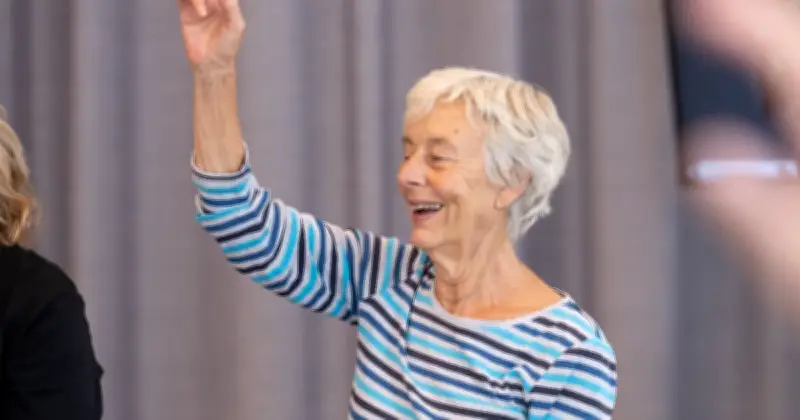
At English National Ballet's Dance for Dementia programme, participants are welcomed into a professional rehearsal studio and treated as dancers, not patients. The programme, which runs in East London, uses music, movement and shared experiences to help people living with dementia rediscover confidence and connection.
A Creative Space for People with Dementia
Sunlight fills the studio as a pianist plays and colourful scarves rise into the air. Participants stretch, sway and laugh, some seated, others standing. Nobody is referred to as a patient, and nobody is defined by a diagnosis. The simple rule is that everybody is a dancer.
In Britain, around one million people live with dementia, a condition that affects memory, language, behaviour and everyday tasks. Many people experience changes in confidence and communication long before significant memory loss. The programme offers a creative alternative to clinical settings, allowing participants to engage with the arts.
Personal Stories: Vivien and Mary
Vivien Munde, 80, was diagnosed with dementia three years ago and lives in residential care in West London. Her husband, Mike Shaw, 73, travels across the city every Monday to bring her to class. “The consistency is fundamental,” Mike says. “The routine and the people who attend and the volunteers – that's the most important thing.” Vivien adds: “The emphasis is not on the ballet. The emphasis is on participation in a group. The ballet is just a vehicle for personal interaction.”
Mary Amoako, 86, attends with her daughter Sue Agyakwa, 56. Mary, a former nursing lecturer and midwife, diagnosed herself before doctors. “I diagnosed myself before the doctors,” she says. “I knew there was something wrong with my memory.” Despite the progressive nature of the disease, she says the classes reconnect her with her love of dancing. “I used to be a dancer. I like ballroom dancing. I just love dancing.” Sue notes that by the end of a session, her mother is “a lot more relaxed” and “more interested in people”.
Programme Expansion and Impact
English National Ballet began exploring dance for neurological conditions with its Dance for Parkinson's programme in 2010. After moving to East London in 2019, the programme expanded. During the pandemic, live online sessions reached 270 care homes. The in-person programme began in 2023 and continues to grow.
Classes are inspired by the company's repertoire, from Swan Lake to contemporary works. Associate artists undergo specialist training and spend around 16 hours adapting material for each term. “We never force participation,” the team explains. “There is no right or wrong way to take part.” One participant who initially sat quietly for weeks later became one of the group's most confident dancers after asking about the benefits of exercise and music.
Laura Harvey, Head of Creative Programmes at English National Ballet, says: “Dementia is a cruel disease. But just because you are living with a neurological condition, it doesn't mean that you don't have an artistic voice.” She adds: “We're not doctors and we're not medics. But what we do recognise is that dance has significant benefits for people living with dementia and their carers.”
As sessions end, participants gather for tea and conversation. For 90 minutes each week, the focus is on music, creativity, friendship and joy, reminding dancers of everything they still are.