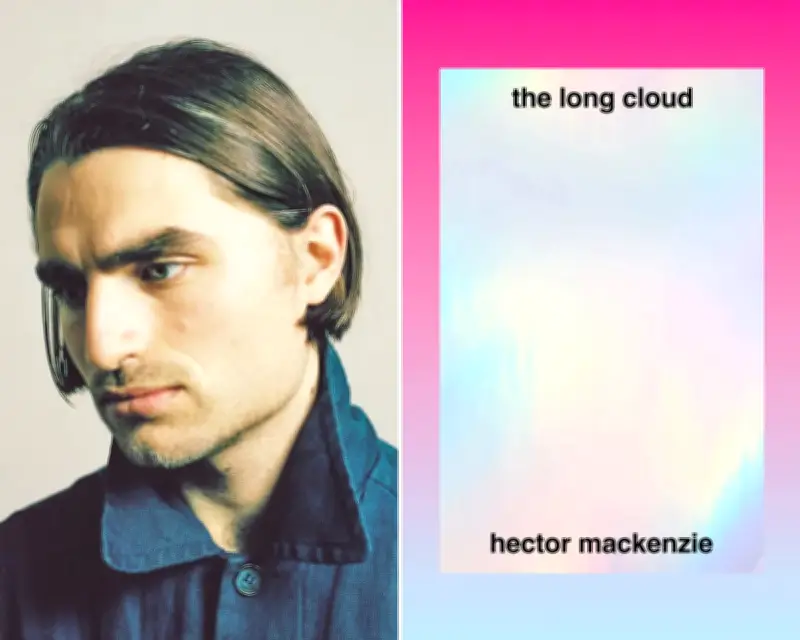
Hector MacKenzie's wry debut novel, The Long Cloud, asks whether readers should care about a vape-loving, philandering male model who just goes with the flow because that's life. The answer, the book suggests, is yes – though whether it convinces is another matter.
A tabula rasa in London
Xander, a 30-year-old former jock ageing out of the modelling industry and into an existential crisis, is a tabula rasa of sorts – a way for readers to glimpse reflections of themselves. In an age dominated by how we're perceived, the novel probes what exactly that “self” is.
The most immediately striking feature is the prose: lowercase fragments with sparse punctuation, a stream of consciousness spewing forth Xander's inner conflicts, reflections and insecurities. His polished surface belies an inner turmoil. His success is waning as a model working in London, where he lives with his emasculatingly successful actor girlfriend, Tessa. He hasn't “really felt anything for a long time”. Life is something that happens to him.
Return to Hawkes Bay
At Tessa's insistence, Xander flies home to Hawkes Bay in New Zealand, his first trip back in a decade. He's apprehensive: the place and its past, inhabited by everyone he left for greener pastures, is the one big mirror he doesn't like looking at. Once home, he feels unmoored. He spends time with his divorced parents: his paranoid, doting mother, and his father and his new girlfriend, who live on the family farm – Xander's totemic “home” (and the “envy of rich people everywhere”) – which he learns will soon be sold. He sees former friends and former lovers, one of whom seems keen to rekindle things.
Adrift and alienated, Xander begins to splinter: “who the fuck was i? was i a farm boy? or was i a handsome boy? or was i just a washed-up big-dog jock of the year with nothing to my name.” MacKenzie astutely shows how nostalgia becomes a siren's song, luring us back to the familiar only to dash us upon the rocks. Xander falls into reveries about his past relationships, wondering about what might have been, the person he could have become. He then meets Charlotte, a woman 10 years younger than him, who he thinks may solve his woes.
Tender insights, limited depth
The long cloud of the novel's title – a nod to the Māori word Aotearoa, meaning long white cloud – feels like a culmination of the lives we leave unlived, both past and future: a spectre that casts shadows over our choices and thus who we are. Via Xander – as comically vapid as he is at times poignantly reflective – we see how the anxieties of adulthood are born from the anxieties of youth; how, as we strive to define ourselves, fleeing what shaped us so that we may carve out something new, we can wake suddenly, years later, feeling estranged. We become newborns again, distressed at having lost what's familiar. As Xander laments, “how dare the world force us to decide what we'll do as adults when we are only children.”
For these tender insights, The Long Cloud is an enjoyable novel, but it isn't a great one. There's only so much depth to a himbo. Beautiful, simple men have beautiful, simple thoughts, but when you're stuck at the party with one, you can eventually get bored. There is a sense, too, that the novel is missing its ending: it's only just as the edges of Xander's world properly begin to fray that we leave him, leaving things feeling a bit prematurely tied off.
What MacKenzie renders well is the fading of youth, the throes of nostalgia, the disorientation of displacement – and all in the prose of a friend's late-night Facebook message. There may have been a version of this book that, while staying true to Xander and his internal tensions, took it to the profound, but it doesn't quite get there.
A mirror for flawed selves
Xander is indeed like one big mirror. In all the ill-considered decision-making that wreaks the very devastation he laments, amid all the stumbling and posturing and multiple redrafts of a 10-word flirty SMS, there are many glimpses of our own flawed, unsure selves. When Xander is at one point beaten up, his face finally looking how he feels inside, he finds relief. So too is there some comfort in recognising the “collage of mild anxiety” that MacKenzie's debut pieces together. The Long Cloud is out now via Scribe in the UK and Australia.