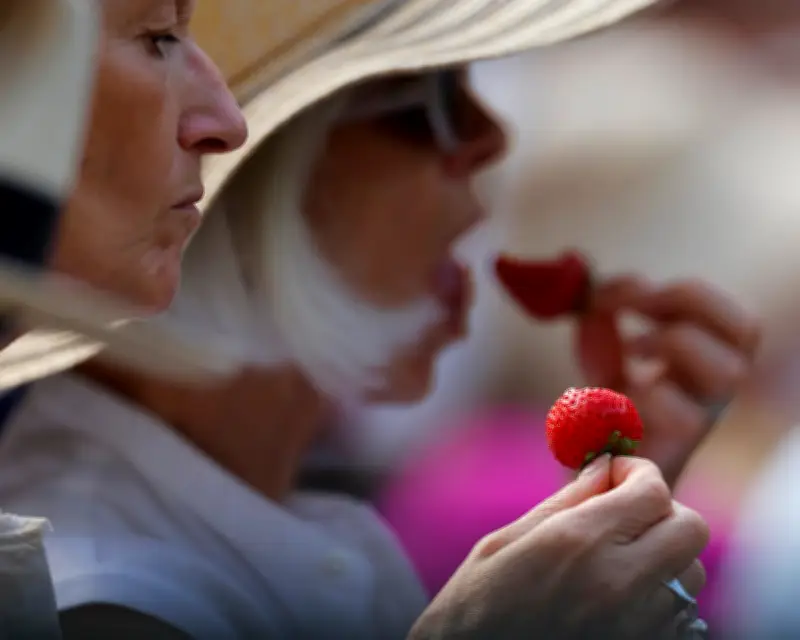
The All England Club opened its gates on Monday to a familiar scene: pristine lawns, long queues for strawberries and cream, and a small group of protesters. Ten demonstrators gathered outside the main entrance, opposing Barclays' sponsorship of the championship due to the bank's investments in weapons manufacturers supplying the Israeli Defense Forces. "We're not against tennis," one protester shouted through a loudhailer. "We just want the Championships to drop Barclays." Their presence barely registered inside, where the focus remained on the tennis and the traditions that define this event.
Inside the Bubble: Wimbledon's Perfect Isolation
Once past the gates, the outside world fades. The only concerns are the state of Jack Draper's arm (he lost), Emma Raducanu's foot (she also lost), Naomi Osaka's kimono-inspired warm-up outfit, and whether the strawberry queue has shortened. By midday, the line stretched to a couple of hundred people. By the time the last person reached the front, the protesters had dispersed, leaving one lone man in a West Ham shirt holding signs, guarded by police. He was as welcome as a "crusty juggler in Sandford town square."
Everything at Wimbledon is meticulously curated: every privet trimmed, every berry topped. It is a vision of England as if run by the Rotary Club—a retired brigadier's dream. Yet, the more the championship is buffed (funded by lucrative debentures), the more it resembles other luxury sports venues. The shops at Wimbledon and Augusta National sell similar items, from £35 candles to high-end apparel, attracting the same clientele.

Luxury and Exclusivity: The Cost of Wimbledon
The cost of indulgence has risen slightly: a bottle of Lanson Rose champagne is up £1.10 to £102, and strawberries are 15p more expensive. But for those willing to spend, these increases are negligible. Debenture ticket prices have tripled in three years, partly due to the government exempting Centre Court debentures from new legislation capping resale prices. This has priced out moderately wealthy fans, replaced by overseas buyers willing to pay up to 100 times face value. As one observer noted, "It is easier for a rich man to get into heaven than a moderately wealthy one to make it into Centre Court these days."
Out Courts: Where the Real Action Happens
For true tennis aficionados, the first week's excitement lies on the outer courts. Watching the world's 100th-best player from three feet away beats viewing the 10th-best from 30 rows back. Early Monday, Court 18 hosted Mika Stojsavljevic, the 17-year-old US Open girls champion, who lost to Belinda Bencic before the coffee machine warmed up. On Court 14, Max Basing, world No. 331, faced Japan's Shintaro Mochizuki (No. 151). Basing had a small fan club, but he went down 6-3, 6-0, and 1-0 in the third set. "He hasn't won a game in a while, has he?" an elderly spectator remarked. "No, not since we got here."
Basing briefly rallied to 30-0, only to lose four straight points. "Comeback time," the old man said sarcastically. A Japanese fan shouted, "Good try Max," as Basing netted a forehand. The old man then asked his wife, "What time did you say play started on Centre Court?"
On Court 3, Felix Gill (world No. 220) took a beating from Spain's Rafael Jodar (No. 23), losing 6-3, 6-3, 5-4 when I arrived. Gill at least showed anger, grunting and hitting aces to force a 13th game. Cam Norrie lost in five sets on Court 2, and Harriet Dart lost in three on Court 1. This familiar English tableau—trimmed hedges, Pimm's, polite applause, and passive aggression—is as much a part of Wimbledon as posing by the Fred Perry statue.