The cello has become a cinematic shorthand for sensitivity, intensity and emotional depth, a role that even superhero blockbusters acknowledge. In the 2012 film The Avengers, Tony Stark mentions a cellist in a moment of pathos, highlighting the instrument's narrative weight.
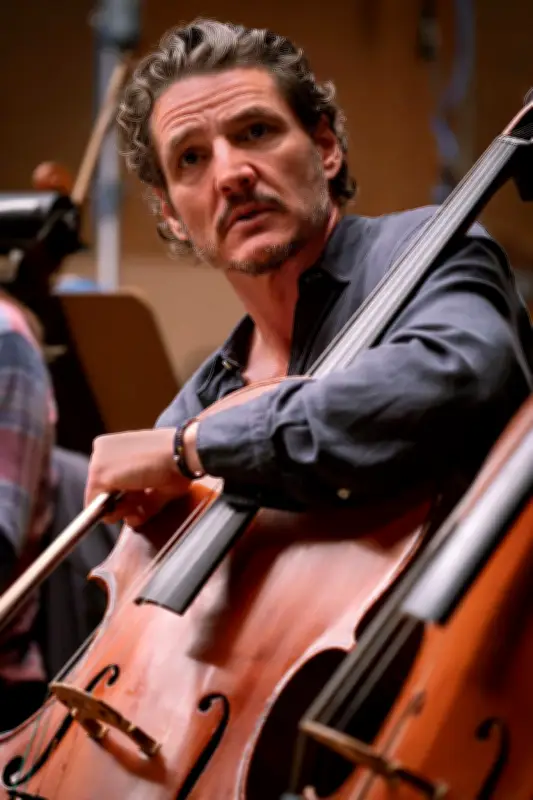
Earlier this month, a trailer dropped for the upcoming Pedro Pascal drama Behemoth!, in which he plays a celebrated cellist returning to Hollywood to score films. Real-life cellist and film composer Hildur Guðnadóttir says the instrument “is definitely having a moment right now. But it’s always been present.”
From Audrey Hepburn to Pedro Pascal
This cinematic love affair began almost 70 years ago, when Audrey Hepburn played a witty young cellist in Love in the Afternoon. Since then, the instrument has come to mark a certain type of character: cultured, intense, romantic, haunted. Think Alan Rickman in Truly, Madly, Deeply, or the titular cellist in the 1996 Czech drama Kolya, which won the Academy Award for best foreign language film. Even Woody Allen toyed with the stereotype; in Annie Hall, Carol Kane’s leftwing, liberal intellectual played the cello in a deleted scene.

The human voice of the orchestra
Why did the cello become the instrument of introspection? “It’s the cliche, but it’s probably because the cello comes closest to the human vocal range,” says Guðnadóttir. “It has this ability to play around with notes, too, like human intonation. Press a note on a keyboard and it’s straightforward, definitive. The cello – like our voices – can play with this intonation for expression.”
She adds that the only other instrument with this human timbre and “fluidity of intonation” is the bass clarinet, but you’re unlikely to see a protagonist reaching for one. The cello has cornered the market on tragic orchestral stories, most notably in the Emily Watson-starring Hilary and Jackie. “That film, the story of cellist Jacqueline du Pré, is the cello film that has stuck with me most,” says Guðnadóttir. It is not the only cellist biopic; in 2009’s The Soloist, Jamie Foxx’s primary instrument was swapped from double bass to cello.
Cellists as emotional anchors
The cello’s human register makes it visually dynamic. A cellist’s bow strokes are physical and expressive, and the performer’s face is rarely obscured. That is why cellists tend to be the beating heart of musical dramas. Guðnadóttir scored Cate Blanchett’s Tár, in which a cellist becomes the drama’s catalyst. Christopher Walken’s cellist with Parkinson’s is the centrepiece of 2012’s A Late Quartet, and Dermot Mulroney (a real-life cellist) frequently guest-starred in Mozart in the Jungle.
But cellist characters are not confined to musical dramas. The cello’s emotional shorthand appears across genres: Chloë Grace Moretz in If I Stay, Maryam d’Abo in The Living Daylights, and cellist love interests in sitcoms from Frasier to New Girl. There is also a darker side, seen in Michelle Pfeiffer in What Lies Beneath, Uma Thurman in Jennifer 8, and Jenna Ortega in Wednesday.
The gothic and sensual side
“There is a gothic connection to the cello,” says Guðnadóttir, who won her Oscar for scoring Joker, a soundtrack that features the instrument prominently, with its neck being “choked”. “When it’s played in an ugly way – because we yearn for it to be this beautiful instrument – it feels uncomfortable.”
Director Richard Shepard took that darker side further in 2018 with The Perfection, a horror set inside a prestigious music academy. “I remember growing up on the Upper West Side of New York City, near Lincoln Center,” he says, “and seeing these young cellists on the subway, lugging these huge cases. It stuck with me. How big it is. How much effort it takes to not only play it, but just move it. When writing The Perfection, we felt that physicality could make a statement. It’s sexy. It’s a sexy instrument.”
The film-makers were determined to make the cello playing convincing. “It was really hard work,” says Shepard, “but I’m proud there are only two shots of musicians’ hands rather than actors’ hands in the entire film.”

An instrument actors cannot fake
The cello is an instrument actors cannot bluff. Ortega trained for Wednesday and earned Golden Globe and Emmy nominations. Watson trained for Hilary and Jackie and got an Oscar nod. Pascal told Vanity Fair that taking on the cello was “literally the hardest, hardest, hardest thing I’ve ever had to learn to do.”
David Cohen, principal cellist of the London Symphony Orchestra, says “there’s definitely a stereotype that cellists are the orchestra’s empaths – warm, thoughtful and just a little bit intense. I’m not sure it’s entirely true, but it’s amusing that film-makers so often cast cellists as the emotionally intelligent ones. You rarely see the villain saying: ‘Just let me finish my Bach Suite …’”
Cohen adds that the cello’s versatility shapes characters. “It can sound noble, lonely, hopeful or quietly heroic – often within the same phrase. It’s the Meryl Streep of the orchestra. And, because it has the depth to suggest sadness without wallowing in it, the cello is also film music’s favourite therapist.”
Catherine Warner, a music therapy practitioner, points to the instrument’s role in memorable cinematic dialogues. In The Witches of Eastwick, Jack Nicholson’s devilish character seduces Susan Sarandon’s cellist during a duet, which Warner says “seemed to symbolise Sarandon’s character’s sexual awakening, as well as her discovery of authentic emotional expression – she had previously struggled to bring that into her playing”. In Master and Commander: The Far Side of the World, Paul Bettany plays a cello bass line under Russell Crowe’s violin flourishes, symbolising a close supportive working relationship.
Warner returns to something she once wrote: “Symbolically, the cello can evoke the sense of the instrument being rather like a person.” This gets closest to explaining Hollywood’s obsession. More than any other orchestral instrument, introducing a cello is like casting another actor. Guðnadóttir says “there’s something about the size of it being quite close to the human body – not to mention the shape of the cello almost looking like a torso.”
Pair its resemblance to the human body with its similarity to our vocal range, and it is no wonder cinema loves the instrument. It can be embraced, fought, comforted or strangled. The inevitable Oscar category for best bowed string instrument in a leading role may soon arrive – or Pascal risks having his cello nominated ahead of him.