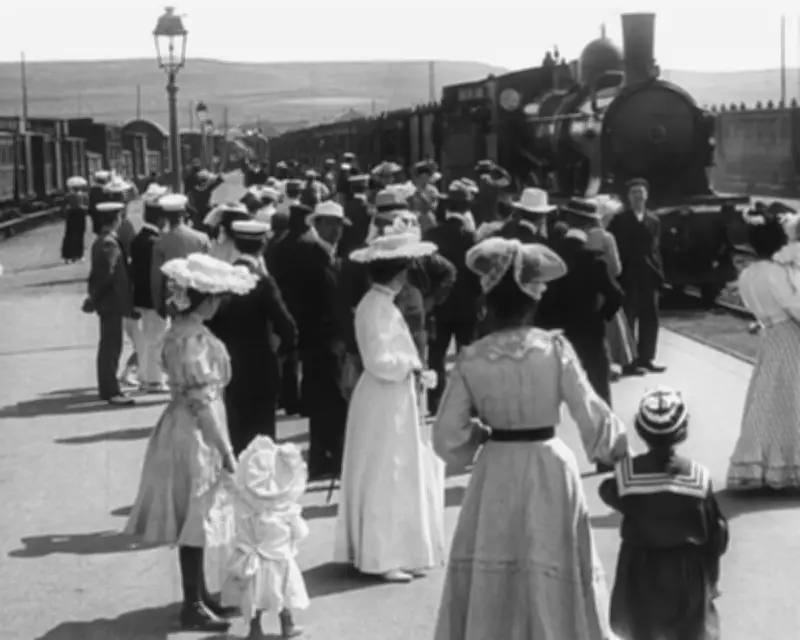
Maciej Drygas's compelling documentary 'Trains' presents a magnetic cine-essay that delves deeply into the profound liberation and unsettling disruptions brought about by the locomotive. Constructed entirely from archival footage without any voiceover, this film offers a sweeping survey of the 20th-century transformations ushered in by steam trains, capturing both the optimism and the darker consequences of this revolutionary technology.
The Dawn of a Social Revolution
The advent of the steam age marked a great acceleration of modern society, fundamentally altering logistics and leisure for the masses. Drygas acknowledges the sense of liberation and optimism that trains provided, as vividly illustrated by 1920s flappers gazing brightly out of carriage windows. This new era introduced unprecedented consumer opportunities and reshaped travel, enabling widespread mobility and connecting distant communities in ways previously unimaginable.
A Journey Off the Rails
However, prefaced by a poignant Kafka quote – 'There is plenty of hope, an infinite amount of hope … But not for us' – Drygas's film suggests that this technology also led society quickly off the rails. The documentary opens with a glowering sequence of a steam engine being assembled, evoking imagery of ancient cultists constructing a great Molochian idol. This foreboding tone sets the stage for an exploration of the locomotive's role in wartime destruction.

Drygas gives heavy emphasis to the railway's critical function in both world wars. Archival footage transitions from munitions supply lines to newly forged shell casings glowing with an unholy light in black-and-white scenes, symbolising a full-speed descent into hell. The film effectively portrays how trains facilitated war mobilisation, with shots of convulsing shellshocked soldiers reduced to broken-down machines, highlighting the human cost of this technological advancement.
Contrasting Icons of the Age
The documentary draws striking parallels between cultural icons and dark historical figures. Charlie Chaplin is shown being borne aloft by a crowd from a passenger carriage at the dawn of mass stardom, only for the same adulation to be immediately applied to his dark doppelganger, Adolf Hitler, saluting from a first-class compartment. This juxtaposition underscores how trains served both as vehicles of celebrity and instruments of tyranny, reminding viewers of the technology's ambiguous legacy.
Postwar Reflections and Modern Ambiguity
Thankfully, the film loosens its tense narrative in the postwar stretch, allowing individual faces – dreaming on escalators or expectant before timetables – to linger more prominently on screen. Yet, hurtling headlong into Saulius Urbanavicius's cavernous sound design, the documentary concludes on airy abstraction with intersecting and diverging tracks, suggesting that modernity still lacks a fixed destination. The occasional smiles of passengers to the fourth wall, including a group of Nazi officers mugging for an early handheld camera, add layers of historical complexity.
Ultimately, 'Trains' serves as a hidden tribute not only to the locomotive but also to its contemporary, the movie camera. Both technologies voyaged through space and time, capturing and shaping human experience. This magnetic cine-essay masterfully explores how the railway revolutionised society while simultaneously charting a course toward unforeseen disruptions, leaving audiences to ponder the dual legacy of this transformative invention.
The documentary 'Trains' is screening at Bertha DocHouse in London from 20 March, offering viewers a profound cinematic journey through the rails of history.