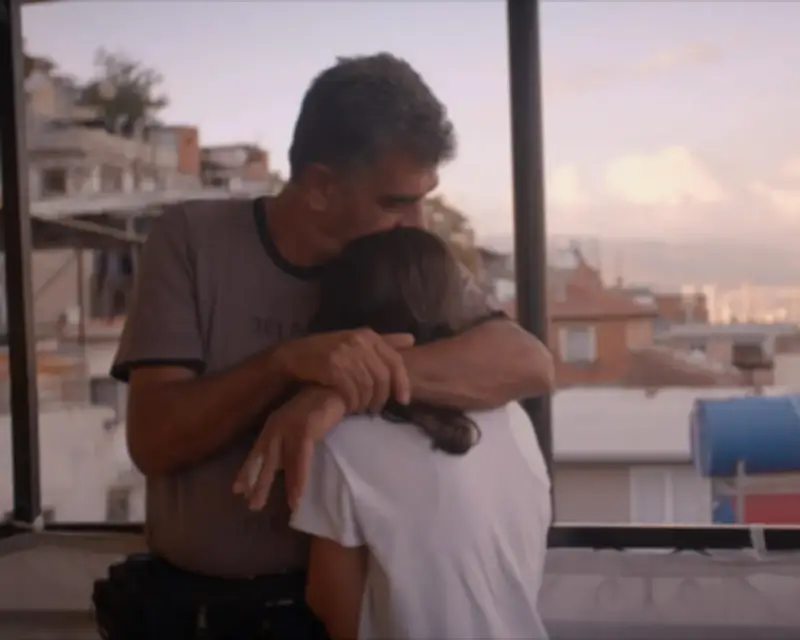
One in a Million, a documentary ten years in the making, chronicles the journey of Syrian refugee Israa from age 11 to adulthood, capturing her family's perilous escape from Aleppo to Germany and their subsequent life in Cologne. The film, by wife-and-husband documentary-makers Itab Azzam and Jack MacInnes, offers an intimate portrait of displacement, integration, and family dynamics.
Meeting Israa in Turkey
In 2015, Azzam and MacInnes first met Israa in İzmir, on the Turkish coast, where she was selling cigarettes with her father to raise money for people-smugglers. Azzam, who is also Syrian, remembers: "This ray of sunshine appeared in front of us. Israa was smiling and started talking to us. It was love at first sight. She was so bubbly, enthusiastic and positive." The family had fled Aleppo after their home was destroyed by a missile.
At 11, Israa joked about the dinghy sinking, too young to understand the risks. Her father Tarek agonised: "I'm gambling with the lives of my children," he says in the documentary. Just months earlier, the body of three-year-old Alan Kurdi washed ashore in Turkey. As he parted from the film-makers on the night of the crossing, Tarek said: "If anything bad happens to us, you have to tell our story."
MacInnes recalls the emotional weight of that moment: "At the time we knew there was a chance that we would say goodbye to them, and that would be it." Azzam, brushing away tears, remembers filming in İzmir: "It was absolutely heartbreaking. You saw lots of families putting life jackets on their children." MacInnes adds: "People were selling fake life jackets as well. Life jackets that didn't actually work. I'm not sure we could have filmed it if we'd had children at that point."
Filming the Journey to Germany
After Israa's family landed in Greece, they joined the flow of refugees—Europe's biggest movement of people since the second world war. Israa trudged through mud and freezing rain carrying her baby brother, while her parents pushed her sister in a wheelchair. Azzam and MacInnes were there every step. "We slept in the street with them. We went on refugee trains and buses," says McInnes. "By the time we arrived in Germany, we just became a family."
The family settled in Cologne, but the film-makers found it impossible to walk away. Azzam explains: "When we got to Germany, Israa was asking: 'Are you going to visit us?' We said: 'Of course.'" She adds: "When we started, the idea was: let's document this journey. Then there was a lot of talk about integration: will these people integrate in Europe? So we kept filming to cover that. Then it became a film about a family and love."
In Cologne, Israa learned fluent German in five months. She started school, made friends, and fell in love with Justin Bieber. Aged 12, she chose not to wear the hijab, a decision she later revisited. Her once close relationship with her father became antagonistic.
Family Dynamics and Transformation
It took Azzam and MacInnes three years to get financial backing. They juggled full-time jobs and put the cost of making the documentary on credit cards. "I think we were at least 40 grand in debt at one point," McInnes replies grinning. "But we were young freelancers."
In the documentary, Tarek lost much of his identity when he left Syria. In Aleppo he ran a falafel restaurant: "He was a big character there," says McInnes. "Everyone knew him. Now here he is in Germany, just another immigrant." While Tarek struggled to adjust, his wife Nisreen—Israa's mother—transformed from a background figure to a central presence. "She has a sort of hero's journey, doesn't she?" says MacInnes. "It's so wonderful to see what's happened to her."
When Israa was 14, she disclosed to MacInnes that her father had been hitting her. He switched off the camera and into safeguarding mode: "We suddenly realised something much more important was happening than the film," he remembers. The film-makers chronicled what happened next with great sensitivity.
Their plan was to stop filming when Israa reached 18, but then she met her future husband Mohammed, who also arrived in Germany from Syria as a child refugee. In late 2024, the Assad regime unexpectedly fell. The film is bookended with footage of Israa returning to Aleppo to visit.
Reflections on Identity and Home
Azzam, who is from the Druze religious minority in Syria, reflects on the struggle of displacement: "I went through that. It's a struggle. Even though I'm settled in the UK and we have a child together and our life is here, there's something missing. You feel like a guest that overstayed their welcome. And you struggle with identity. Who am I? Am I Syrian? Am I British?"
Asked about anti-immigrant feeling in the UK, she says: "It is hard, but you get used to it. There's a lot of negativity, and you learn to block it." She adds: "I've been in this country for 14 years, and I have never experienced any racism. I understand that people have. But honestly, it's been an absolutely positive experience." Months after the fall of the Assad regime, her village in Syria was destroyed: "We saw footage of our house, completely black, burned down."
Israa, now in her early 20s with two small children, has returned to education and is training to be a civil servant in local government. She remembers meeting the film-makers: "I felt a blind trust from the moment I saw Itab, I trusted her straight away. And our relationship over the years turned into a really deep friendship." The first time she watched One in a Million, she cried all the way through. Now, as a mother, she says: "I always say that both of my parents are very brave. Because now as a mother when I look at my children, I say that I would never have the courage to take such a trip. I am very proud of them because they took this decision and went on this journey with us." One in a Million is in UK and Irish cinemas from 6 November.