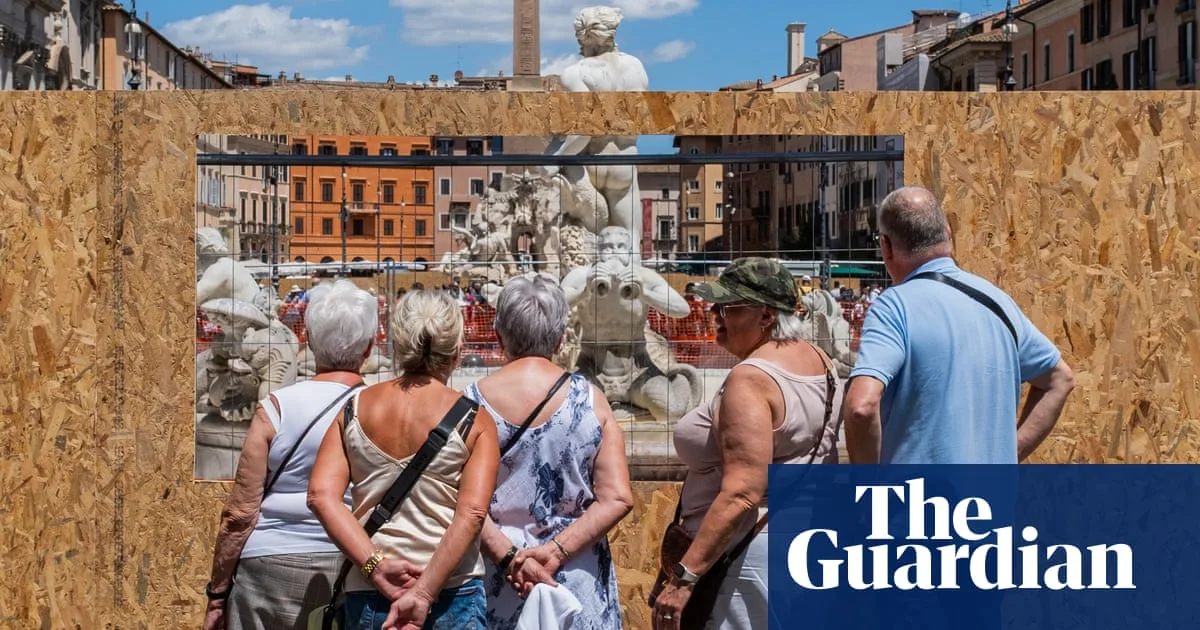
Rome's historic centre has gradually reorganised itself around the constant flow of visitors, with barriers, temporary routes and portable toilets becoming part of the city's normal visual language, according to a photo essay by Lorenzo Grifantini. By mid-morning, areas around landmarks like the Trevi Fountain are difficult to cross, as tour groups gather behind raised umbrellas and security staff redirect crowds through temporary barriers.
During the Jubilee year, the city often feels structured almost entirely around visitor management. Pilgrims queue in the heat outside St Peter's Square and Castel Sant'Angelo, while portable toilets sit beside churches and Renaissance walls. Public space has become a place of waiting, circulation and constant exposure.
Around Rome's most visited landmarks, the same gestures repeat throughout the day: visitors photograph monuments through their phones before looking at them directly, crowds raise smartphones towards Michelangelo's Pietà, and tourists sit exhausted on church steps seeking shade. Luxury advertising now occupies the same visual space as churches and fountains.

Rome has always been crowded, but the experience of the city is increasingly organised around movement, visibility and repetition. Visitors arrive with familiar images in mind—the Trevi Fountain, the Pantheon, St Peter's—and much of the city now operates around reproducing those images as efficiently as possible.
In the summer heat, much of the historic centre becomes organised around waiting: queues for churches, fountains, tickets, toilets, shade and photographs. At times, sacred space, tourism infrastructure and spectacle collapse into one another, as when a pilgrim queues beside temporary toilets outside Castel Sant'Angelo—a scene both absurd and completely ordinary.
Rome has become a prototype for a historic city reorganised around the expectations, rhythms and behaviour of its visitors, feeling shaped less by permanence than by the uninterrupted flow of people moving through it each day.