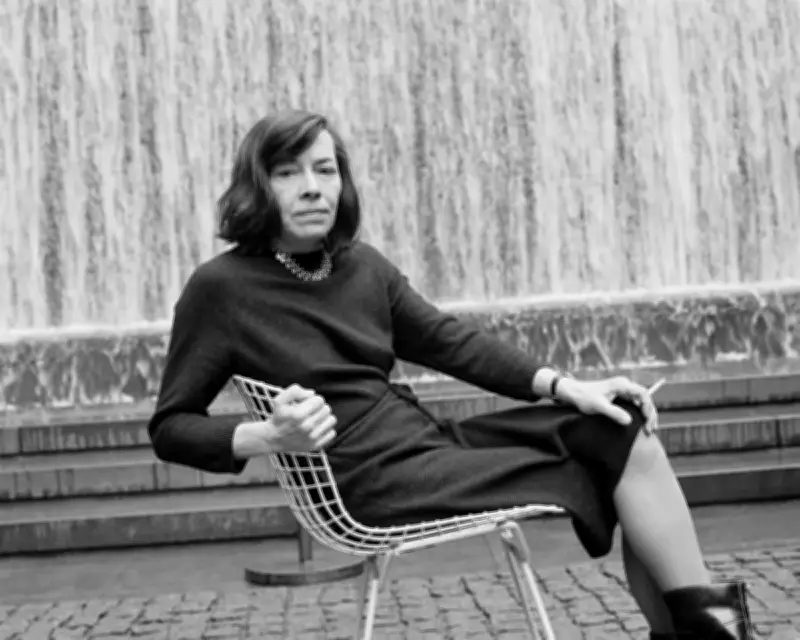
Publisher Otto Penzler has loved Patricia Highsmith's work all his life, but their first meeting in 1984 was a washout. She agreed to give a reading at The Mysterious Bookshop, his store on West 56th Street in New York, but almost no one showed up. The American author of the Ripley novels, then 63, had lived in Europe for 20 years and seldom made public appearances.
Highsmith had little time for her readers. "She was somewhat taciturn. People got their book signed and left within five minutes," Penzler recalls. She stonewalled his small talk about France with an "I can't stand the bloody frogs".
A Difficult Author to Publish
Highsmith, born in Fort Worth, Texas, in 1921, had a hit with her 1950 debut Strangers on a Train, boosted by Alfred Hitchcock's film. Her second novel, lesbian road trip The Price of Salt (later republished as Carol), sold a million copies under the pseudonym Claire Morgan, and The Talented Mr Ripley (1955) was a critical success. But by the mid-1960s, her American luck ran out: her agent wrote that her books were "too subtle", her characters too unlikable, to make it into paperback. By 1984 she was without an American publisher.
"She never found a home because she was so unpleasant," Penzler says. Not yet knowing this, he signed a six-book deal with Highsmith, creating a new imprint in the process. "Pat didn't want to be identified as a mystery writer, so I started Penzler Books." Highsmith's first editor, Joan Kahn, warned him: "God, what's wrong with you? Later we agreed she was a monster."
A Talent for Murder and the Misanthrope Image
In Anton Corbijn's new film A Talent for Murder, adapted from Joanna Murray-Smith's 2014 play Switzerland, a dying Highsmith is played by Helen Mirren. By 1995, when the film is set, Highsmith had lived alone for years, ending her last relationship with the translator Monique Buffet, then 27, when she was 66. The film's premise is that a young American editor must persuade Highsmith to write one last Ripley novel.
The image of the misanthrope has helped keep Highsmith's legacy alive, with Ripley recently remade by Netflix. Penzler remembers that on one book tour, his wife and he took her to their most beloved Italian restaurant. A young publicist came with two long-stemmed roses. "My wife said, 'Oh, what a sweet thing!' Pat threw hers on the floor without making eye contact. You can't imagine a person like this."
Prejudices and Work
By 1967, Highsmith had begun a lifelong relationship with the Swiss publisher Diogenes, who took control of her literary estate when she died – as well as 56 volumes of unpublished diaries, letters and stories. Those diaries laid bare Highsmith's antisemitism and racism. In her introduction to a published edition of them in 2021, her Swiss editor Anna von Planta writes that Highsmith's views have been represented faithfully, even where offensive, but that "in a handful of more extreme instances [we did] feel it our editorial duty to deny Pat a stage for them".
Even those repelled by Highsmith's prejudices shared an appreciation of her work – its strangeness, precision, gift for character and its unfashionable darkness. That bleakness sold better in Europe: even a weak late novel, Found in the Street, sold 40,000 copies in Germany compared with 4,000 in America.
Final Editor's Memories
Gary Fisketjon was Highsmith's next and final American editor, at Atlantic and then Knopf. He died suddenly of a stroke on 7 November, aged 72, but a week earlier he had nothing but good memories of her. "We never had a cross word," he said. At the Frankfurt book fair, she and Fisketjon talked about their cats. "She was a superstar in Germany, and she was careful to instruct me on the best way to drink their beer, with the foam on top."
Fisketjon had passed on her final novel, Small g: A Summer Idyll, feeling he "couldn't publish it as fervently as Pat deserved. She took it better than I feared." He had seen A Talent for Murder a couple of days earlier, and liked it, while finding the plot implausible. "Dame Mirren's expressions reminded me vividly of Pat, even if her personality was a lot darker than I ever saw."
Legacy and Recognition
Liz Calder looked after Highsmith at Bloomsbury in the late 1980s until the author's death. Now 88, she remembers Highsmith as "very, very unusual. She would comment a lot on things around her – 'look, something's happening over there' – or on what I was wearing. She was almost unsocialised." At the same time, she had close friends in London, France and Switzerland.
Highsmith died of lung cancer and anaemia on 4 February 1995, aged 74. The American papers ran obituaries but there was no bump in sales. When editor Robert Weil approached Diogenes about publishing a couple of her books at WW Norton in 1998, they insisted he acquire all 14 that were then out of print in America, including Strangers on a Train. "I was new at Norton. They said, 'This is folly, the sales don't bear up.' But I was persistent." He agreed to Diogenes's terms, eventually taking on her last unpublished novel, Small g, as well as the Ripleys, Carol and dozens of unpublished stories.
Now an executive editor at the Norton imprint Liveright, Weil thinks there is still more to be done with Highsmith. "What she could do in 12 pages was amazing," he says. "Highsmith can write these stories where you feel stabbed at the end – she knows how to finish something." He reckons there are at least five potential screenplays in a 2002 collection, Nothing That Meets the Eye. "She learned to skin and savage America. She never left it psychologically." In her understanding of greed, she is like Edith Wharton, Weil says. "But in terms of psychological manipulation, there are very few like Highsmith. She was so far from the mainstream, and she should have been a debutante from Dallas."
Highsmith was rude and sometimes bigoted. She also had a capacity for friendship, and for work that would have been impossible without empathy. Both things can be true, as her favourite creation Ripley attests – beneath the good man lies an evil one; beneath her cruel exterior lay someone capable of kindness. In March 1995 Liz Calder caught a train to Highsmith's memorial service at the Chiesa di Tegna in Switzerland, accompanied by her UK agent Tanja Howarth. They had both found Highsmith difficult. "But we wanted to go. And it was very strange – it was well attended but not by many publishing people. Tanja and I didn't know anybody." The Highsmith they knew was not the one her friends mourned. She was a mystery to the last. A Talent for Murder is released in cinemas on 20 November.