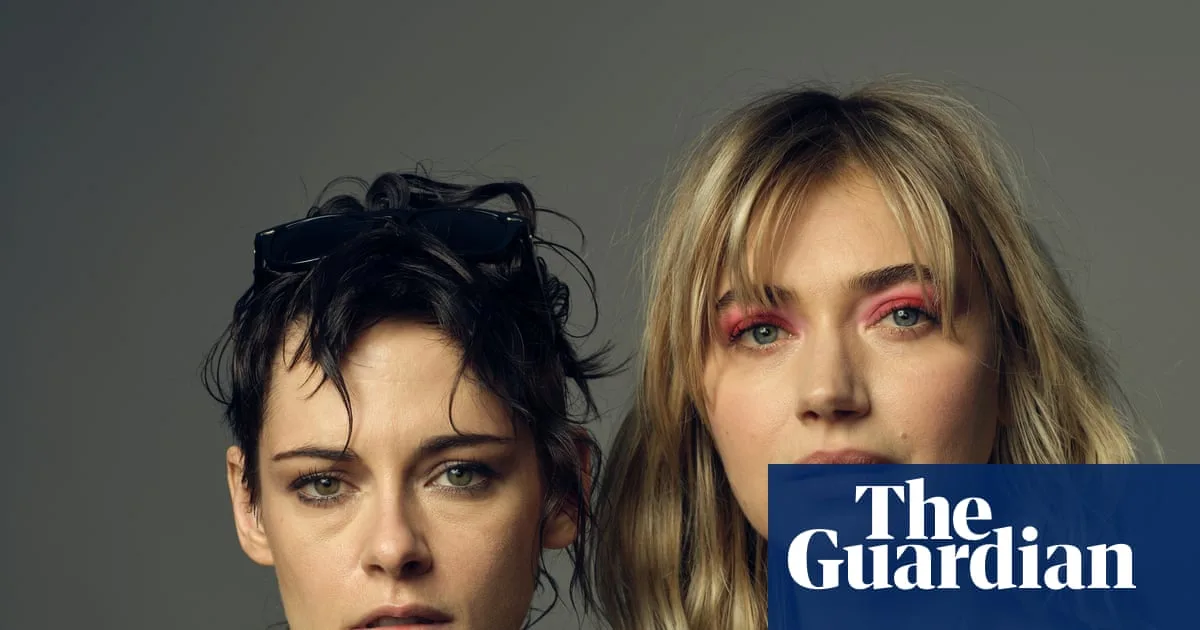
Kristen Stewart has described her feature directing debut, The Chronology of Water, as a film that is “to be eaten alive and re-metabolised and shat out differently, from everyone’s perspective”. The impressionistic, arthouse collage, adapted from Lidia Yuknavitch’s experimental memoir, has been doing the rounds at film festivals, and reviews are coming in. Stewart is unapologetic about the polarising response, quoting one Letterboxd review: “The Chronology of what the fuck did I just watch?” She insists the film is genuine: “Whether it’s your least favourite movie or your most favourite, it’s not lying, it’s genuine. And I’m so fucking proud of that.”
The film follows a woman’s pain and loss, the elusiveness of memory and the reclamation of desire. Stewart first read the book in 2018 while on the set of JT LeRoy, and was immediately convinced it had to be her first feature. “Forty pages in, I was so rallied and so viciously adamant that nobody else could make the movie but me,” she said. “It was so physical. So vital. Such a permeating secret.” She was drawn to Yuknavitch’s treatment of trespass and how desire is “carved into your body”. In typically forthright style, Stewart added: “As a woman, we have these seeping birthplaces that are our orifices, and it’s where we hold our power, but it’s also where we’re taken advantage of.”
Stewart said the book felt like “the muzzle was off”, and sent Yuknavitch an email. The author, speaking from her home in Portland, Oregon, recalled being “wildly excited” by the message. “She was explaining to me why I could never let this book be a regular biopic movie, and how I had to let her make a piece of art out of it,” Yuknavitch said. The author, who has been obsessed with films since childhood, had long admired Stewart’s work, and even wrote a novel with her in mind. “I pictured her in my brain when I wrote this novel,” she said, referring to Dora: A Headcase. Of the connection, Yuknavitch said: “Artists have a tendency to find each other. They run across each other’s work, and these threads or streams we don’t entirely understand touch each other.”

The film was not easy to finance. Stewart and star Imogen Poots discussed how confessional literature by men is taken seriously, while work by women is “belittled, constantly”, in Stewart’s words. “We’ve just been fully X-ed out of modernism in the canon,” she said. “You have to be Virginia Woolf to be considered a good writer.” That attitude extended to pitching the film. “When people read it, it was reduced to how to sell it. OK, well, what’s it about, incest and rape? Fun!” Stewart admitted. “It’s about the gouging out of desire, and the reframing of that, and how empowered that is. In a slug line, it’s a really tough sell.” Despite the challenges, Stewart remains fiercely proud of the work, which she described as having “a loud mouth. A big, wide-open mouth.”