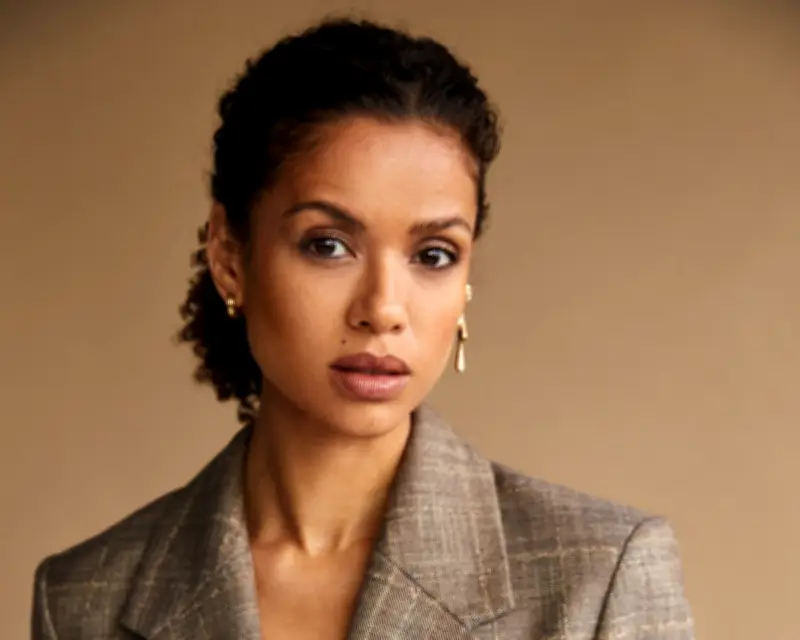
Gugu Mbatha-Raw seems blissfully immune to the heat. London is pushing 40C on one of those heatwave mornings when everyone is wearing the weather: damp collars, flushed faces, hair slicked to foreheads. Arriving at the cafe of the central London hotel where we meet, however, the star looks as if she’s stepped in from an altogether different climate. Dressed in a pristine white linen two-piece, makeup free, hair scraped back, she carries herself with a composure that makes everyone else’s perspiration seem faintly melodramatic.
She is, in every sense of the word, cool. This impression is only reinforced as we settle in for some small talk and she mentions that she’s been to the hotel once before. “I stayed here during the premiere of Belle – gosh, almost 15 years ago now,” she says. Then, almost as an afterthought: “And Prince performed at the afterparty.” She laughs at the look on my face. “It was incredible,” she says. “Just completely surreal.”
From Belle to Possession
Since Belle – Amma Asante’s luminous 2013 period drama about Dido Elizabeth Belle, the real-life mixed-race daughter of an enslaved African woman raised in the English aristocracy – Mbatha-Raw has become one of Britain’s most fascinating actors. From playing the lead in Charlie Brooker’s acclaimed queer Black Mirror episode San Junipero and starring in Jennifer Aniston and Reese Witherspoon’s workplace #MeToo drama The Morning Show to leading Apple TV’s identity-bending psychological thriller Surface in which she plays a woman recovering after a suicide attempt, the 43-year-old has consistently chosen projects that are intellectually and politically ambitious – roles one might summarise as having “something to say”.

“I don’t want to do the same thing all of the time,” Mbatha-Raw tells me. “It’s fun for me to go from a period drama to a romantic drama to a comedy – it keeps me stimulated.”
A supernatural thriller about slavery
That instinct is precisely what drew her to Possession, Sky’s new supernatural thriller. Mbatha-Raw plays Claudia, a Bristol lawyer dispatched to Jamaica after a white plantation owner’s wealthy descendant dies suddenly, leaving his fortune not to his family but to a Jamaican man nobody can seem to track down. Claudia is assigned the case partly because, as one colleague bluntly puts it, having a Black, half-Jamaican lawyer would be “better optics”. But the legal work slowly gives way to something far more unsettling: the ghosts of Britain’s colonial legacy – both literal and metaphorical – intrude upon the present.
“I was fascinated by Claudia because she’s caught between her professional obligations and her own personal history,” says Mbatha-Raw. “[She goes] from this relatively detached, brittle, ambitious career woman who was quite numb to her heritage and disconnected from her Jamaican background to becoming more grounded and rooted.”
The story slips between modern Jamaica and the brutal realities of plantation slavery. But the enslaved do not remain confined to history: the enigmatic Cudjoe East, the man at the centre of the inheritance dispute, claims to be an enslaved man cursed centuries earlier to wander the Earth. In the past, a plantation mistress keeps grisly relics – locks of hair, severed ears – to perform magic on the bodies of those she enslaved. Present-day characters find themselves possessed by the spirits of enslavers, while Claudia struggles to resist being claimed herself.
Filmed on location, much of the show’s richness comes from the vision of its Jamaican director, Storm Saulter, whose work has long explored the country’s layered histories and identity. The island is rendered in full polyphonic Technicolor: music and traditional masquerade rituals punctuate the narrative, while Obeah – the African-Caribbean spiritual practice of contacting ancestors, long feared by colonial authorities for its association with resistance and rebellion – becomes one of the show’s recurring motifs.

“We wanted everything to feel as real as possible – the beauty of the colour, music and smells of Jamaica, but also its darkness,” says Mbatha-Raw. “We filmed at a real plantation house – all the scenes in the grounds, with enslaved people working on the land – real people lived and died there. Driving up the hill towards the house, you could really feel the weight of history.”
Racially conscious horror
The show belongs to the same lineage as Jordan Peele’s Get Out – racially conscious horror, in which the supernatural is merely a conduit for the far more terrifying legacy of racism. It is a provocation about reparations, colonial wealth and Britain’s historic relationship with slavery. In one pointed exchange, Claudia and the son of the plantation owner discuss the fact that the British government compensated former slave owners after abolition – a debt underwritten by taxpayers until 2015 – while those who had been enslaved received nothing. These are conversations that feel particularly pointed with the rise of far-right nationalism and racism in the UK and beyond.
“It’s uncomfortable to talk about reparations, it’s hard to talk about slavery and how we make peace with that history,” she says. “I think that’s what makes [the show] so compelling,” she continues. “You can’t just paper over the cracks of history. If we don’t deal with it, it will find ways of haunting us.”
Belle’s legacy and Bridgerton
More than a decade separates Possession and Belle, but the two projects feel in conversation with one another in their meditations on empire. “It’s funny because it wasn’t like a huge blockbuster film,” she says when I ask how the movie changed her life. “But it was my first lead role, and it opened up lots of opportunities for me. And it was an important story to tell. A lot of people didn’t know that mixed-race characters existed in history – certainly not of any status, because you never saw them in movies unless they were a slave or being brutalised in some way.”
Before we meet, she tells me she took a walk through Hampstead Heath to Kenwood House, once the stately home where Dido lived. “I wanted to immerse myself in that history again before speaking to you,” she says. Looking back now, she believes Belle helped widen ideas about who gets to exist in Britain’s period dramas. “I do think Belle helped pave the way for a show like Bridgerton,” she adds. “Just having Black and brown people visible is a huge change in the last 10 years or so.”
Personal history and career
Politics has never been optional in Mbatha-Raw’s life. She was born in 1983 in Witney, a town just outside Oxford. Her father was a student anti-apartheid activist and ANC campaigner who fled South Africa to avoid imprisonment on Robben Island, eventually rebuilding his life with support from the UN’s Refugee Agency. “I remember we would talk about politics at the dinner table, but when you’re South African, you don’t know any different,” she says.
She grew up an only child, living with her mother, a British nurse. Her parents split when she was young, but her father remained in her life. Ballet was her first love, as well as music – she trained with the National Youth Music Theatre before going on to Rada.
As a young, biracial aspiring actor – particularly one growing up outside of London – has she ever felt held back by her race? She demurs. “There were certainly some roles that would have been closed off to me, like those early Regency-era roles, but the industry is changing in a really positive direction,” she says.
She does mention that early on in her career, an older – white – actor suggested she change her name to something easier to pronounce. It was advice she politely ignored. “I love my name, it’s what makes me who I am,” she says. “I don’t think it’s that hard to pronounce. Plus, it translates to ‘our pride’ in Zulu, so changing that would feel so wrong – the opposite of what it means!”
After graduating from Rada in 2004, Mbatha-Raw built her career the old-fashioned way: on stage. In 2005, she appeared in Antony and Cleopatra before landing one of her first major roles opposite Andrew Garfield in Romeo and Juliet at Manchester’s Royal Exchange. Supporting screen roles in Bad Girls, Marple and Doctor Who followed, before a celebrated turn as Ophelia opposite Jude Law’s Hamlet in the West End and on Broadway. JJ Abrams saw the production and cast her in his American spy drama Undercovers, opening the door to Hollywood.
For years she lived peripatetically, dividing her life between sets in the US and London. For now, she is London-based again. Her move coincided with a broader exodus of Black British actors across the Atlantic. Daniel Kaluuya has spoken about not getting roles in the UK “because of the colour of my skin”; David Oyelowo has talked of being “pushed out” because of the racial “glass ceiling”, as has David Harewood. Blockbuster names such as Cynthia Erivo and Damson Idris have found some of their biggest roles in the US, fuelling a long-running debate about whether Britain’s film and television industry truly nurtures its Black talent.
“It’s definitely something I’ve heard, but it hasn’t been my personal experience,” she says when I ask about this. “I didn’t go to the US looking for opportunities; I got offered a role in Hollywood because of the work I’d already done here – and that’s not really something you turn down. I was very lucky.”
Mbatha-Raw is thoughtful and politically engaged, but I get the sense she would rather speak through her characters. “I wouldn’t ever want to tell people what to think or experience,” she says. “Maybe Possession will inspire people to think about the more thought-provoking conversations around slavery, the idea of reparations and the complexity of that. But mostly, I just hope people find it entertaining.”
Possession starts on 6 August on Sky Atlantic at 9pm.