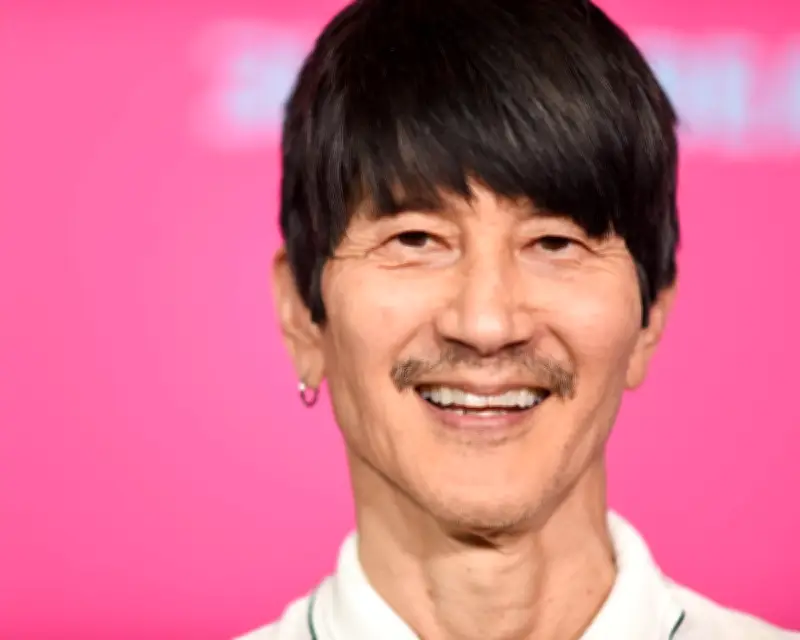
Gregg Araki is in a buoyant mood. On a video call from his Los Angeles home the week of the release of his 12th feature, I Want Your Sex, the 66-year-old cult director wears a striped tank top and looks at least two decades younger than his age. “The world’s so fucked up right now with wars and ICE and fucking genocides that I want to put a little queer joy and positivity into the world,” he says.
I Want Your Sex is a deliriously fun and often hilarious study of desire, power and art, featuring bondage, full-frontal nudity and a vagina made out of pink chewed-up bubble gum. It is not Araki’s first heterosexual movie – that was 1995’s The Doom Generation – but it is his starriest in years, perhaps a sign that Hollywood has caught up to his anarchic vision. The film opens on 700 US screens this week, his biggest audience to date and a wider opening than recent films by indie veterans such as Nicolas Winding Refn and Jim Jarmusch.
A queer story across the spectrum
“For me, it is a very queer story,” Araki says. “It’s a take on kink and alternate sexuality that goes right across the straight-queer spectrum.” The film follows Elliot (Cooper Hoffman), a puppyish 23-year-old college graduate whose ambition in life amounts to a vague goal to start a podcast. After he becomes an assistant to the brash, sexually carnivorous artist Erika (Olivia Wilde), he instantly falls under her spell, leading to a polymorphous parade of sexual epiphanies as he becomes, as he says of one of Erika’s artworks, “a slave to this vagina”.

Charli xcx plays Elliot’s dorky girlfriend, whose idea of a good time between the bedsheets is poring over a neurology textbook. Johnny Knoxville and Margaret Cho appear as detectives who interrogate Elliot after a body is discovered floating face-first in a swimming pool. Mason Gooding’s Zap cuts down Elliot’s claim of being “queer adjacent” by retorting: “Have you ever sucked a dick?” Araki has a soft spot for the character too. “He’s very much my snarky sensibility,” the director says.
From 50 Shades to a role reversal
The project was originally scheduled to shoot after Araki wrapped promotion for White Bird in a Blizzard, a 2014 drama starring Shailene Woodley and Eva Green. Back then, the script was something like “a comic 50 Shades of Grey”, he says, with a female intern seduced by her male boss. But after initial funding fell through, the project was put on ice. When Araki revisited the script after making 2019’s teen TV comedy Now Apocalypse, he worried it felt tone-deaf in the wake of #MeToo.
“I started to feel uncomfortable with the [script’s] image of a woman getting dragged around by the hair, even in a consensual situation,” he says. “I don’t want to kink-shame anybody, but as a man, I didn’t really want to put that image out there.” That is when he got the idea to flip the sex roles and make it a male sub and a female dom. “I’ve always been a very hardcore feminist from the time I was in film school in the late 70s, so the Erika Tracy character became much more interesting to me.” The script further crystallized after a 2022 study found that gen Z were having less sex than previous generations. Erika tells Elliot: “Your generation’s all about Fomo and you’re missing out on the sexual part.”
Gen Z and the fear of missing out
The day before the interview, the Hollywood trade magazine Variety tweeted an Araki quote predicting that gen Z will inevitably “regret” not having sex out of fear of getting hurt. Some readers got defensive; others took it as a kick up the butt. “He’s so right let me start fucking for real,” wrote one young cinephile. Araki seems thrilled about getting people talking. “That is one of the most exciting things about the movie to me,” he says. “I don’t want to lecture anybody, but I want to open up a conversation.”

“I don’t want to say all of gen Z, but a certain number of gen Z live a sheltered life and don’t go out much,” he continues. “It’s like [they have] a fear of making a mistake, or being uncomfortable or of having an experience that’s not wonderful. A lot of those experiences are not wonderful! The first time you ever get your heart broken or someone cheats on you, it really rocks your world. I just can’t imagine going through life without that experience.”
The R-rated HBO of sex scenes
Araki thinks that sex is missing in movies, even the ones ostensibly about it. “There’s this whole talk about [cinema’s] sexual renaissance with Babygirl and Pillion,” he says. “But I didn’t find Babygirl sex-positive at all. The way that the Nicole Kidman character gets punished for exploring her own desires made me a little uncomfortable.”
The hockey-themed gay TV show Heated Rivalry has been accused of sanitizing sex for the female gaze. Araki responds with a slight frown and “Uh huh”, but he turns out to be a big fan. “I thought the sex scenes were well-handled and not really watered down,” he says. “It’s kind of what a lot of my sex scenes are: ‘R-rated HBO’. You don’t see genitalia but it’s as explicit as you can be without crossing the line into adult entertainment.”
Trusting actors and finding sweetness
Amid the raunch, there is a sly sweetness to I Want Your Sex. Elliot discovers an unexplored desire to fulfill orders, telling Erika moonily over lunch, “I kind of like being your toy.” Araki based Cooper’s character on himself in his early 20s, when he was trying to figure out his sexual identity; the director now identifies as gay but was in a public relationship with actor Kathleen Robertson in the late 90s. Erika is partly inspired by post-fame Araki, with much of her dialogue culled from the director’s own past interviews. Before shooting, he told Wilde there was no room for nerviness on his set: “Whoever plays this part needs to be completely fearless and not give a fuck about what people think.” She replied, “That’s what I want to do.” Between this and The Invite, Wilde has emerged as one of the most fun actors to watch this summer.
Araki has always taken audiences out of their comfort zones. His breakout feature The Living End featured a then-unprecedented sex scene between its HIV-positive gay lead characters, while 2004’s Mysterious Skin unflinchingly examined the after-effects of childhood sexual abuse, anchored by career-best performances from a young Joseph Gordon-Levitt and future Oscar-nominated director Brady Corbet. He says the key to his relationships with actors is trust: “I’m not a director that is like: ‘OK, here’s how you’re going to act this scene.’ Once I find the right person and they’re in front of the camera, I just let them have at it.”
The hideous art of Erika Tracy
While Wilde and Hoffman’s chemistry is explosive and often outrageously funny, the film is just as cutting in its satire of the commercial art world. Erika’s art is frankly hideous, with her gallery space full of garish pop-feminist sculptures and photography that a finance bro might buy to impress co-workers with his hip bona fides. Araki, perhaps a little generously, describes the character as a cross between Robert Mapplethorpe and the “pure provocation” of Madonna circa Sex, the 1992 top-shelf publication that caused much pearl-clutching for its graphic content.
Make love, not war
Asked whether society has gotten any more open-minded about sex in the 34 years since, Araki says no. “In America, things are worse than they’ve ever been,” he says. “The level of puritanical tyranny, repression and cancelling of trans people … it is awful right now. That’s why the movie ends with the Jessie Ware song Free Yourself. I’m old school in a sense: I absolutely believe in ‘make love, not war.’” He goes on: “So much of the hatred, the misery and the aggression and the violence and all the fucking terrible shit in the world right now is from this weird sexual repression. My movie is my version of Free Yourself... The sentiment of the song is very positive, inclusive and progressive – the opposite of this culture of oppression and fascism with the dictatorship of our current administration.”
Hope for the next generation
He feels fundamentally hopeful about the next generation, despite wishing they would get laid more. “Whenever we do screenings in New York, [the audience is] all these Letterboxd kids,” he says, referring to the social platform for movie fans. “And they’re very sophisticated cinephiles – Charli xcx is one of them! They have very discerning taste in auteurs. It really gives me hope that this younger generation seeks out films that are not your standard popcorn multiplex movies.”
While a recent Glaad report found that LGBTQ+ inclusion is at a three-year low in films from the 10 largest distributors, Araki says that queer cinema is in great shape if you know where to look. “At Cannes this year, it was like a bonanza of queer movies,” he says. “It’s amazing that that is the state of where we are at. That’s kind of where the queer new wave came from in the first place, way back in the early 90s where all of us – Todd [Haynes] and Gus [Van Sant] and I – were just kids.”
He sees similarities between LGBTQ+ life today and that of the early 90s. “Because of the Aids crisis, queer people were kind of being exterminated, so there was a need for expression,” he says. “I think that exists today as well. Queer film-makers that can see the writing on the wall, and that the right wing in this country are not going to stop at trans people. We’re not safe.” Still, he says, “It’s very important to be able to have a queer voice and be unfiltered about it. That’s where almost all my movies come from. You know, that’s the magic.”
I Want Your Sex is out now in the US, on 27 August in Australia and on 28 August in the UK.