Being young is a terribly embarrassing, unbearably gauche state of affairs – or it is in the world of Samuel Beckett's 1958 miniature masterpiece Krapp's Last Tape, anyway. Gary Oldman makes a vanishingly rare stage appearance in this time-stained monologue, playing a man who rages against his bumptious past self, as captured in old reel-to-reel recordings. There's a strange aptness to the Royal Court's decision to stage it alongside a new play by 19-year-old Leo Simpe-Asante, which is full of the kind of youthful boisterousness that Krapp abhors.
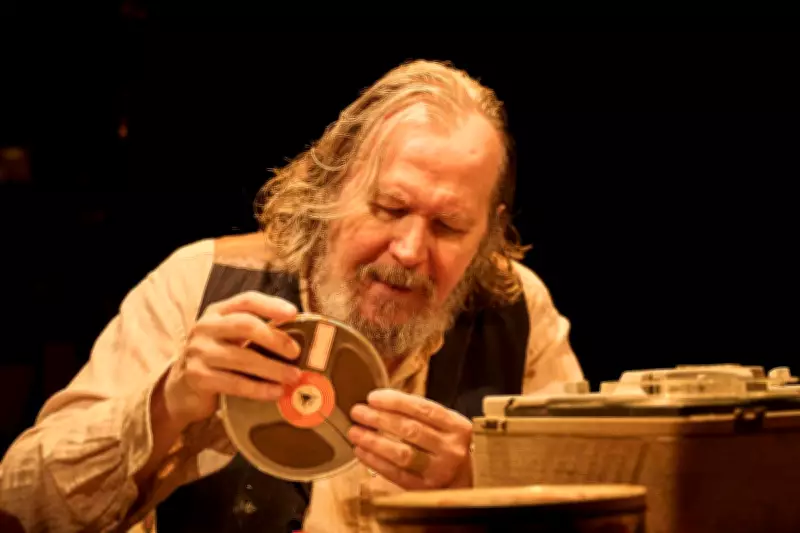
This is Oldman's first stage work in nearly four decades, transferring down to London after an initial run in York last year. It feels like he's obsessed over every detail of this big, elegiac (and self-directed) comeback, crawling into the heart of Beckett's dark and dingy play. He's even designed the set himself, turning the stage into a crusty kind of living room piled high with tea chests and the accumulated detritus of Krapp's unsatisfactory life. Oldman gives his Krapp a dried-out brittleness, his hair puffed out in grey wisps, his voice thin and whistling. Memories are just more meaningless clutter, this weary failed writer is realising, as he messily spools out his past self's thoughts and ideas in the fading light.
This play is Beckett at his brilliant, merciless best, and Oldman's staging brings out all its cruelty by showing how utterly destroyed Krapp has been by his own self-deluded ambitions. Again and again, the tape gives us younger Krapp expounding on how he's at the pinnacle of his intellectual powers, on the brink of a great realisation, or setting some great goal – only for his weedy, cynical present self to cut him off with an impotent cry of “b*****ks”! When Krapp's emotions are swayed by his past, it's quieter – he lingers on a section obsessively, wallowing in his regret at a relationship that he allowed to fizzle out, or a woman's fine pair of eyes that he'll never see again.

Beckett's final words land devastatingly here. “My best years are gone...but I wouldn't want them back,” Krapp tells us, emptily, even though the only pleasure left in his desiccated world seems to be the juicy bananas he scoffs in the play's opening moments. You can almost feel the audience having a collective existential crisis, sinking into their leather chairs as they confront an essential human truth: we always cling onto the feeling we're getting somewhere, even as the powers we once had are slipping from our grasp.
But before we get to this emotionally crushing finale, there's Simpe-Asante's rowdy curtain-raiser to get through. Yes, there's a long tradition of Beckett's shorter works being paired up in performance, and it's certainly a nice gesture to platform a fresh voice at the home of new writing. Still, the actual reality of watching Godot's To-Do List doesn't really live up to those worthy justifications. It's an underdeveloped meta-theatrical short about a weirdly ordinary, everyguy version of Beckett's famous protagonist Godot (Shakeel Haakim). He's trapped in liminal space, while a voice on a demented self-help tape (Flora Ashton) forces him to contort himself through a series of quasi-helpful tasks. There are moments that feel like accurate satire of 2026's mindfulness-saturated psychological landscape: the tape repeatedly commands Godot to breathe until he's basically hyperventilating. But there's also a juvenile crassness to its jokes about pig orgasms, and a flimsiness to its structure that can't stand up to Beckett's masterfully constructed monologue.
It takes a lot of genius and a lot of experience to convey oceans of complexity in a few short words – and Oldman's return to Beckett does just that. It's a profoundly weighty half an hour, saturated in regret and loathing for the youthful hubris that's gone before. ‘Krapp's Last Tape / Godot's To-Do List’ is at the Royal Court Theatre until 30 May.