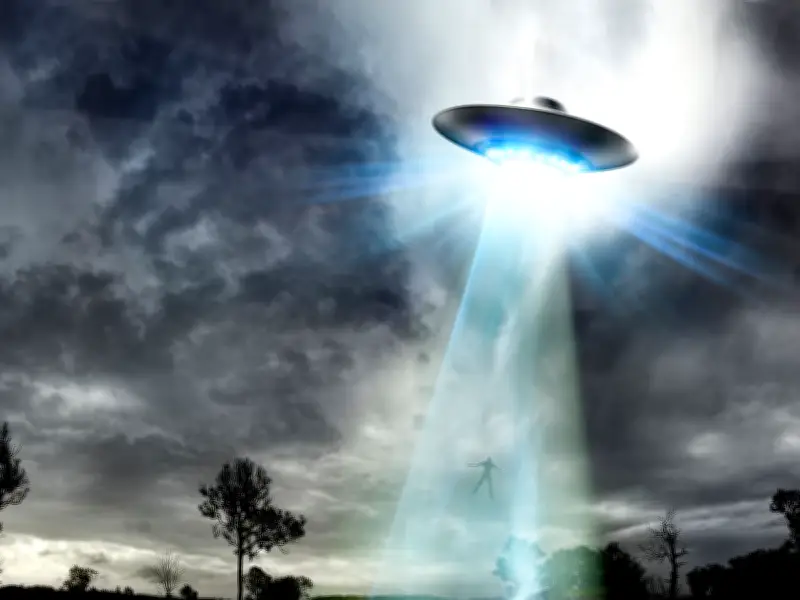
As the US government finally blows the lid off what it really knows about extraterrestrials with its latest mind-blowing disclosures, the world has gone officially UFO-mad. But while modern boffins are busy analysing high-tech radar data, humans have actually been coming up with utterly bonkers ideas about space for centuries.
From the moment Galileo built his first telescope in the 1600s, history's biggest brains became obsessed with finding cosmic neighbours. Legendary philosopher Immanuel Kant genuinely believed Mercury was home to total dimwits while Saturn housed absolute geniuses, while Uranus finder William Herschel claimed that heat-resistant "Solarians" were happily living inside the scorching hot sun.
But while we've spent centuries shouting into the void, the late Stephen Hawking famously warned that we might want to shut up before we attract ruthless alien "pirates" looking to conquer Earth. Here, the Star takes a look at the craziest theories and close encounters from our long history of searching the skies.

Written in the Stars
We've been searching for aliens for longer than you'd think. We got our first decent look at the night sky in the early 1600s, when Galileo Galilei built a telescope strong enough to use for astronomy. After stargazers spotted dark shadows on the moon, many believed they were oceans teeming with life.
Space Oddities
Born in 1724, Immanuel Kant was convinced the six known planets in the solar system were full of extraterrestrials. The philosopher thought these creatures were arranged in order of intelligence, with the thickest on Mercury, brainiest on Saturn.
Place in the Sun
Astronomer William Herschel, who discovered Uranus in 1781, was a committed alien believer who thought every celestial body was inhabited - including the sun. Rather than a star, he claimed it was a planet with a fiery atmosphere. He said the "solarians" who lived there had adapted to the extreme heat.
Contact Sport
We started thinking about how to contact aliens in the early 1800s. German mathematician Carl Friedrich Gauss is said to have suggested carving massive shapes into the Siberian forest, big enough to be seen from the Moon.
The Sky's the Limit
Thomas Dick raised eyebrows in 1837 when he claimed the Solar System was packed with 22 trillion aliens - with 7 trillion on Jupiter alone. The Scottish scientist based his calculation on the population of England, which had 280 people per square mile at the time.
Active Listening
One of the first projects searching for alien life was launched by US astronomer David Peck Todd in 1924. His team of scientists used an airship to lift a radio receiver several miles above the ground. They hoped to hear messages from creatures on Mars, which was making a close approach to Earth.
Saucer Concern
The first famous UFO sighting took place in 1947 near Mount Rainier in Washington, US. Businessman Kenneth Arnold claimed to see a group of nine crescent-shaped objects while flying his small plane. A newspaper incorrectly described them as saucer-shaped, coining the phrase "flying saucer".
Stars in Their Ears
The international search for extraterrestrial intelligence (SETI) started in 1960, when US university Cornell used a radio telescope to listen for alien signals. Boffins in Ohio picked up a sound bearing the hallmarks of otherworldly origin - dubbed the Wow! signal - in 1977, but it has never been heard since.
Watch This Space
Stephen Hawking warned humanity not to advertise our presence to other planets in 2010. The late astrophysicist feared we could attract alien "pirates" who wanted to take over. He said it "could be like the Native Americans encountering Columbus".