Ernest Hemingway employed a straightforward technique to make the start of each day's writing as effortless as possible: he would stop the previous day's work in the middle of a sentence. Conversely, novelist Ann Patchett would enter work mode by attaching a sign-in sheet to her office door.
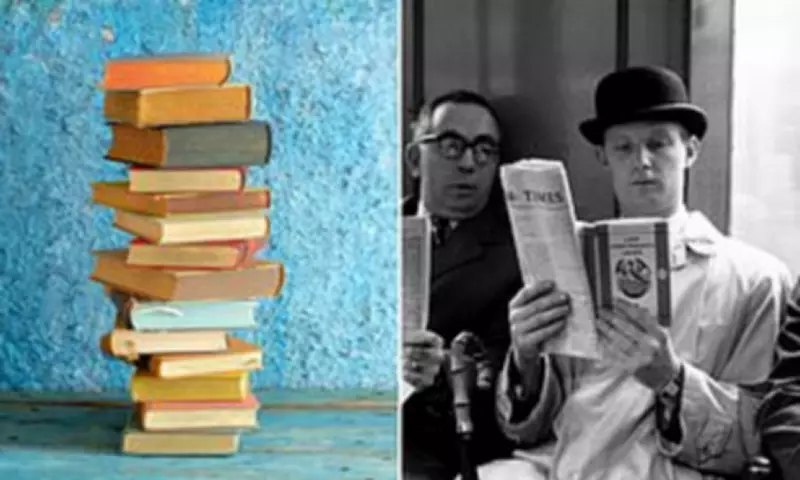
Scandalous sixties: reading Lady Chatterley's Lover. And D. H. Lawrence, as one might expect from the author of Lady Chatterley's Lover, sought inspiration by climbing mulberry trees in the nude.
If you think writers are peculiar, you should observe their readers. Barry Humphries amassed a collection of 25,000 books—a clear case of tsundoku, the Japanese term for buying more books than one can read.

One woman, when confronted while attempting to steal Andrew Morton's biography of Princess Diana from a London shop, burst into tears, only able to utter 'she was the people's princess'.
When Making a Book Goes Wrong
Lee's captivating book examines what happens when book production goes awry. In the days of metal type, one might occasionally see the line 'etaoin shrdlu' by mistake because the typesetter had forgotten to remove a row of letters, which were arranged by frequency of use. 'Rogues' and 'orphans' are words left isolated at the beginning or end of a paragraph.
Alternatively, the problem might be getting your book read at all. The Catholic Church only abandoned its list of banned books in 1966, while in 1940 the Soviet Union employed 5,000 censors—more than it had writers.
Returning to Lady Chatterley, the prosecuting counsel in the 1960 obscenity case was asked how he decided whether to take action against a book. He replied: 'I put my feet up on the desk and start reading. If I get an erection, we prosecute.'
Rejection and the Changing Industry
There is encouragement here for any aspiring author who has faced rejection from a publisher. It happened to many greats, including Rudyard Kipling ('I'm sorry, Mr Kipling, but you just don't know how to use the English language') and Marcel Proust: 'Rack my brains as I may I can't see why a chap should need 30 pages to describe how he turns over in bed.' Although, as Lee points out, anyone who has tried reading Proust may agree.
The industry has changed significantly since Johannes Gutenberg invented the first printing press. Today, anyone can self-publish on Amazon—in 2007 only 3,804 books appeared that way; by 2023 it was 1.4 million. People are also concerned about the implications of artificial intelligence. Could a computer write a novel? Perhaps, but it will always require human input to learn from. If AI only ever copies from itself, the quality of its work will gradually diminish. Computer scientists call this 'system collapse'.
And every writer, whether cyber or human, needs an editor. Though Mark Twain had his doubts: 'Yesterday [my publisher] wrote that the printer's proof-reader was improving my punctuation for me, and I telegraphed orders to have him shot without giving him time to pray.'