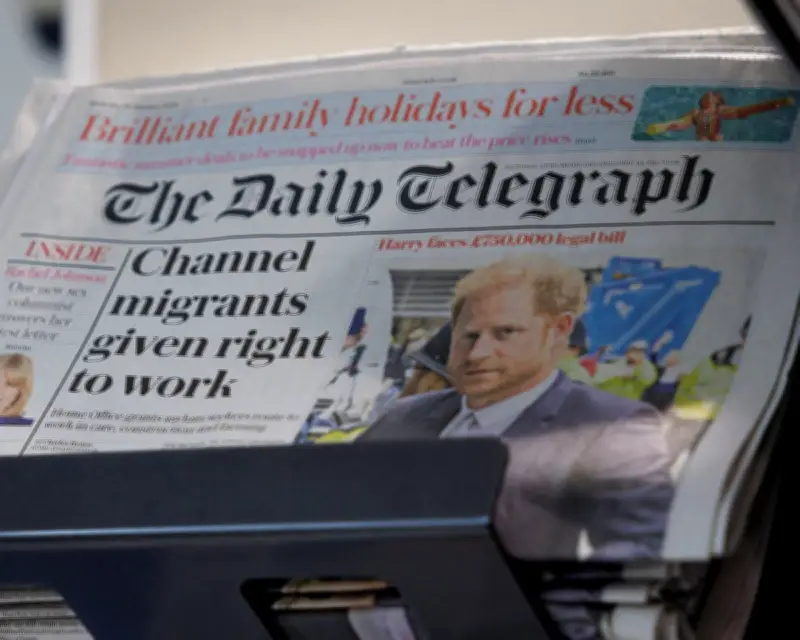
Axel Springer acquired Telegraph Media Group for £575m in June, ending three years of uncertainty about its future. The German chief executive, Mathias Döpfner, has outlined a bold vision to transform the traditionally conservative British newspaper into a global brand, with the United States as the primary target.
Döpfner's Vision for a Global Telegraph
Addressing staff at the London headquarters, Döpfner referred to his company's decades-long pursuit of the titles. He stated, "The Daily Telegraph can be a global Telegraph. It's a bold vision, but why not? The centre-right audience is vastly underserved in democracies around the world. So, the biggest opportunity is, of course, the US, the biggest media landscape in the world. What a big white spot the Telegraph can take advantage of." He also cited opportunities in Asia and Latin America, but US expansion is a top priority. According to an Axel Springer spokesperson, US expansion is "a top priority since we see a lot of potential."
Challenges of Breaking into the US Market
Senior media figures question whether Döpfner and his team are ready for the enormous challenge and expense. Andrew Neil, former Sunday Times editor, noted, "There is a gap in the market. The legacy US newspapers are overwhelmingly on the liberal left. But in my experience, not every gap in the market is a profitable business opportunity. It will require enormous resources. America is a very expensive country to do business in and it's a big country, so you need deep pockets. There's no overnight success. No one's heard of the Telegraph. Even the title – the Telegraph – that's what they used in cowboy movies. It's a 10-year project."

Comparison with Previous Attempts
The US plan is similar to the strategy of former CNN president Jeff Zucker, who led a UAE-backed consortium's failed 2023 attempt to buy the Telegraph. Zucker planned to target a free-market, socially conservative audience. Supporters said that vision came with £100m spending money. Telegraph insiders are guessing how the stateside push will be funded, with some believing money will come from non-editorial posts. Axel Springer also has its own cash reserves.
Political Positioning and Competition
The Telegraph's political stance is a key question. UK media figures observe a shift further right, with flirtation with Reform UK. However, US senior media executives note it is not an easy time to pitch at a fractured US right. One executive said, "The kind of highbrow, Trump-curious right is about five people. We're in the middle of this huge backlash against the Trump administration, so it's a tricky moment to jump into rightwing media." The Free Press, launched by Bari Weiss, has found an audience with anti-woke, anti-cancel culture focus, making it harder for the Telegraph to find untapped audience. The Maga audience is served by Fox News and digital channels. Tina Brown, ex-Vanity Fair editor, said, "I do think there is potential if it doesn't go excess Maga. They could also go very strong on the new business stars of both tech and crypto."
Advantages and Strategies
Axel Springer can leverage its US assets, Politico and Business Insider, to bolster the Telegraph. Some see advantages in British journalism's disruptive style. The Spectator has its highest-ever US subscriber numbers. Brown suggested the Telegraph should be "less earnest than US papers with some of the Spectator flair" and "very scoopy on politics." Neil backed retaining irreverence and brevity. Lionel Barber, former Financial Times editor, said the Telegraph must hire US journalists: "You definitely need to hire local – you can't just have redcoats turning up. Then the question is, how do they connect to London?"
Funding and Investment
The ultimate question is investment. Brown stated, "A lot more than they have in mind. A fact that is always true in buying media." Döpfner's podcast series has featured OpenAI's Sam Altman and rightwing figures like Nigel Farage and Viktor Orbán, causing nervousness among Axel Springer's German staff. The acquisition came after a turbulent three-year search for a new owner involving political intrigue and new laws to block state-backed owners.