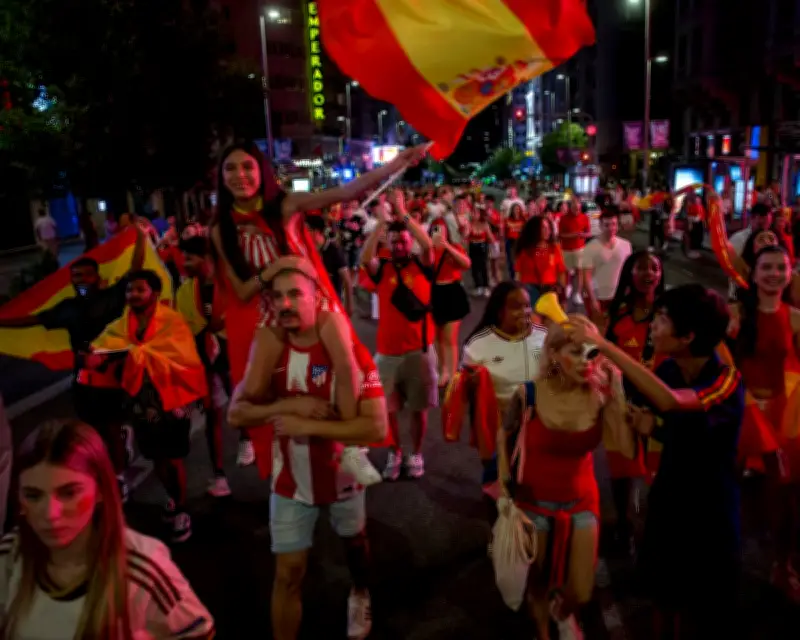
Just past midnight, cheers erupted from blocks of lit flats in central Madrid. Hours later, people of all generations were still out in the streets in another tropical night, with temperatures near 30°C. In Plaza de Olavide, fans gathered around screens, children and dogs running free. A girl played on the swings, her Spanish-flag cape fluttering.
A Diverse Celebration Across Spain
Argentinian Lionel Messi jerseys were visible throughout the crowd. Many gathered at a nearby Argentinian bar, unsurprising given over 400,000 Argentinians live in Spain. Messi, whose career is embedded with Barcelona, remains a football hero there.
Barcelona hosted over 30,000 people watching on a giant screen. Catalonia is home to 19-year-old Lamine Yamal, the national side's most promising player. The team reflects regional variety: several players come from the Basque Country, once reluctant to support the national team; Aymeric Laporte was born in France. Backgrounds are as diverse as the population.
Belonging to Many More
Ferran Torres, who scored the extra-time goal, said his achievement belonged to "47 million people, not just me or my teammates." But it felt as though the success belonged to many more worldwide, from Gaza, where Spain represents solidarity with the Palestinian cause, to Brazil.
The celebratory mood was palpable three years ago during the women's World Cup win, but joy was overshadowed by sexual harassment and misogyny after the Jenni Hermoso case.
A More Rounded Victory
Sixteen years ago, I watched Spain's first World Cup victory in Brussels during the eurozone crisis, with a burst property bubble and soaring unemployment. This win feels more rounded. Spain's economy is now one of the strongest in the developed world; its cities feel more prosperous and dynamic.
The national team is young, diverse, and relentlessly professional. Cheers in Lavapiés, one of Madrid's most diverse neighborhoods, felt momentous in a country where over 10 million people (about 20% of the population) were born abroad.
Maturity Under Pressure
Players offered an example of maturity. Lamine Yamal's clear response to former prime minister Mariano Rajoy's racist comments about the French national team contrasted with the politician's crudeness. The contrast between football's power to promote integration and the constant partisan battles in Spanish public life is sharp.
Coach Luis de la Fuente and his players repeat: "We are a team. We embrace diversity while working together towards a common goal." Spain's strength lies in cohesiveness greater than the sum of its parts. Ironically, that shared purpose is what Spanish public life misses most.
Football's Power to Unite
Even if football's impact seems fleeting, its extraordinary appeal can inspire shared spirit. At its best, it fosters solidarity; at its worst, it fuels violence, as Argentina's team showed before, during, and after the match.
Everyone sees what they want in the Spanish national team—nationalism, diversity, or great football. The variety of fans on the street, regardless of age, origin, or gender, reminds us of football's immense power to bring together different people.
I keep thinking about the US motto, E pluribus unum—out of many, one. Unity in diversity remains painfully unfulfilled in the US and much of the world, including Spain. But at least for a night, amid chants, klaxons, and fireworks, one could hope it is still possible.