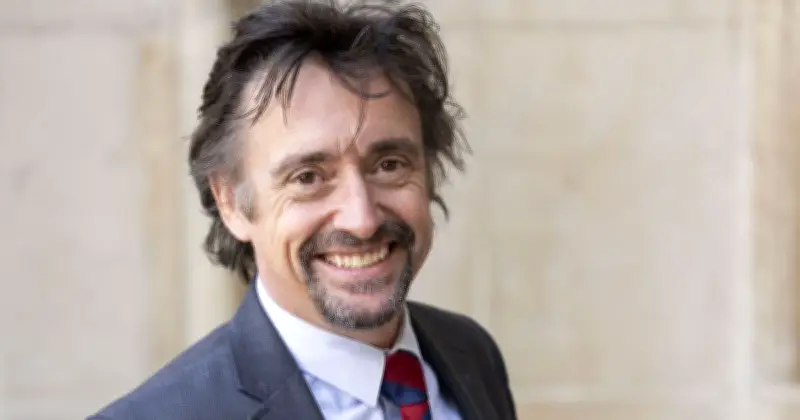
Richard Hammond has revealed he "forgets things" and "loses things" and admitted he is "scared to death" to undergo a brain scan despite worrying that his past brain injury could lead to early-onset dementia.
The 56-year-old Grand Tour star suffered a brain injury when he crashed his Vampire dragster at 320mph at Elvington Airfield in 2006. He has been involved in further car crashes since, barely escaping his Rimac Concept One supercar in 2017 before it burst into flames.
Worries over brain injury
Speaking on the High Performance podcast with Jake Humphrey and Damian Hughes, Hammond said: "The brain injury is with me forever, probably, and I do worry that it will lead to early-onset dementia. I very much hope not, but it's entirely possible that it could."
When the hosts suggested he have a scan to assess the condition of his brain, he declined, saying: "No. I'm scared to death to do it. But I absolutely should. I'm honestly too scared. I do lose stuff a lot, I do forget stuff, but that's probably because I'm 56 and not concentrating. But I should."
Fear of the results
Hammond explained his reluctance to seek answers, comparing it to his annual MOT, saying: "I'm bad enough when I go for my annual MOT, where you go and get mauled by a doctor. I don't like getting the results from that. I wouldn't like the results from a brain scan."
Pressed on why he does not want to know, he said: "I wouldn't want to know that's what was coming, would I? To be fair, if it's happening, you're less aware, but it's a bloody struggle. Some people are lucky, and they're happy."
He added: "I'm just selfishly scared [of the scan]. And my daughters, I don't want to let them down. It's going to be primarily difficult for them. I'd have to tell them. But maybe I should."
Unpleasant procedures
Hammond also discussed two "unpleasant" procedures he has undergone, one of which he does not remember due to sedation. He described having kidney stones removed, saying: "It's a kinetic drill [that goes up there]. It's not a laser; think Black and Decker."
He recalled telling medical staff before the procedure: "Oh, I forgot to ask, is this a general anaesthetic? Let me put this another way, if it's local and any of you come anywhere near my todger with anything on that tray, one of us is going to be unconscious. Make sure it's me to start with."
Of a second procedure, he said: "I said, 'Is it general anaesthetic?' They said, 'No, we give you a sedative'. So I'll be conscious?! 'But, here's the really clever bit, Rich, you won't remember anything about it afterwards'. Yeah, but I've still got to go through it!"
Reflecting on the experience, Hammond said: "For me, it raises a really interesting question. I know I went through that, and anybody who's had a procedure like that with that particular sedation knows, they went through something pretty ghastly, put themselves through it, and can't remember it."
He added: "But it still happened. Which I suppose has something to say about the fact that the past doesn't exist, because you can remember or not remember it. It's gone. The only way in which it exists at all is if it has any influence on what you do now. But it still doesn't exist, per se."
Hammond said he presumed he was "crying and screaming" in agony during the "undignified" procedure, but he does not remember anything from it.